


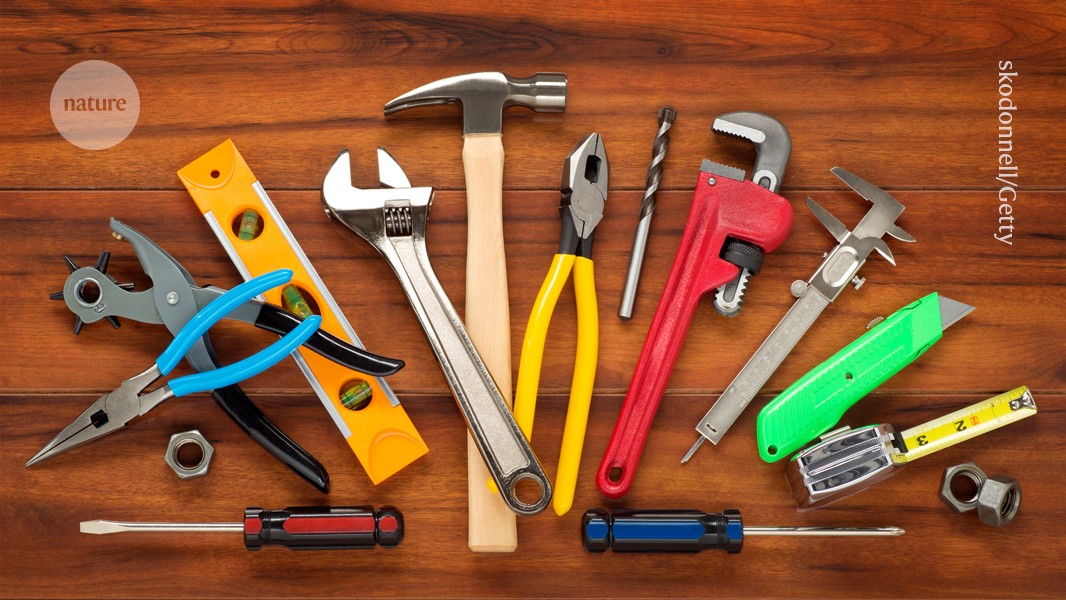

A basic toolkit can be useful for coming up with creative solutions to technological hurdles.Credit: skodonnell/Getty
For David Thomas, a walk to the kitchen for coffee is a trip down memory lane. Standing amid the spoons, pans and pantry goods of his home, Thomas — an Arctic researcher at the University of Helsinki in Finland — is reminded of days spent on the ice, swaddled in layers of clothing that keep him alive at temperatures as low as −40 °C. That’s because when some of these kitchen staples are not being used for their usual duties, Thomas brings them on expeditions as crucial components of his field kit.
A DIY approach to automating your lab
Thomas studies the biogeochemistry of aquatic systems, including the role of microscopic algae and bacteria in the carbon cycle of sea ice. To investigate this, he and his team collect ice cores and samples of the salty brine that sits between the individual ice crystals. The brine collects at the bottom of the hole from which the core is taken, about half a metre down, and it can be difficult to retrieve. The hole is too deep to stick an arm down, and when the team tried using syringes, they clogged and broke in the extreme cold.
“We’ve found over the years that a soup ladle attached to a pole is the ideal thing,” Thomas says, adding that once the brine is collected, another kitchen tool — a strainer — helps to remove lingering ice crystals that would otherwise dilute the sample. “You can get very technical sieves, of course, but the one in my kitchen is perfect in that it’s robust, cheap and easy to sterilize.”
At a time when there seems to be a niche scientific ‘unitasker’ for every process, getting back to basics and repurposing, or even developing, simple tools offers a sense of freedom. With a little creativity, scientists are building surprisingly robust kits to aid tasks in fields from microscopy to oceanography. Their experiences highlight what research do-it-yourself enthusiasts have long understood: that compelling science doesn’t always require the most-complex equipment, or the most expensive.
A spirit of improvisation
Thomas’s work in polar systems is an extreme example, but the fact remains that fieldwork demands a certain level of thinking on your feet, particularly when working in remote areas with little support. “When something breaks, you usually have to make do with what you have on hand,” Thomas says. “A spirit of improvisation is essential in a good field scientist.”
As a result, field researchers often travel with essentials such as bundles of zip ties and rolls of duct tape for on-the-fly repairs. But beyond these universal items, some researchers have developed or adopted common, low-tech solutions that are tailored to the specifics of their work.
Creative workarounds
Kristina Young, an ecologist at the University of Wisconsin–Madison, studies the soil of dryland ecosystems, which cover 40% of Earth’s land area, excluding Antarctica. With little plant cover to break wind and water flow, the microtopography in these areas — or how bumpy the surface is — can be an important driver of processes such as dust deposition, seed sprouting and erosion. Young says that she’s used a handful of seemingly strange tools in her work, including a BB gun and a jewellery chain. Shooting a pellet into the ground helps her to gauge the susceptibility of the soil to wind erosion, and draping a chain over the ground’s surface and measuring its length provides an estimate of soil roughness. “These are pretty crude estimates,” Young admits, “but they still tell us a surprising amount about the ecosystem.”
Modern tools, such as drones, can make the same measurements, sometimes with greater precision, but the chain is much cheaper and easier to travel with. Getting permission to fly a drone is often difficult, or even impossible in some countries, Young says. And drones can complicate reproducibility if collaborators don’t have access to the same tools. Young is part of an international effort called CrustNet, in which researchers use shared protocols to study drylands, and the chain method is one of several simple metrics that have helped the project to expand.
“We’ve been able to launch a global collaboration purely by basing protocols around things that most people can access and learn to use quickly,” Young says, adding: “We’d love to study every site in really deep detail, but the reality is that we have to be practical about what works. For this project, the jewellery chain is the correct tool for the job.”

David Thomas uses a soup ladle on a pole to collect brine samples in the Arctic.Credit: David N. Thomas
Accessibility and reproducibility also form the foundation of Saša Iskrić’s work as part of KAP Jasa, a non-profit kite organization in Ljubljana, Slovenia. The group isn’t focused on science, but Iskrić says that they have sometimes assisted on research projects, such as an aerial survey of a newly discovered Roman villa, imaging remnants of medieval agriculture and assessing water pollution in the Ljubljanica River.

Rapid 3D-printing method could be used on space missions
The group’s most common kite for these studies is a rokkaku dako, a six-sided structure of Japanese design. Around 1.8 metres tall and 1.5 metres wide, these large kites can carry more than one kilogram, and Iskrić predicts that people will send microphones, meteorological equipment or even Geiger counters aloft to help answer research questions.
Kites offer several benefits compared with drones, Iskrić says. “A kite can stay aloft for hours, while a simple drone flies for half an hour before its batteries get depleted,” he says, adding that this problem is greatly exacerbated once you start adding weight. “Also, one can’t fly [drones] in urban areas, in national parks or over heritage or archaeological sites. But, one can fly a kite pretty much anywhere.”

