


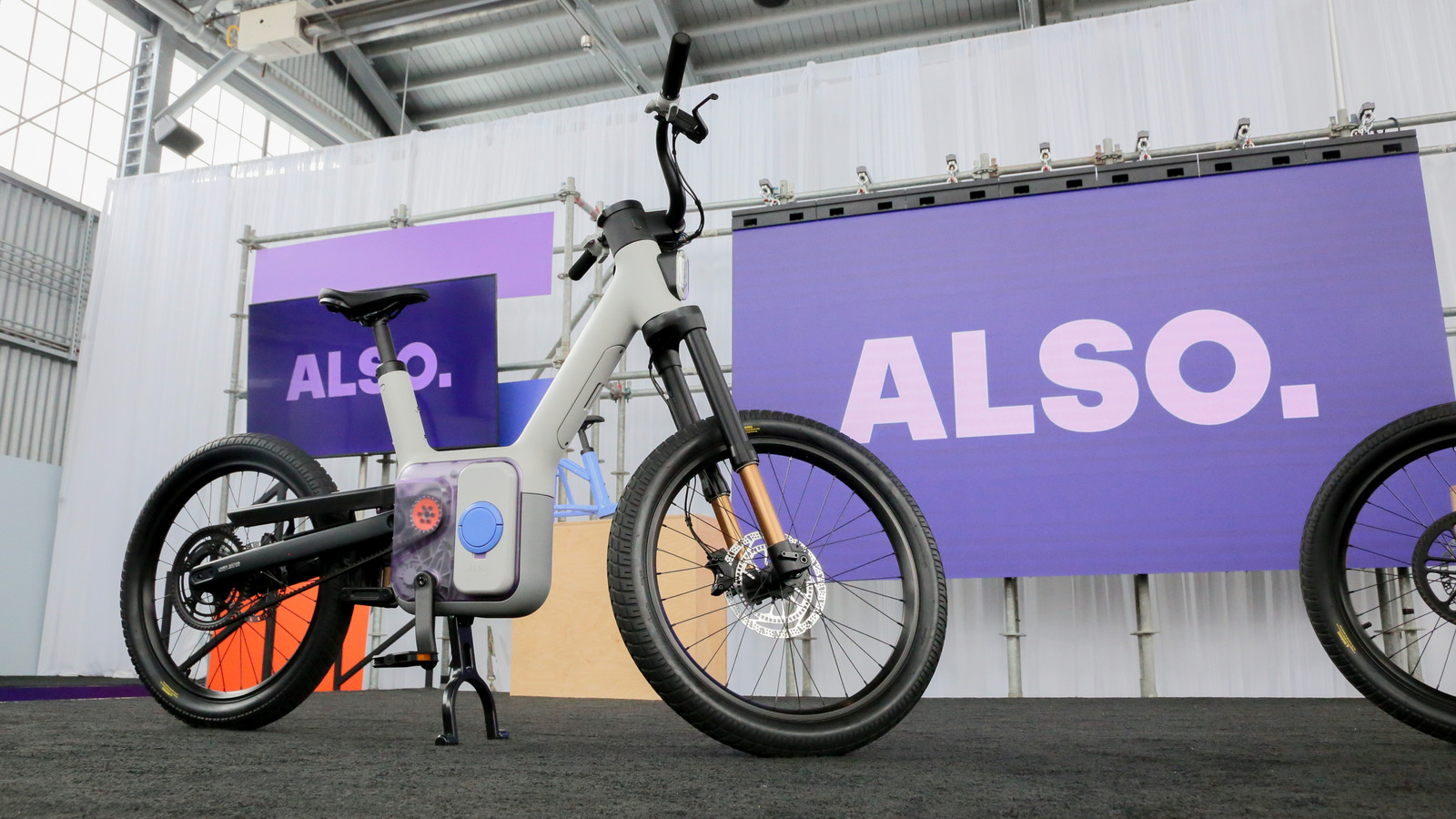
Let’s give you a picture of what’s going on with Rivian’s micromobility spin-off, which is called Also. The company capitalizes the name and use a period after it, like this: ALSO. But that’s just weird, so I’m not going to do that.
Still, Also employees I interviewed vehemently insist that Also isn’t a bike company. Saul Leiken, Also’s director of product, calls Also an electric vehicle brand. In my Zoom with Leiken he used the word “vehicle” 15 times during a 40-minute call. He wasn’t alone. Matt Liddle, Also’s director of physical experience, called Also a vehiclemaker, too. Liddle joined me for for my test ride of their TM-B bikes from Rivian’s Brooklyn outpost across the Williamsburg Bridge and into Manhattan.
Some of this vehicular nomenclature comes down to branding and partnerships. Leiken noted that the Rivian spin-off is making commercial quads and partnering with Amazon to build their last-mile delivery rigs, much as Rivian already makes the distinctive Amazon vans you see dropping diapers (and probably e-bikes) all over America. Likewise, Also will do something similar with DoorDash — only in that case their small EVs will be autonomous robo-delivery food bots.
But those vehicles are all on the way and not yet here, much as the Rivian R3X is the rally car of the future. Also’s new TM-B is the right-this-moment coolness, and I say that without hesitation, despite a sticker price starting at $3,500. You can reserve one of these bikes now, and delivery will start this fall. The Also TM-B is not merely a blast to ride, and shockingly fast. It’s a technological platform that’s game-changing in ways that I didn’t expect — and I’ve been testing bikes and e-bikes for about two decades. I’m super jaded, and yet the TM-B kinda blew my mind.
Bristling with fascinating technology
The TM-B is pedal-by-wire. Eyeball that photo and you’ll see gears and a belt drive, but when you pedal you’re not actually pushing gears that motivate that rear wheel. Instead, pedaling acts like pressing the “gas” in a Rivian. Leiken explained that a Rivian, like most modern EVs, is software-defined, with brake-by-wire and accelerate-by-wire controls. Nothing is physically connected, like with the throttle cable or brake pedal in an old-school car. But almost every electric-assist bicycle has step-changed gearing and a physical connection between the cranks your legs turn and the rear wheel. Not the TM-B.
“When this project started,” Leiken explained, “it started around the question of how do we bring the sort of magical experience that you get from a Rivian and from a Tesla, from a software-defined automobile to a smaller-than-car form factor.” Leiken stressed that with most e-bikes, “The best they ever are is the day that you take them home from the bike shop… and they only get worse from there.” By contrast, Also will have over-the-air updates (OTAs), like modern EVs.
That way they can provide improvements other bikemakers cannot. “We’re not the only bike on the market that has a motor that you can do an OTA upgrade to,” Leiken said. “But we are the only bike on the market that you can do an OTA upgrade to and change the number of gears you have.” A virtual drivetrain enables the sensation of gear changes and adding or subtracting these faux gears through a software update. Or rolling with the TM-B’s fully automatic transmission (also entirely simulated), which is the mode I preferred.
Fast as hell and more agile than you’d think
If you think pedaling without actually having your output motivate the bike would feel weird, that was my guess, too. But it doesn’t, because the TM-B only has to read your effort and the amount of boost you want. I was testing the pricier $4,500 TM-B Performance, which offers up to 10 levels of assist, while the Launch Edition merely goes up to 5 levels of assist. But even riding the more powerful bike, I never once went above level 6, which was enough added gumption to launch forward when I stood and sprinted — and that was while climbing the ramp of the Williamsburg Bridge, a reasonably significant hill.
This is a Class 3 e-bike, meaning it has a throttle that will offer power up to 20 mph and cuts pedaling boost at 28 mph. (If you need a further primer on e-bike classes, here’s what each e-bike class means.) With up to 133 pound-feet of torque, you can accelerate from a standing stop pulling up to 0.3g. It feels as quick as a Zero electric motorcycle, which is why I turned the assist down from level 6 to level 3. That was plenty, whether pedaling or using the throttle.
But the bike is both fast and very nimble, not what you’d expect when you hear the TM-B weighs about 80 pounds. Leiken explained that by centering both the battery and the motor in the square block at the bottom of the frame, the goal was to make the TM-B bely its heft. Smaller 24-inch wheels also help, particularly when starting from a standstill at a stoplight.
Designed for multiple riders
Beyond the funky powertrain, Also has a lot more new-fangling stuff up its sleeve. First off, the bike features several top frames. That’s an electronically locked portion of the bike, which includes the saddle you sit on, the post that supports it, and a section of the frame that clicks onto the rest of the bike.
The logic here is to allow multiple riders within the same household, from someone who is 4-foot-10 to someone that’s 6-foot-8, to be able to hot swap top frames and pedal the same rig. And that top frame array includes not just different height masts, but a cargo setup so you can convert the TM-B from a commuter to a grocery getter or kid hauler. Plus, because your phone is paired to the TM-B because that’s how you unlock it, the bike knows which rider is aboard.
Also engineered its own suspension, too, in part because the team didn’t find off-the-shelf parts reliable enough. The bike will read how much suspension cushiness it can provide; if there’s too much squish from either your weight or the payload you’ve added to the the bike, the TM-B will squawk at you to add air to the rear shock. And every TM-B is shipped with a handy pump for doing that.
It stops like no other bicycle
Wait, if my pedaling is disconnected from the powertrain, is pedaling a TM-B pointless? Nope. The bike uses your wattage to recharge the battery and, combined with regenerative braking, up to 25% of the bike’s 60-to-100 mile range (depending on specification) comes from your legs and the bike’s brakes.
In addition to regen, the TM-B has ABS brakes as well. Sure, ABS isn’t so odd in the two-wheeled space, since some motorcycles, like Ducatis, have had ABS for decades. But in the TM-B it’s more complex than you’d see on a motorbike. As you start to brake regen kicks in, just as regen does with an electric car.
Further, Also engineered a way to prevent the front brake from locking up because regardless of which brake lever you grab — and ideally you’re braking with both levers — the bike equalizes the braking force and slows the rear wheel more quickly than the front. Then, just in case you’re squeezing really hard, Leiken explained, the TM-B can feed propulsion back into the rear wheel, preventing the calipers from achieving full lock.
Naturally, I tried like hell to overwhelm the ABS. I pedaled up to 28 mph, then grabbed both brakes as hard as possible. I actually managed to generate a tiny, stuttering skid from the rear tire, but just barely. Instead of smoke and a power slide, I came to a very undramatic stop. No biggie, save that that’s just what you want when you’re trying to avoid a crash.
E-bike specific mapping and stealth security, plus a better battery idea
The Also TM-B comes with a round color touchscreen display that serves as a bike controller, and Also is doing its own custom turn-by-turn mapping. Leiken told me that even though Google Maps has integrated bike routing, its not very accurate or useful for e-biking. “It’s sending me on a route that’s avoiding all these hills because it thinks I’m on an analog bike,” he explained, whereas Also’s own mapping will cater directly to the capability of a TM-B rider with the added assist.
That interface can pair to Bluetooth earbuds as well as your phone, and turn-by-turn directions can be broadcast into speakers in a helmet that, yes, Also will sell you. You’ll see prompts on the TM-B’s display, as you would on your car’s touchscreen. Matt Liddle, who rode with me, said they heard from potential customers that they use their current commutes to make calls — or to listen to podcasts — and they didn’t want to take those options away from buyers.
Similarly, Also wanted as seamless a security experience for customers as possible. So the bike unlocks when you approach it, and your phone serves as the key. Walk away, and it locks itself, locking the motion of the rear wheel and the battery into the frame. Plus it has a very powerful alarm. If someone bumps your bike while you’re elsewhere, you’ll get a ping. If someone actually begins to move it, an alarm sounds and you’ll receive a notification, with the bike’s GPS coordinates. Even if thieves disable the battery, there’s a stealth power source that will keep sending the GPS signal for up to a week.
The Rivian of bicycles isn’t flawless
One of the dumbest things about the current crop of e-bikes is that their batteries are useless for anything but assisting your cycling mojo. Leiken commented that because Also’s based in Silicon Valley, having a conventional e-bike battery on your desk charging in your office is almost embarrassing, so they wanted the Also’s power supply to be physically attractive — and to be functional as a source of juice via dual USB-Cs, too.
Speaking of power, however, I left my pedaling experience thrilled. And concerned. Yes, e-bikes, like cars, can be too powerful, and the TM-B could be too potent. New Jersey might merely be the first state to mandate laws requiring licensing and registering e-bikes. The justification for that legislation is that because some e-bikes are as powerful as motorcycles, they should be regulated identically.
More pragmatically, the whir-whir of the TM-B’s motor isn’t the quietest system on the market. It’s not that loud, but e-bike powertrain suppliers are aware the customers prefer quieter powertrains. Plus, so much of what Also is bringing is proprietary, making repairs a greater challenge. Startups often come with grand visions, but the hum-drum of service and supplying parts can be a massive headache. Rad Power Bikes, once a darling disruptor of the segment, fell to pieces after a series of recalls and warnings of battery fires led to eventual bankruptcy. In the car world, Fisker’s just the most recent example.
Also will probably be different — especially with DoorDash robo-food bots underwriting them. Personally, I hope so. The bikes are a blast, and the two-wheeled world needs as much innovation as the automotive realm. Still, the TM-B isn’t a vehicle. It’s just a dang clever, if a bit freaky-looking bicycle.

