


You have full access to this article via your institution.
Hello Nature readers, would you like to get this Briefing in your inbox free every day? Sign up here.

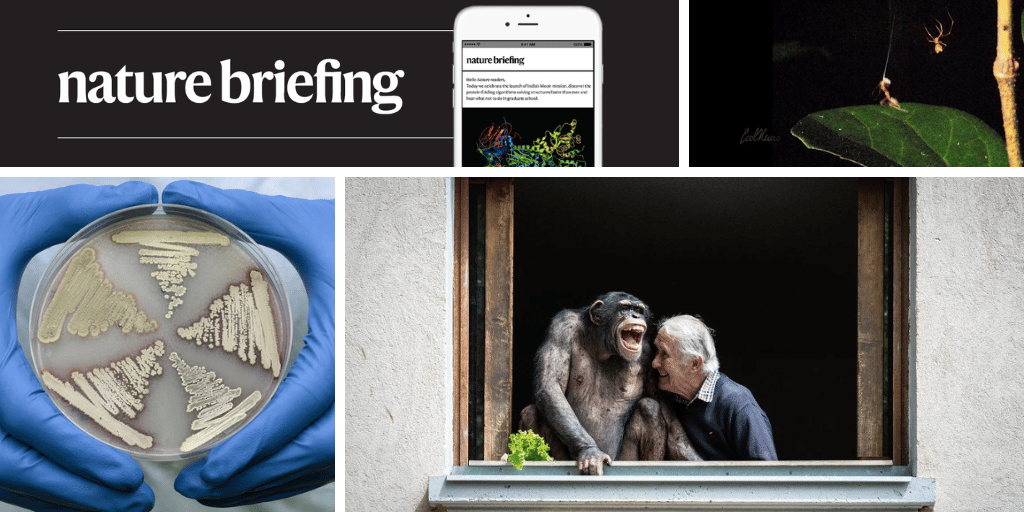
When laughing, chimpanzees and other great apes produce similar patterns of vocalization to human children.Credit: Jean-Philippe Ksiazek/AFP via Getty
Chimpanzees (Pan troglodytes), gorillas (Gorilla gorilla) and children laugh in similar rhythms when tickled. Researchers found that kids and apes left evenly spaced intervals between laughing sounds during a tickle attack, though children had a faster laughter rhythm compared with apes. Laughter might have picked up pace during the course of human evolution, the team suggests, which could reveal “something about laughter itself, but also, in a way, about the evolution of human speech”, says primatologist and study co-author Chiara De Gregorio.
Reference: Communications Biology paper
A newly discovered gene ‘megacluster’ in Streptomyces bacteria enables them to produce a variety of potent antibiotic compounds. These compounds act as a multi-pronged offensive weapon against other species, with each targeting different stages of the bacterial metabolic process. It’s more difficult for bacteria to develop resistance to attacks that hit several targets, so the discovery could lead to the development of new antibiotics, experts say. The research has “discovered something new in a system so extensively studied — hidden in plain sight,” says medicinal chemist Mark Blaskovich.
Green sea turtles (Chelonia mydas) use Earth’s geomagnetic field as a map, but are only able to follow it approximately. Researchers tracked eight turtles as they made a journey of more than 1000 kilometres. They found that the animals tended to plough ahead in one direction for extended periods, then stop to reorient when they’d strayed from their course. The turtles have only “an approximate idea of where they are and where they’re going”, says marine ecologist and study co-author Graeme Hays. So they take “circuitous routes that eventually get them where they want to be”.
Reference: Science Advances paper
Features & opinion
Scientists are exploring the potential of printable inks that could prevent scarring after burn trauma. These gels are laced with cultures of skin cells to coax the body into rebuilding healthy skin after burns, rather than launching the frenzied emergency-repair pathway that leads to scar tissue. In initial clinical trials, the inks will have to be administered by doctors with a syringe. But researchers are also developing robotic arms that could one day precisely map a person’s injury and print the gel directly onto it.
Neutrinos, a type of fundamental subatomic particle, are elusive. They carry no charge, have almost no mass and generally pass through objects and living things with no discernible effect — all factors that make them difficult to detect. Collecting data on these mysterious particles requires some of the most ambitious experimental set-ups in the business, which are detecting neutrinos in Antarctic ice, the caves of an active Canadian mine and at the bottom of the Mediterranean sea.
Quanta | Picture-filled scroll
Earlier this month, astronauts on board the International Space Station (ISS) had to shelter in a docked capsule because of an air leak in the Russian part of the station. All was well in the end, but it was “a dose of engineering reality”, writes Christopher Newman, an expert in space law and policy. “NASA and Russia’s space agency Roscosmos dispute the seriousness of the problem,” he writes. “Not only is the structure under strain, but also the fabric of the agreement that keeps the ISS running.” Private space stations were always envisaged as the next step, but they’re ill-prepared to take over, Newman argues.
Image of the week

This newly described ‘ballista’ spider (Propostira sp.) uses a spring-loaded snare to catch prey. The arachnid’s trap flings unsuspecting green tree ants (Oecophylla smaragdina) into a waiting web at an acceleration of more than 1,300 metres per second squared, around 100 times greater than that of a Formula One car, says sensory biologist and study co-author Ajay Narendra. The team aren’t sure why these spiders evolved this strategy, but suggest that it could protect them from angry worker ants that might attempt to rescue their colleague. (CNN | 6 min read)
Reference: Current Biology paper (Ajay Narendra et al./Current Biology (CC BY 4.0))
Today I’m thinking of the good times, inspired by some optimistic young people. Researchers asked more than 1,000 teenagers to write about the most important events they’d experienced, and followed up with them to ask the same a few years later. The team had expected to receive tales of woe, but they were wrong: of 5,000 answers, more than 80% recounted positive happenings.
Send us your feedback on this newsletter — positive or constructive — at [email protected]
Thanks for reading,
Jacob Smith, associate editor, Nature Briefing
With contributions by Flora Graham
• Nature Briefing: Careers — insights, advice and award-winning journalism to help you optimize your working life
• Nature Briefing: Microbiology — the most abundant living entities on our planet — microorganisms — and the role they play in health, the environment and food systems
• Nature Briefing: Anthropocene — climate change, biodiversity, sustainability and geoengineering
• Nature Briefing: AI & Robotics — 100% written by humans, of course
• Nature Briefing: Cancer — a weekly newsletter written with cancer researchers in mind
• Nature Briefing: Translational Research — covers biotechnology, drug discovery and pharma

