


You have full access to this article via your institution.
Hello Nature readers, would you like to get this Briefing in your inbox free every day? Sign up here.

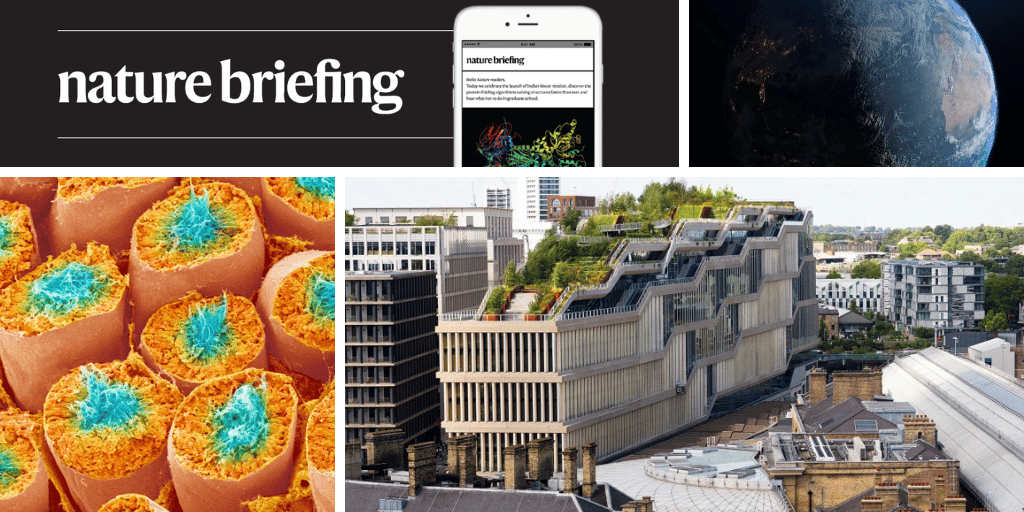
Developing sperm cells (blue; artificially coloured) fill the centre of seminiferous tubules (orange), which form the human testis.Credit: Susumu Nishinaga/Science Photo Library
A man’s ability to make sperm has been restored after a transplant of tissue samples that were removed from one of his testicles and frozen 16 years earlier, when he was ten years old. The samples were taken shortly before he received chemotherapy treatments that put his fertility at risk. Whether the sperm collected from the transplanted tissue can successfully fertilize an egg, and produce a healthy baby, remains to be seen. But the achievement could mark the beginning of a new wave of fertility treatments, scientists say.
Reference: medRxiv preprint (not peer reviewed)
Earlier this month, the US government approved a plan to launch a giant mirror into orbit to reflect sunlight onto shadowed parts of Earth — the first of a planned 50,000 mirror-bearing satellites. Reflect Orbital, the start-up behind the plan, say that this ‘manufactured daylight’ could increase agricultural productivity, aid natural-disaster relief efforts and allow solar panels to make electricity at night. But many astronomers are worried that the mirror beams will interfere with sensitive telescopes and increase light pollution.
The UK government has finally revealed how it will slash overseas development funding by 40% in 2027 to increase spending on national defence. Programmes in some of the poorest countries, including Malawi, Mozambique, Kenya and Tanzania, will be worst hit. “Some of the UK’s most enduring development partnerships are receiving cuts of up to 92%,” noted legislator Sarah Champion in her role as chair of the cross-party committee that oversees international development. “It is chilling to consider the consequences of these decisions.”
Features & opinion
A postdoc hunting a job in industry tells Nature that they are lost amid the opaque, multi-stage interview processes of big science companies. Career coaches and hiring managers offer a dose of clarity. The key is understanding who you’ll be speaking with at each stage — information you can get from an initial chat with a recruiter — and to tailor your answers to suit their expectations, they say. And above all, make sure you’re thoroughly prepared: research the company you’re interviewing with and compile anecdotes that demonstrate your skills in advance.
At a 1976 American Legion convention in Philadelphia, a mysterious disease struck down 182 people, of whom 29 died. The culprit was eventually described as Legionella pneumophila, a bacterium that can cause a type of pneumonia called Legionnaires’ disease — of which there is a current deadly outbreak in New York City. “Legionnaires’ is a disease of the built environment,” writes environmental journalist Brett Walton. “Any mist will do — a rooftop cooling tower, a shower, a hot tub, a decorative fountain,” he says, making it devilishly hard to prevent.
Circle of blue | 8 min read & The New York Times | 3 min read
Image of the week

Researchers took a real photograph of an epaulet oriole (Icterus cayanensis) (centre) and asked the Google Gemini AI tool to ‘make this look better’. The result: a convincing red-winged blackbird (Agelaius phoeniceus) (right). The tool also conjured a fully AI-generated red-winged blackbird (left). The images illustrate how easy it is to generate bird pics, including ones that have been accidentally made to look like a different species, that are flooding citizen-science platforms with AI slop. (The Guardian | 7 min read)
Reference: Nature Ecology & Evolution correspondence (see a bigger version of the image here) (Alexander C. Lees et al./Nature Ecology & Evolution (Photograph: David Theobald))
On Friday, Leif Penguinson was hiding amid the breathtaking beauty of Paratiisikuru — Paradise Gorge — in Finland. Did you find the penguin? When you’re ready, here’s the answer.
Thanks for reading,
Flora Graham, chief editor, Nature Briefing
With contributions by Jacob Smith
• Nature Briefing: Careers — insights, advice and award-winning journalism to help you optimize your working life
• Nature Briefing: Microbiology — the most abundant living entities on our planet — microorganisms — and the role they play in health, the environment and food systems
• Nature Briefing: Anthropocene — climate change, biodiversity, sustainability and geoengineering
• Nature Briefing: AI & Robotics — 100% written by humans, of course
• Nature Briefing: Cancer — a weekly newsletter written with cancer researchers in mind
• Nature Briefing: Translational Research — covers biotechnology, drug discovery and pharma


