


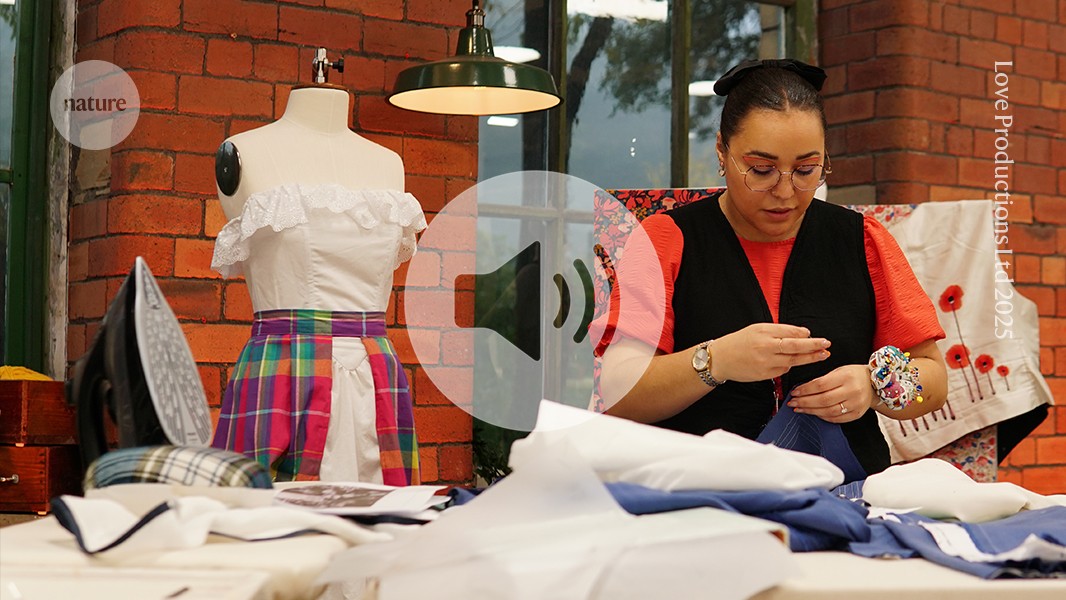
Yasmin Proctor-Kent 00:08
I don’t think I can sew without engaging the same part of my brain that I do science with.
David Payne 00:14
This is Creativity in Science, a series brought to you by Nature Careers.
Yasmin Proctor-Kent 00:19
Both endeavours, you need to be very creative, and it’s about applying theoretical knowledge to something tactile, something practical that you’re doing.
I find them really really hard to separate in my brain.
David Payne 00:39
A podcast about how science and creativity go hand in hand, and about how one can nurture the other.
Yasmin Proctor-Kent 00:48
The level of planning, the level of research and experimentation that I’ll do before I start working on the final garment is something akin to what I would do to get to the point where I have a successful experiment.
David Payne 01:04
Here’s a researcher who applies the scientific process to their hobby, and to such success that it took them on a journey to TV stardom.
Yasmin Proctor-Kent 01:20
Hi. My name is Yasmin Proctor-Kent. I am currently a lead R&D scientist working in cancer diagnostics at Leica Biosystems in Melbourne.
Before I moved into industry, I was in academia looking at mRNA and RNA in mitochondria.
So I genuinely don’t remember learning how to sew. It’s always been a skill that was associated, or a skill that was practiced in my family.
Not in the sense that I do it now. So we didn’t sew our own clothes, but we were very practical, so if something broke, you fixed it.
That included mending broken items of clothing, re-upholstering things that had torn.
So the basic skills involved with hand sewing and machine sewing were something I was around a lot.
But it was only in the last couple of years that I really tried to focus on using that skill to make my own clothes.
I dabbled with it slightly at university to make fancy dress costumes.
But during lockdown I had a lot of time, and I had a sewing machine, so I started making clothes, and haven’t really looked back since
Yasmin Proctor-Kent 02:53
I’m not from a family of academic scientists.
Actually in fact, I was the first person in my family to graduate uni.
So it was quite a big step for me to then go and get a PhD.
But I am from a family of engineers, specifically in the military. So both my grandparents were in the military, and my dad. So being around people whose instinct is to fix things is really where the background in sewing comes from.
And because they were engineers, albeit in different fields, I was always very encouraged to look at STEM as something that was very, very possible for me.
So when I had an interest, or started having an interest in science, which was very, very young, I was always encouraged to look into that.
So that was buying the horrible science books, the horrible science magazines.
It was going to the Science Museum in London. Whenever my family could encourage it, they definitely would.
Yasmin Proctor-Kent 04:02
So The Great British Sewing Bee is a TV show on BBC. And it’s a competition TV show for Britain’s best amateur sewer. And it’s something that I had watched with my dad for a very long time.
He was somebody who loved sewing and loved crafts and loved building anything he could. And we both caught the spark of sewing during lockdown, him in an historical recreation sense, (he liked to make tailored clothes and follow historical kind of sewing guides to make an accurate 16th century shirt, for instance).
But Sewing Bee and sewing became a way for us to connect with each other for a really long time. And it felt like a really lovely way for our already very close relationship to continue to develop as I got older and moved out of home.
Yasmin Proctor-Kent 05:12
My dad was, he was my favourite person. Because he was a very curious person, and that curiosity meant he wanted to just try things and do things.
And it is something that I wanted for myself. I wanted to try and emulate that.
He died too early, at 62, after a short battle with cancer.
And I think when someone you’re very close to dies in circumstances like that, it gives you a wake-up call to just do things, to take more chances.
And applying to be on the show that we loved was my kind of opportunity to take a chance. I hadn’t really considered applying before, not in a serious sense anyway.
So on the last day of applications, I decided to submit one to just see if I could do this for him.
Yasmin Proctor-Kent 06:26
From the moment I put in my application, it felt like a whirlwind. I didn’t expect a call back, let alone a call back and then a technical sewing interview, and then to be flown to Bristol to do an in-person video interview where we had to sew an item of clothing on camera.
And then I really didn’t expect to be cast in the show at all.
Yasmin Proctor-Kent 06:55
When I met the other contestants, I was very, very nervous, because they all seemed absolutely exceptional.
And then you can tell from the first episode just how much talent there was in the room. It was crazy to walk into the sewing space for the first time.
I have never been on camera before in a professional sense, and I walked into a room where there are 50 people looking at you, and about 35 cameras, and I was trying to act normal, and I was trying to sew normally.
I was trying to answer questions by producers so that they could make the TV show work.
It was very, very stressful. And I think the first few episodes, I was trying to find my footing for sure. But after that, it was genuinely, really enjoyable.
For the first time in my life, I was surrounded by creative people, people from creative spheres, and people that shared my favourite hobby. And that was something I’d never really experienced before.
And then beyond that, I was sewing items of clothing that I would never wear. They were exceptional garments. They were for things I would never go to, or too bold. So I got to really be creative and push the envelope, whereas normally I sew clothes I can wear to work.
So it was a very, very different experience, but I loved every single second of it.
Overall, I’m so happy with where I came. I was one of two runner ups, which I think was the perfect way for the finale to end.
Yasmin Proctor-Kent 08:58
I truly think that sewing and the scientific process are really similar. I think I engage the same part of my brain when I am working through a sewing project, or designing a sewing project, as when I’m working through an experiment and designing that experiment.
To me they’re so aligned, and it makes and it makes no difference to me what I’m applying the scientific process to, or the scientific method to. When I have a plan for something I want made in a really specific way, the level of planning, the level of research and experimentation that I’ll do before I start working on the final garment is something akin to what I would do to get to the point where I have a successful experiment.
I have an initial concept. I use my own prior knowledge and prior experience, as well as the knowledge and experience of other experts. So reading papers or reading from other people who have sewn a similar garment.
I will probably then go through an iterative process of trial and error to figure things out in order to make a final piece of clothing or have an experiment that is successful.
I think both endeavours, you need to be very creative, and it’s about applying theoretical knowledge to something tactile, something practical that you’re doing. I find them really, really hard to separate in my brain.
I don’t think I can sew without engaging the same part of my brain that I do science with.
I think it’s interesting and not unsurprising that one of the other contestants who made it to the semi final of the TV programme I was in, Kit, they were a mathematician and so, even more so than biology and sewing, mathematics and spatial reasoning and 3D plotting and all of that mathematical brain that Kit has really did apply to the Bee.
When we were in the room and we were given a sewing pattern and told to make it in two hours, I would often have a conversation with Kitt, and they already knew exactly how every single pattern piece fit together, because they could create a 3D image out of it immediately, which is not something I can do off the top of my head. But their specifically spatial mathematics background meant that they could.
Yasmin Proctor-Kent 11:51
I think sewing hasn’t necessarily impacted my practice of science in a huge direct way, apart from, as I’ve said, the scientific process.
But I do think really basic things like my attention span and the ability to focus on really, really fine tasks for a long period of time has definitely improved.
Even basic things like fine motor skills when pipetting.
I have to hand sew really niche things quite a lot. I assume my pipetting might be better, or some of my handling skills in the lab because of that.
I think it’s much less of a direct impact that sewing has on my professional career. But I think they’re really complimentary, rather than having a huge impact directly on one another. The skills I gain from both help the other.
I think when I’m sewing, I’m mostly thinking about the thing that I’m sewing. So I find it very relaxing to sew, because I can’t think about other things other than what I’m working on.
I don’t often sew with other media around. I don’t have videos playing very often or listening to things. So for me, sewing is a space for my brain to be quiet and just focus on the actual task at hand, which is something I also do at work when I’m working on an experiment.
It’s not necessarily a time for me to think a lot. For me anyway, this is just my experience.
If I’m sewing something for the first time, I will almost certainly be sewing in silence, because I need to focus on learning a new technique or figuring out how something fits together.
I have some sewing patterns that I have made in double digits. And for those, I could watch TV and sew it, I think, at this point, because I just I know how they put together. I don’t have to read any instructions. I can just go for it.
Yasmin Proctor-Kent 14:10
I’ve had a lot of experience in academia and in my professional career of not making time outside work, of experiencing burnout and living in the lab or the place I’m working. And I know for myself that I am worse at my job. I’m horrible to be around, and I’m very, very unhappy in those circumstances.
So I’ve worked really hard to create an environment where I have a good work-life balance. I’m very, very lucky that my job allows me to have a good work-life balance.
And I’ve also been afforded the opportunity by Leica Biosystems, to move to Australia within the company, which has been an incredible experience.
I’ve had a lot of time to reflect on the experiences I want to have and the things I want to achieve. And while some of them are professional, a lot of them are personal. And living on the other side of the world for a year while being fully employed was an opportunity too good to turn down.
I get to experience a different culture. I can just pop to New Zealand for a weekend, which is something I never expected to be able to say,
Melbourne has the greatest coffee in existence. So I’m very, very caffeinated. And above anything else. I get to experience this with my fiancée as well.
So we get to have this once-in-a-lifetime year where we can spend all of the free time that we work so hard to make sure we have, having and creating new experiences.
I’m very, very, very lucky that I’m able to do this. But it comes from experiencing what it’s like to not be able to do anything other than focus on work.
So I know I’m better at my job. I know I’m a better scientist when I’m well-rested and when I have things I enjoy, such as sewing, such as ceramics, such as cooking, such as reading.
Whatever it is that allows me to switch off and find something creative or exciting to do.
Yasmin Proctor-Kent 16:43
I would say, take risks. Do something different. That could be being more creative and trying a creative hobby. A one-day pottery lesson is a great way to start.
Or it could mean take risks and do something that’s more aligned to what you enjoy. If you’re sporty, try out a new sport. Try out water sports if you’ve never done that before.
But just take a risk and be bad at something. I think once you get to a point in your career where you have success and you’re making progress, and you want to focus on only that so you continue to have success, you have a fear of being bad at trying something new.
And I think we should all sit in that fear. Allow ourselves to be wrong. Allow ourselves to be bad at stuff And allow ourselves to be embarrassed. Just take a risk.

