


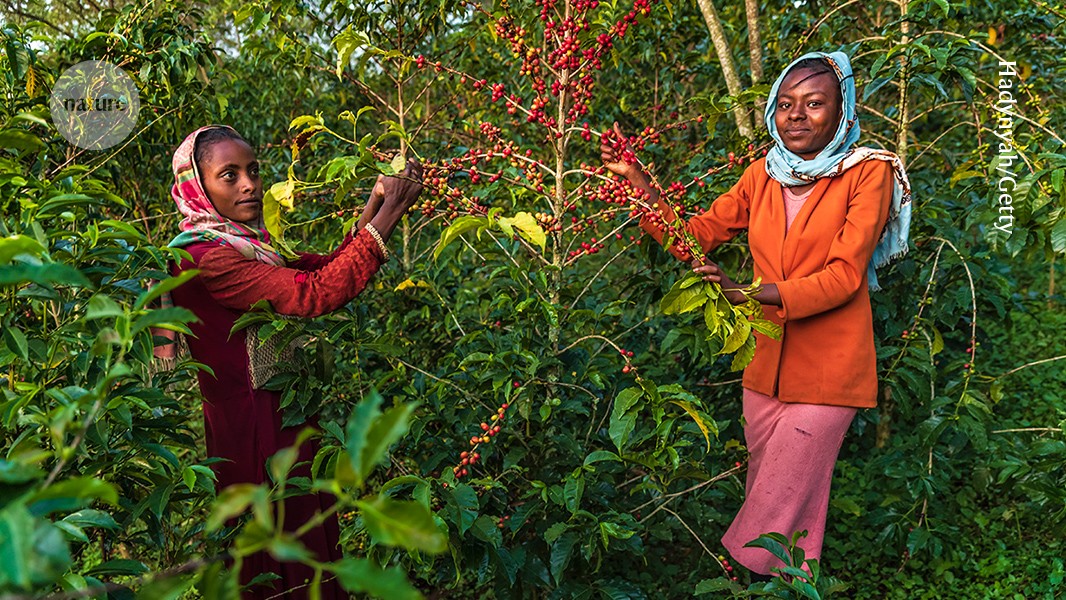

Ethiopia is the homeland of arabica coffee (Coffea arabica).Credit: hadynyah/Getty
“A mathematician is a machine for turning coffee into theorems” is a quote often attributed to the late Hungarian mathematician Paul Erdős. The brew is one of the world’s favourite drinks and an essential stimulant for many researchers — but its future is uncertain.
“Coffee is critically threatened by climate change,” says Kassahun Tesfaye, a plant geneticist at Addis Ababa University.
Nearly all the 10 million tonnes of coffee beans consumed annually around the world come from two plant species: the strong and often bitter robusta (Coffea canephora) and the more-delicate-tasting arabica (Coffea arabica). Unfortunately, arabica suffers or dies when temperatures rise just a few degrees1, and robusta requires massive amounts of water and its yields drop drastically in a drought.
Researchers are racing to keep the world’s coffee-drinkers awake — and preserve the livelihoods of the many lower-income-country farmers who grow the cash crop. Solutions vary from improving the resilience of the two main species, to experimenting with relatives in the Coffea genus, to squeezing more coffee out of current crops with clever chemistry tricks.
Cold coffee beans grind smaller
Arabica’s birth
Ethiopians are proud of their country for being the homeland of arabica coffee — and coffee rituals are a social glue across the country’s many cultures, Tesfaye says.
The Ethiopian government has been establishing conservation areas to preserve the natural genetic diversity of the species. It also grows more than 12,000 arabica plants in living collections at the Ethiopian Biodiversity Institute in Addis Ababa and at the Ethiopian Institute of Agricultural Research in Jimma.
The government is betting that these plants will provide the material for breeding — or genetically engineering — arabica cultivars with traits designed to withstand high temperatures and drought. The plants’ cells also come with four full sets of chromosomes, rather than the two found in many other Coffeas (or in humans), reflecting arabica’s origins from the spontaneous interbreeding of two other species within the past 50,000 years, Tesfaye points out. “I believe we have enough gene pool to fight climate change.”
As temperatures increase, arabica cultivation might need to move to increasingly higher terrain to stay cool, which will not be easy for owners of small coffee plantations. Another solution is to grow other species of coffee plants that can better withstand climate change. There are 134 known wild coffee species, and a few are being grown for their climate resilience, including C. liberica and C. excelsa.
Starting in the late 1990s, Davis led efforts to find all wild Coffea species by travelling across Africa and Madagascar — or, in a few cases, by searching the historical herbarium at London’s Royal Botanic Gardens, Kew, for long-forgotten specimens2. He estimates that, together with his collaborators, he is responsible for scientifically describing about one-third of coffee species known to science.
All arabica coffee is genetically similar: how can beans taste so different?
Excellent excelsa
Davis has been visiting coffee-producing regions around the world to see “where farmers are facing existential issues, and how they coped”, he says. “The success stories are always about changing the species” that farmers grow.
In wet regions, that could mean switching from arabica to robusta, but in other places it could instead mean growing C. liberica, which tolerates higher temperatures than arabica does and does not require as much water.
But the coffee industry has historically been sceptical of this approach — it is rare to find wild plants that can be turned into productive crops that produce palatable coffee.

When brewed into a coffee, C. liberica tastes of tropical fruits such as jackfruit and mango.Credit: angin hiqaru87/Shutterstock
On a late-June morning, Davis brewed several different coffees for me at his office at Kew’s herbarium, using Hario cone filters. Two types had quite distinctive flavours. A C. liberica from peninsular Malaysia — where the species is traditionally grown and popular — had intense aromas of tropical fruits such as jackfruit and mango. A C. racemosa from West Africa had a strong whiff of chocolate in its beans. When brewed, it also released musky, fungal and herbal bouquets. “For some people, it’s like marmite,” Davis said, referring to the yeast-based savoury spread popular in the United Kingdom. “Some people love it, some hate it.”
But two other varieties, a C. excelsa grown commercially South Sudan and libex, a hybrid of C. liberica and C. excelsa with fruity and almondy tones that Davis had bought in Kuching in Malaysian Borneo, seemed indistinguishable from speciality arabicas to my untrained palate. According to Davis, even professional tasters often cannot tell those two varieties apart from arabica. Which is part of the point: they are resilient plants that could easily satisfy consumers accustomed to arabica.

