


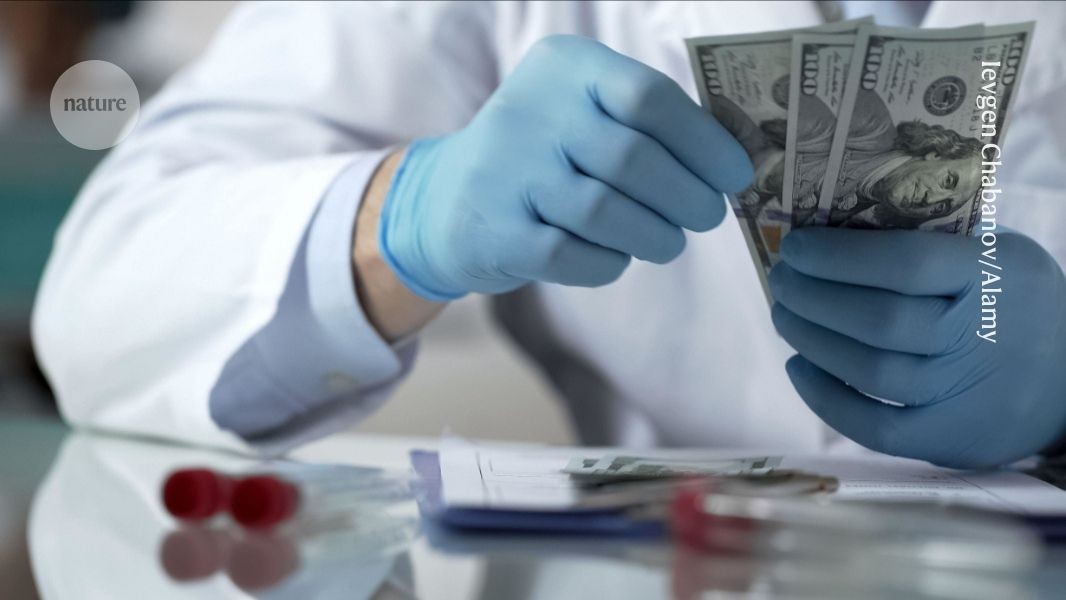
The cost of authorship slots on studies produced by papermills ranges from less than $100 to more than $5000, an analysis found. Credit: Ievgen Chabanov/Alamy
Researchers have amassed a data set of thousands of advertisements selling research-paper authorships online, shedding light on the global marketplace for academic fraud.
The collection — the largest of its kind — contains more than 18,700 adverts that were posted between March 2020 and early April 2026 by seven paper mills — businesses that produce fake or low-quality research and sell authorships. Together, the companies cater to academics in the Middle East, Central Asia, Eastern Europe and India.
Authorship for sale: Nature investigates how paper mills work
An analysis of the advert data found that, on average, a first-author slot on an article sold by a paper mill costs a median value of nearly US$800, with prices ranging from $57 to more than $5,600. The work is described in a preprint submitted toarXiv this week.
Researchers, publishers and indexing services could use the list of adverts to screen their publications and audit which journals and research topics are most likely to be targeted, says study co-author Reese Richardson, a metascientist at Northwestern University in Evanston, Illinois.
“The preprint paints a valuable picture of the significant financial scale of these operations, underscoring the pressure put on researchers to publish in order to advance in their careers,” a spokesperson for the New Jersey-based publisher Wiley told Nature.
Global operations
Richardson and his colleagues archived 2,311 advertisements that were posted on the messaging app Telegram by three paper mills that seem to be based in India, Iraq and Uzbekistan. The team also identified 16,399 advertisements from the websites of four businesses thought to operate from Russia, Latvia, Kazakhstan and Ukraine.
“What we’re beginning to see here is a pattern of global operations and the platformization of social media and online websites to operate a global network of businesses and corporations that exist for the purposes of scientific and academic fraud,” says Sarah Eaton, who studies academic integrity and fraud at the University of Calgary in Canada. The data set “tells us an awful lot about the businesses, their marketing and some of their operations”.

Science’s fake-paper problem: high-profile effort will tackle paper mills
All seven paper mills advertised authorships for research articles — sometimes giving the title of the article and the journal in which it would be published. But two companies also offered authorships on other types of publication, such as textbooks, as well as other services, including being named on patents and copyright registrations or receiving awards.
“Paper mills are really in a variety of different businesses to the extent that the phrase ‘paper mill’ doesn’t capture everything that’s going on,” says Richardson. “I like to think of them as businesses operating in the market for reputation manipulation.”
The study found that some of the paper mills even ran seasonal discounts and holiday sales.
Papers in the wild
There are signs that manuscripts sold by paper mills make their way into the published literature at least some of the time. Using the data set, Nature’s news team manually checked more than 600 adverts for some 400 research articles that included manuscript titles in English. The search identified 53 published papers with titles that matched those in adverts from three businesses. Only five of those papers have been retracted, and one was withdrawn while the article was in the press.
Out of the papers that have not been retracted, four were published in Springer Nature journals and five in Wiley journals. Twenty-three papers appeared in conference proceedings published by the Institute of Electrical and Electronics Engineers (IEEE). Nature’s analysis also identified a further three papers, one each in journals published by Elsevier, Frontiers and Taylor & Francis. Some of the papers appeared in different publishers to those named in the advert.
Nature’s news team shared these findings with all six publishers.

