


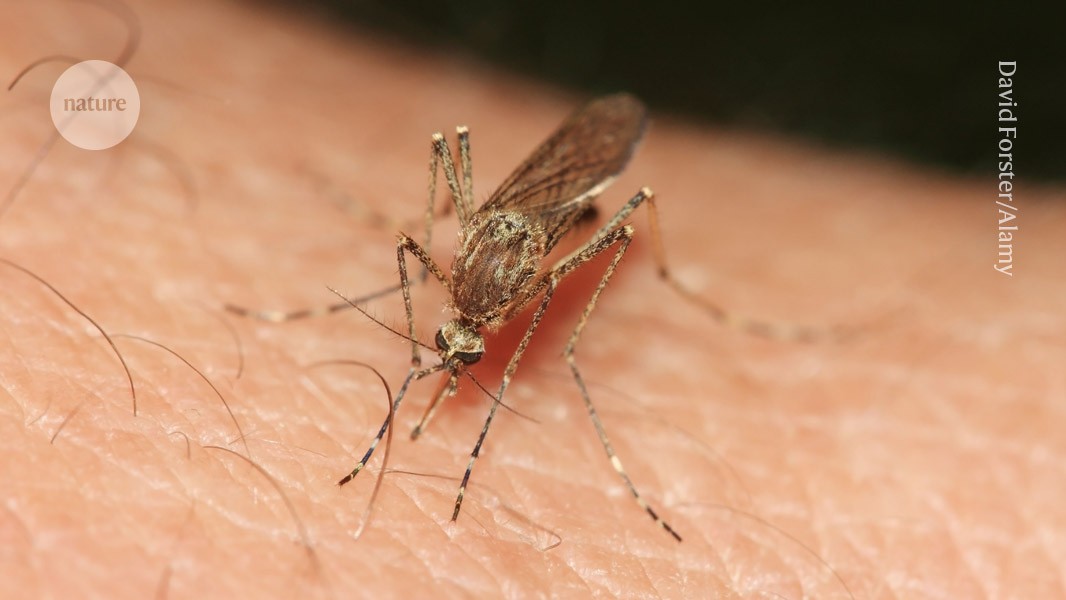

Studies predict that the spread of mosquitoes will put billions more people at risk of mosquito-borne diseases in the coming decades.Credit: David Forster/Alamy
Earlier this month, the UK Health Security Agency warned people travelling abroad during the summer holidays to protect themselves against mosquito-borne diseases.
That threat is no longer limited to tropical countries.
Disease-carrying mosquitoes have now spread to previously unaffected regions in Europe, Asia, the Americas and Australia. Between June 2025 and April 2026, Aedes albopictus — a mosquito that can transmit dengue and chikungunya — spread to new regions in several European countries, including Portugal, France and Greece.
In 2024, the estimated number of malaria cases totalled 282 million, up from 273 million in 2023, and 610,000 people are thought to have died from the disease (see ‘Malaria remains a deadly disease’).

Source: WHO
Over the past two decades, chikungunya — a viral disease that causes fever and joint pain — has also emerged in more than 100 countries, causing outbreaks in China, Italy and France in the past two years. Last year in Cuba, an outbreak that started in July killed 46 people. Every year, about 14.4 million people worldwide are thought to develop chikungunya, with most of the cases occurring in South Asia and Latin America1.
Dengue also hit a record high, with more than 14 million reported cases and 12,000 deaths worldwide (see ‘Dengue is a growing threat in the Americas’).

Source: Pan American Health Organisation
Mosquito invasions
The rate at which disease-carrying mosquitoes are invading new regions is accelerating, according to an analysis published last October2. Researchers reviewed records dating back to the fifteenth century, when ships carrying enslaved people to the Americas from Africa also carried mosquitoes such as Aedes aegypti, which transmits dengue, chikungunya and other viruses.
Dengue is spreading in Europe: how worried should we be?
The authors found that a total of 45 disease-vector mosquitoes had invaded new regions at some stage, with 12 doing so since 2000 (see ‘Mosquitoes are spreading, and quickly’). “That really indicates a very strong increase in terms of new introductions,” says César Capinha, a biogeographer at the University of Lisbon and a co-author of the study.
Over the past century, used tyres and live plants have become important carriers for eggs and larvae. Live mosquitoes can also travel on cars, trains and planes, covering long distances in just a few hours. “We have this major expansion of the global trade networks, so this allowed many species being transported, which is very often the case with mosquitoes,” Capinha says.

Source: Ref. 2
Mosquito-borne diseases
Aedes aegypti leads the list of the most widely introduced mosquito species2 and is now present in some 150 countries3. Because of climate change, some regions have become more suitable than they were for the mosquito’s development (see ‘Climate change is expanding mosquito territories’), notes Christovam Barcellos, a health geographer at the Oswaldo Cruz Foundation in Rio de Janeiro, Brazil.
Aedes aegypti requires warm temperatures and rain to reproduce. In parts of South America, such as the south of Brazil, Uruguay and some regions in Argentina and Paraguay, those conditions used to be met for only a short period of time each year, so there wasn’t sufficient time for the mosquito to get established and transmit diseases. But that’s changing. “In many countries, you start to see temperatures rise as early as November, and they stay high through March, April or even May. That widens the window for transmission and that’s our main concern,” Barcellos says.
As a result, outbreaks of dengue are being registered in South American regions that were previously dengue-free4, including the south of the continent and cities located at high altitudes. The occurrence of heatwaves is also associated with the progression of dengue on the continent, Barcellos says.

Source: S. J. Ryan et al. PLOS Neglected Tropical Diseases. 0007213, (2019)

