


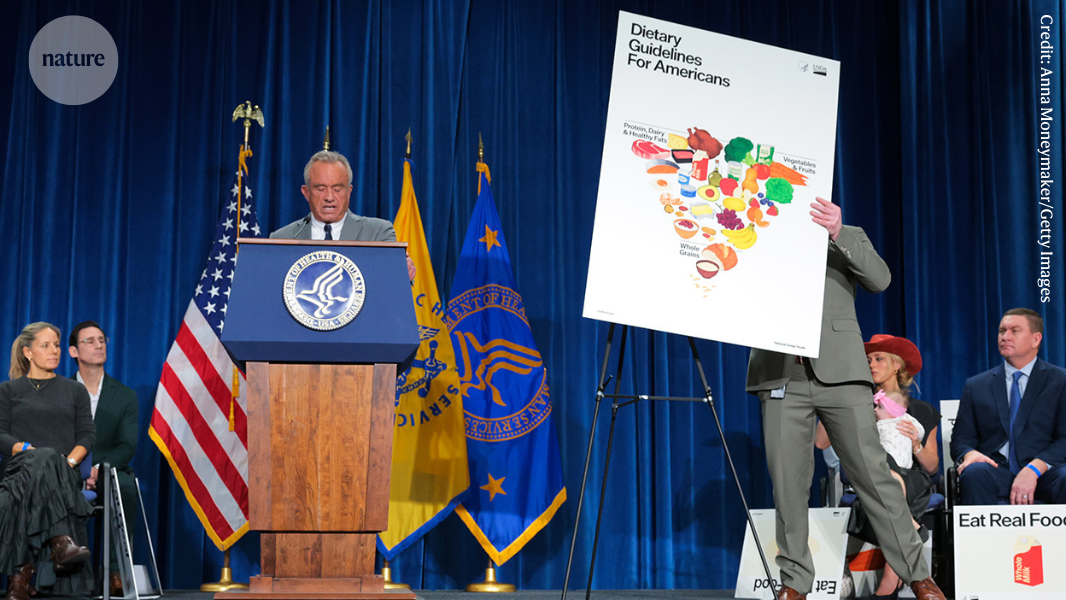
The Make America Healthy Again (MAHA) initiative, spearheaded by US health secretary Robert F. Kennedy Jr, aims to “confront chronic disease, improve nutrition, and lower healthcare costs”. To achieve these laudable aims, those in the MAHA movement have set out to overhaul US health policies on aspects such as nutrition and vaccines and what they see as an over-reliance on medication. Such huge shifts in the United States are likely to have ripple effects around the world.
Kennedy says the MAHA policies are based on “gold standard” science. Some aspects have garnered support from the research community. But in other areas, critics say, the MAHA platform includes claims that are misleading or hyperbolic — for example, those around the efficacy of vaccines and the risk factors for autism spectrum disorder.
What does the science say? Nature spoke to researchers about some of the MAHA initiative’s prominent talking points.
‘Eat more meat and dairy to stay healthy’
On 7 January, the US health and agriculture departments launched their Dietary Guidelines for Americans for 2025 to 2030, a set of recommendations that shape the country’s nutrition and health policies, such as establishing food choices in schools. The guidelines call for US citizens to “eat more real food”, notably diets rich in red meat, full-fat dairy products, fresh fruits and vegetables, with strict limits on added sugars and ultra-processed foods. “Most of their statements are consistent with old statements to focus on real foods,” says Christopher Gardner, director of nutrition studies at the Stanford Prevention Research Center in Palo Alto, California.
But, Gardner says, the guidelines’ emphasis on red meat and dairy results in an increase in the recommended protein intake — from 0.8 grams per kilogram of body weight per day to between 1.2 and 1.6 grams. The recommendation thus sidesteps a 2025 systematic review of protein requirements, which concluded that there wasn’t enough evidence to change the 0.8-gram suggestion1. The dietary guidelines have previously set recommendations in terms of servings of food rather than grams of nutrients. As a result, Gardner says, “the new number was out of left field”.
Gardner was one of 20 people appointed to the 2025 Dietary Guidelines Advisory Committee (DGAC), an independent group that advises the US Department of Health and Human Services (HHS) and the Department of Agriculture on the development of dietary guidelines. In December 2024, the committee prepared a 421-page report collating the latest science underlying the guidance.

The MAHA initiative’s slogan adorns the headquarters of the US Department of Health and Human Services, which is spearheading the campaign.Credit: Francis Chung/POLITICO via AP Images/ALAMY
A separate, supplemental review was subsequently produced by a nine-person committee appointed by the administration of US President Donald Trump. This was used in the creation of the 2025–30 guidelines, alongside some recommendations from the DGAC.
Walter Willett, a physician and nutrition researcher at the Harvard T.H. Chan School of Public Health in Boston, Massachusetts, says that some of the research underpinning the latest guidelines did not undergo a substantive review process that was open to public comment. “The documents attached to the guidelines have nowhere near the rigour of the published report conducted by the original expert committee,” he says.
Despite those concerns, some groups of individuals could benefit from a higher protein intake, notably older adults and athletes who want to put on muscle. Stuart Phillips, a health researcher at McMaster University in Hamilton, Canada, and his colleagues advocated in a 2018 study that older adults should eat at least 1.2 grams of protein per kilogram of body weight to combat muscle loss2. Too much animal protein, however, can lead to a higher risk of developing kidney stones, according to a 2023 study3. A systematic review and meta-analysis of the evidence in 2010 found that diets packed with processed meats are associated with increased risks of coronary heart disease and diabetes4.
‘Ultra-processed foods cause chronic disease’
The 2025–30 guidelines recommend avoiding highly processed, prepared and ready-to-eat foods as well as sugar-sweetened beverages and products containing added sugar or non-nutritive sweeteners. This eliminates most fizzy soft drinks and fruit and energy drinks.
A 2024 review of 45 meta-analyses, published in The BMJ, found that greater exposure to ultra-processed foods was associated with a higher risk of death and of cardiometabolic and mental-health disorders5. Furthermore, a 2024 prospective study in The BMJ that involved more than 100,000 participants found slightly higher death rates in those with high consumption of ultra-processed foods6.
In response to the guidelines, the American Medical Association released a statement on 7 January saying it “applauds the Administration’s new Dietary Guidelines for spotlighting the highly processed foods, sugar-sweetened beverages, and excess sodium that fuel heart disease, diabetes, obesity, and other chronic illnesses”.

A supporter of the MAHA initiative at a US Senate hearing.Allison Bailey/NurPhoto/Shutterstock
But Josiemer Mattei, a nutrition researcher at the Harvard T.H. Chan School of Public Health, points out that not all ultra-processed foods are the same. Scientists have so far isolated the negative health impacts of only two types of ultra-processed food — sugary beverages, notably fizzy soft drinks, and cured or processed meats such as sausages, hot dogs and bacon. Beyond those groups, it’s really difficult to tease apart the health effects, says Mattei.
Any foods that contain additives, colourants, added sugars, dyes or stabilizers, or that are subject to certain industrialized processes, are considered ultra-processed, explains Mattei. By that definition, sweetened yogurt and bread containing preservatives are in this category. “It gets murky, because some ultra-processed foods have highly valuable nutrients; for example, bread that has a stabilizer can also have high fibre and B vitamins,” she says.
“Additives in general are not necessarily bad,” says Willett. “Lots of additives are harmless; in fact, many are good.”
‘Seed oils have a role in inflammation’
Seed oils — the fats extracted from soya beans and the seeds of canola, sunflowers and other plants — are commonly referred to as vegetable oils. They are typically high in unsaturated fats, but also contain high levels of omega-6 fatty acids, which, when considered in a dietary ratio with related omega-3 fatty acids, have a complicated effect on inflammation that researchers have yet to unpick fully. A May 2025 White House MAHA report highlighted the shift in US dietary fats towards seed oils and flagged their potential role in inflammation. Kennedy has also said that people can be poisoned by seed oils, a statement that is “not backed by scientific research”, says Mattei.
The scientific literature generally agrees that consuming plant-based oils is healthier than swapping them out for saturated fats7 as the dietary guidelines suggest, Mattei says. Seed oils are rich in omega-6 fatty acids such as linoleic acid, which the body can’t make itself, and salmon and other oily fish contain omega-3 fatty acids, although consumption of fish in the United States is low compared with in other high-income countries.
The idea that seed oils are unhealthy, says Willett, can be traced back to changes in fatty-acid consumption. A 2016 review noted that modern Western diets now have a much higher ratio of consumed omega-6 and omega-3 fatty acids — from 1:1 in the prehistoric diet to 20:1 today8. Yet there was no evidence of increased cardiovascular disease or cancer, Willett adds. In the past decade, other researchers and health influencers have targeted seed oils, identifying oils from maize (corn), canola, soya beans and sunflowers among a “hateful eight”.

What is the science behind ‘science-backed’ supplements?
Willett says that dozens of studies and reviews have been conducted to determine whether these fatty acids cause inflammation or have other effects9. “None of these studies showed increasing inflammatory factors and some showed decreased inflammatory factors,” he says.
The research consistently reports that omega-6 fatty acids reduce blood levels of cholesterol and that higher dietary intakes and blood levels of both omega acids are associated with a lower risk of cardiovascular disease10. One 2024 study concluded that the evidence for the omega-6 to omega-3 ratio is not informative11. The concerns about seed oils “have been refuted in dozens of randomized trials and long-term epidemiological studies over decades”, says Willett.
‘Artificial food dyes are linked to ADHD and cancer’
At an April 2025 press conference, Kennedy announced that the Trump administration would phase out petroleum-based synthetic dyes, starting with FD&C Red No. 3, also known as erythrosine. The 2025 MAHA report states that some food additives have been linked to increased risks of attention deficit hyperactivity disorder (ADHD) and cancer.
According to Mattei, “The causes of ADHD are not nutritional. They are more genetic and developmental.”

