


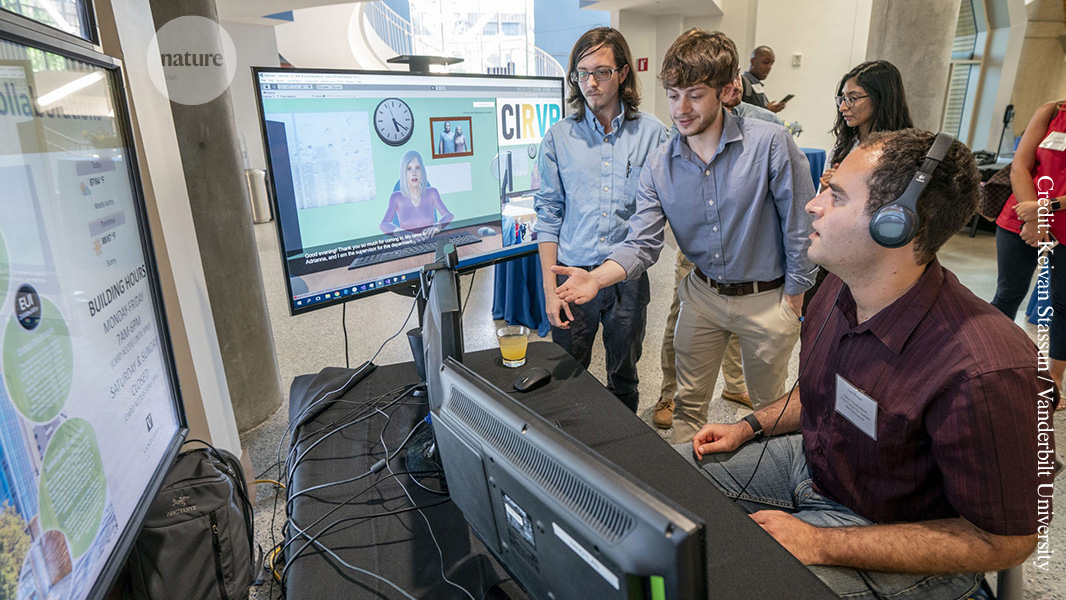

Students at Vanderbilt University in Nashville, Tennessee, assist in the development of technologies to help neurodivergent individuals achieve success in the workplace.Credit: Keivan Stassun / Vanderbilt University
When academics talk about neurodiversity and training the next generation of scientists and engineers, we often begin with the need to give students extra time in exams, along with note-taking support and modified testing environments. But many neurodivergent students face barriers, as we have found in our respective careers teaching science, technology, engineering and mathematics (STEM).
In our experience, the biggest barriers to succeeding in academia and research are associated with communication, interpersonal relationships and ambiguous expectations. For example, students must learn how to e-mail their supervisors, negotiate authorship, ask for clarification without seeming unprepared, manage shifting deadlines and participate in fast-moving, dynamic group discussions. Many people pick these skills up through observation, mentoring and informal feedback. But these unwritten social and professional norms can feel particularly opaque to neurodivergent scientists, both inside and outside the laboratory. Some trainees absorb this ‘hidden curriculum’ easily. Others struggle to do so.
Neurodivergent students might have the most difficulty with a lack of explicit expectations and training in professional behaviour, but the truth is that most graduate students — regardless of how their brains process information — are left to decode these norms on their own. Changing how research is taught and introducing tools to help people navigate academia would make a difference to a wide population of students.
Academic struggles
Both of us have had personal experiences assisting neurodivergent students. For example, a student came to M.C. for advice after spending months producing strong experimental results. She was diligent, technically capable and deeply invested in the project, but she hadn’t clarified with her supervisor what her role would be on the eventual paper. She panicked and approached M.C., a neutral and understanding colleague, to ask, “How do I bring this up without sounding confrontational?” She had never been taught how to navigate this type of situation.
K.S. had a similar experience while working at the Frist Center for Autism & Innovation at Vanderbilt University in Nashville, Tennessee, which studies how to support autistic and neurodivergent people in STEM education programmes and the workforce. There, he mentored Dan Burger, a student who struggled not with the science, but with how to present himself in a world that expected a specific kind of professional behaviour. Burger went on to begin a career in data analysis at the Space Telescope Science Institute in Baltimore, Maryland, and his story was featured on the US television news programme 60 Minutes as an example of what becomes possible when we stop asking neurodivergent individuals to mask their strengths and start designing environments that make room for them. For Burger, one key change that he made as a student, with support from K.S. as his research mentor, was moving away from open-ended verbal check-ins towards structured, written updates that let him demonstrate his thinking in a format in which he excelled. Meanwhile, K.S. began framing expectations explicitly rather than assuming that they had a shared understanding. These were small changes, but they made the difference between Burger thriving or leaving academic research. The lesson that K.S. took from working with him was not that Burger needed to change. It was that the systems around him did.
We have seen many similar cases during our careers. They pointed to a pattern in how an engineering education prepares students, and in who tends to get left behind. Because of our experiences working with neurodivergent students, we designed the Autism Self-Advocacy Center for Equity and Neurodiversity in Engineering, a US initiative led by the Frist Center that is made up of six participating universities. When we started this initiative, we realized that the real work was not only about support in the classroom. It was about redesigning team structures, career preparation and the ways that academics provide advice and mentoring so that students are not left to decode professional norms alone.
AI assistance
We began to investigate these friction points at around the same time that generative artificial-intelligence tools became popular. Considering how embedded they have become in students’ daily academic routines, we could not think seriously about reforming engineering education without factoring in AI. We wanted to know how students could use these tools to strengthen their ability to advocate for themselves and navigate the hidden curriculum of professional preparation and communication.
Generative AI tools are already being used to draft e-mails, outline presentations and summarize complex material. They can also help to clarify tone, structure difficult conversations and translate loosely defined tasks into concrete steps. For example, an AI model could have helped the student whom M.C. supported to identify what questions to ask when negotiating her authorship on the paper. It could have helped her to frame her questions professionally, anticipate possible responses and organize follow-up steps. Used in this way, AI tools can become a rehearsal space. They allow students to think through how they want to communicate before they step into a conversation that feels like it has high stakes.

How to be a brilliant ally to your neurodivergent lab mate
AI tools can assist with other aspects of scientific training, as well. Team-based research, which is required for much of modern engineering and science, often relies on informal negotiations about roles and expectations. For example, teams need to decide who is responsible for which part of the analysis, who leads their meetings and how deadlines are set and revised. For students who struggle with ambiguity and indirect communication, these moments can be more stressful than their technical work. AI tools can help to break up a large project into discrete tasks for each team member, can generate clarifying questions before a group meeting and can help a student to plan out how to ask for more explicit expectations. AI models can support project management by breaking complex research milestones into structured plans that are easier to track.

