


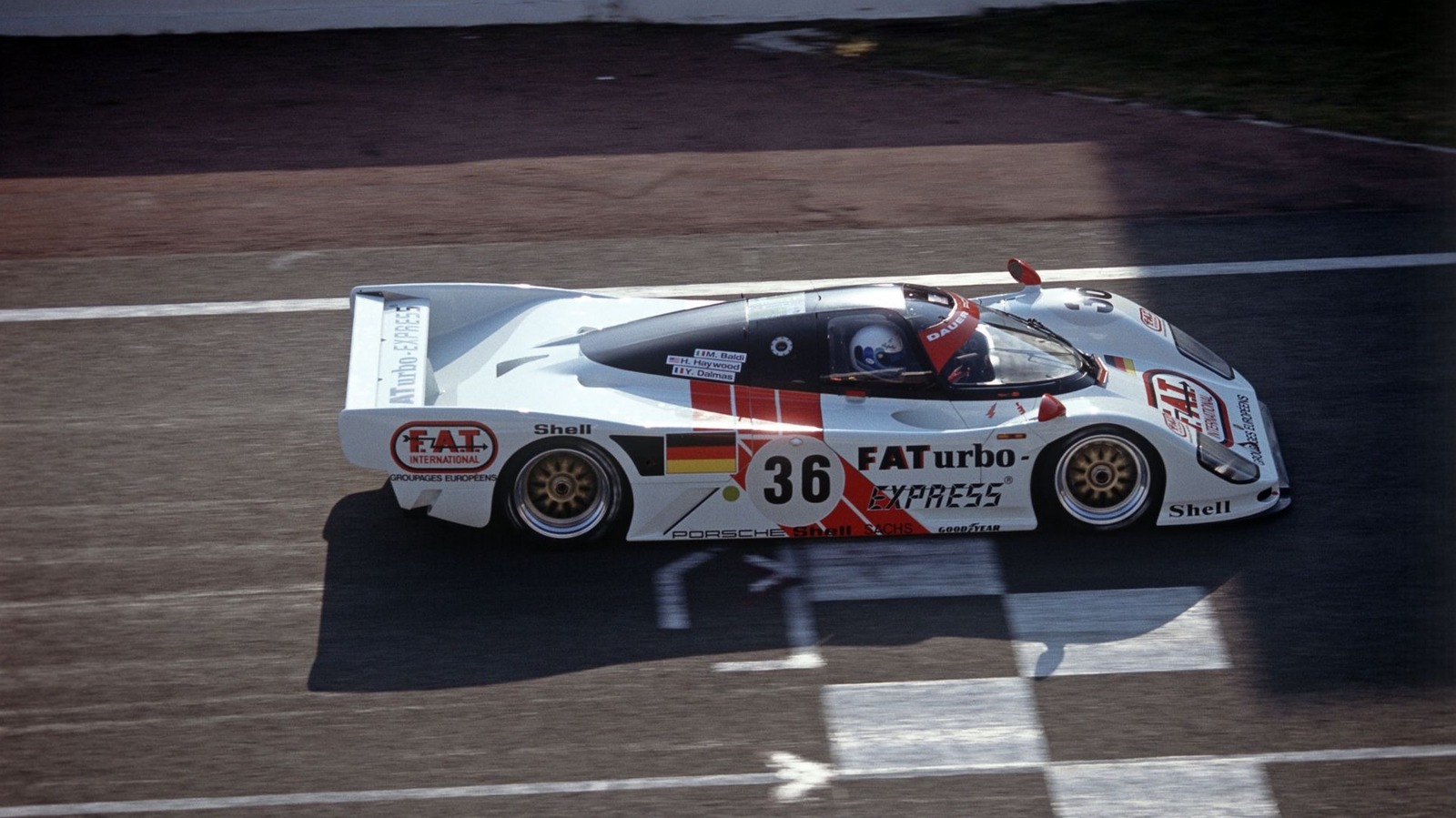
Porsche’s 962 prototype is likely one of the most recognized Porsche racing machines, outside of course, the 911. Its massive success through the 1980s and into the early ’90s made it one of the most desirable prototypes to compete with — an era end-capped with a win at the 1994 24 Hours of Le Mans. But the car that wore confetti in celebration of its win that day wasn’t exactly a Porsche 962. But it also wasn’t not. Had a few other caveats in this story not aligned, it might not have experienced the taste of victory in France at all.
The 962 was originally developed as a way for Porsche to also compete in the Prototype class in America. The 956, Porsche’s choice prototype racer at the time, had a few quirks that disallowed them from American series. With a new racing season looming before them, Porsche’s engineering team, including Norbert Singer, worked diligently through three months to build 12 or 13 cars to compete. If you think about how fast you have to engineer and build that many cars by hand in that amount of time, well, not everything is going to be super finessed. Porsche’s 962 made its debut at the 24 Hours of Daytona in 1984 with father-son duo Mario and Michael Andretti. They topped qualifying and led the field until a myriad of mechanical issues retired it midway through the evening hours. But the 962 would be improved upon gradually racking up successes, including under the guise of a man by the name of Jochen Dauer.
Dauer’s dream(s)
Dauer, a driver himself who had raced the 962 with his own racing team, Jochen Dauer Racing, or Dauer Sportwagen, had an idea to develop a road car from the 962. This wasn’t an uncommon idea as road cars are common inspirations for race cars, and on the rare occasion vise versa. Dauer ended his prototype racing in 1991, and acquired a handful of the 962C race cars to begin working on his new GT-inspired road car.
Around this same time, the 1991 Group C rule changes basically ousted the 962 from competition as engine changes and the group eventually faded into its end in 1993. Enter the introduction of the GT1 group, which the ACO created to allow GT-styled cars to race and the rules would open competitors to racing in Europe and America. Just one problem, Porsche didn’t necessarily have a GT car to compete. Singer told Jalopnik in an interview that the 911 wasn’t a good fit for the series. But there was another car that had made its debut at the Frankfurt Auto Show that year. Dauer had finished building a Dauer 962 LM car. And maybe, just maybe they could take that racing.
A little convincing can go a long way to winning Le Mans
Singer needed to have a very important conversation with the man who ultimately decided that Dauer’s car could run in the series. He spoke with Alain Bertout, Le Mans technical director at the time, who told Singer that the idea was “completely against the philosophy of these regulations, because we want to have road cars converting into race cars, not race cars converting into road cars and going back to race cars.” For cars that would be eventually be developed to compete in this GT1 program in the next few years, it was natural for a road car to become a race car, like the McLaren F1, or a race car to become a road car, which was more rare, but it worked for the Mercedes-Benz CLK GTRs or the eventual Porsche GT1. But never had a race car been turned into a road car to the become a race car like the 962.
Somehow Singer was able to convince Bertout to allow it. “Okay, you were allowed to race, but only one time this year,” Singer says Bertout told him. “Then I change regulation. You never can come back with that car.”
The impossible tale and one-time finish
The Dauer 962 made its maiden and technically final debut at the 1994 Le Mans race. It was looking to be a possible podium finish when the leading Toyota faced transmission issues allowing the Dauer 962 piloted by Hurley Haywood, Yannick Dalmas and Mauro Baldi that race, to pull ahead for the win. Its sister car would earn third.
The loophole that is said to have helped the Dauer 962 get through to race day came down to the number of production cars, although if you do read the section in both the 1994 and 1995 FIA rulebook concerning the Grand Touring class regulations, it reads exactly the same. The thing is that you could enter the race once with plans to produce that many vehicles while in competition. You just had to actually produce that number of vehicles by the next season it seems. But Dauer wouldn’t meet the 25 production car goal by 1995, and thus was never able to race his 962 at Le Mans again.
Instead, Porsche tapped Singer to head the build of its future GT competitor, setting the stage for the 911 GT1 that would debut in 1996 and earn an overall victory at Le Mans four years after the Dauer 962’s run.

