


CEO says counter-UAS protections don’t go far enough
By DRONELIFE Features Editor Jim Magill
(Editor’s note: This story is part of a series of reports on efforts to establish new counter-UAS protocols in the U.S. to protect high-profile sporting events, such as the FIFA World Cup, and critical infrastructure, from the potential threats posed by drones flown by careless or hostile actors.)
As federal, state and local officials scramble to establish a framework of counter-UAS capabilities in U.S. cities hosting FIFA World Cup events this summer, the CEO of a defense technology company questions whether those efforts will be enough to provide drone protection measures not only for the stadium themselves, but also for other potentially vulnerable sites as well.
In an interview with DroneLife, Fortem Technologies CEO Jon Gruen said the drive to establish a coordinated national counter-drone system in the U.S. has been slowed by jurisdictional issues and governmental squabbles over funding, which have led to the recently concluded partial government shutdown.
“They’ve been looking at this for two years, so they’ve known what they’ve needed,” he said. “I think what’s at risk is larger areas -meaning transit hubs.”
Over the last several months, the federal government has rapidly ramped up efforts to establish defensive capabilities to protect specific high-attendance events, such as the FIFA tournament scheduled to get under way in 11 U.S. cities next month, from incursions by unwanted drones.
In December, Congress passed the Safer Skies Act as part of the National Defense Authorization Act. That legislation gave increased authority to certain state, local, tribal and territorial (SLTT) police agencies to engage in counter-UAS and drone mitigation operations. The government also provided direct funding to official state and local entities in World Cup host cities, through a $250 million grant from the Federal Emergency Management Agency (FEMA).
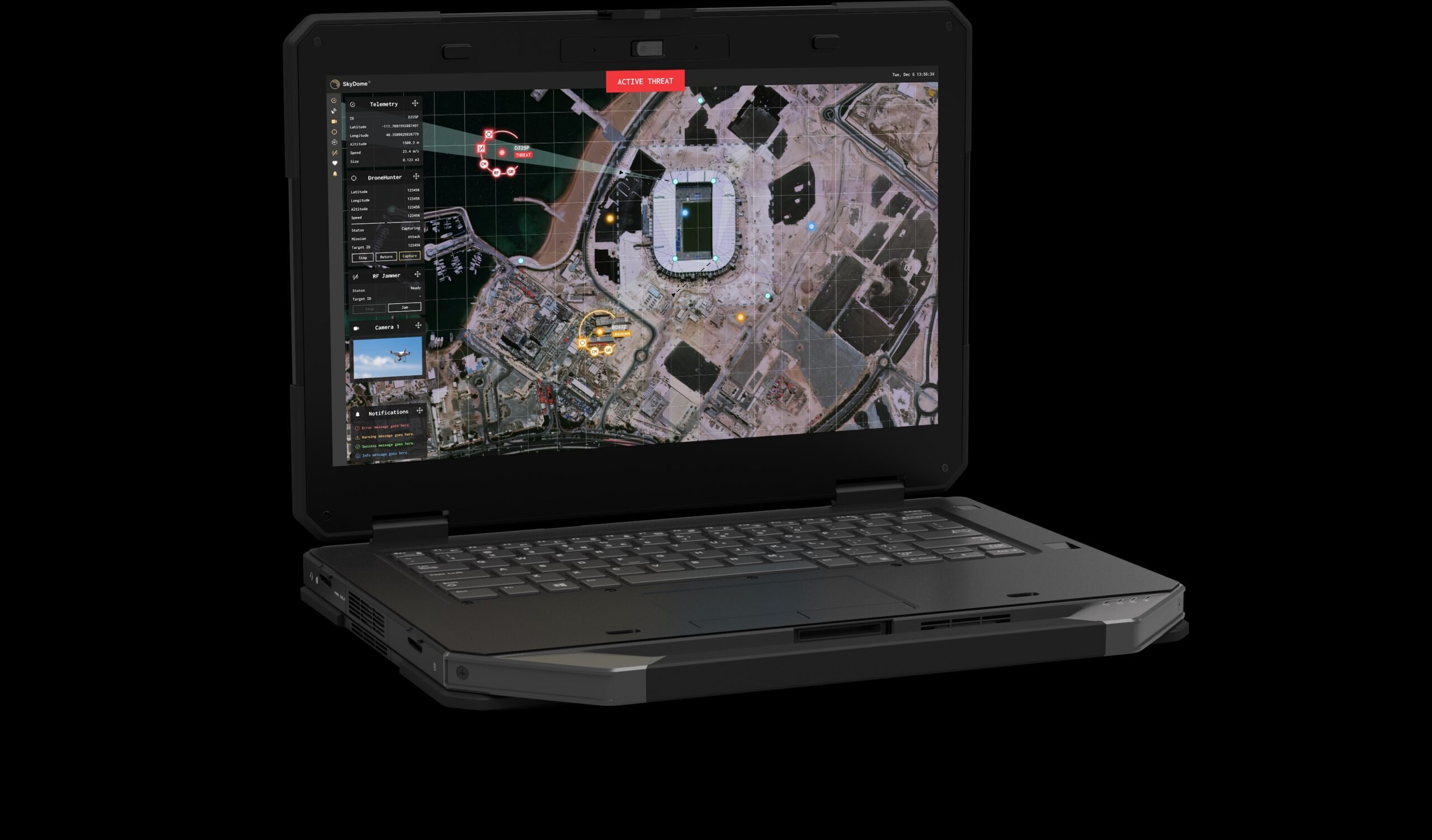
Fortem itself recently became the recipient of the first Department of Homeland Security (DHS) order for kinetic counter-UAS technology to be deployed in association with World Cup events. The multi-million-dollar contract will result in Fortem’s net-equipped DroneHunter interceptor UAVs being deployed in most, if not all of the U.S. World Cup host cities, Gruen said.
Yet, despite the flurry of government activity on the counter-UAS front, the nation is far from having the blanket of counter-drone protection that many government officials and private industry security experts such as Gruen had hoped for.
“The FAA still isn’t protecting airports from drones effectively. They couldn’t get to the full solution of the national counter-UAS problem in a meaningful way,” he said. “That probably wasn’t their mandate, but they also ran into roadblocks of funding and shutdowns and everything else.”
Gruen said the government’s security planners had initially envisioned that they would be able to introduce counter-UAS capabilities across a much broader cross-section of the U.S. infrastructure than simply protecting World Cup-related sites.
“They had some pretty big aspirations of using the World Cup to be the forcing function to start bringing counter-drone protection to a much wider grouping of critical infrastructure sites. I think the reality has been that they’ve had to focus on just the World Cup sites because of the way it’s been funded and because of the timing.”
Gruen said he thinks that the counter-UAS preparations for the World Cup-related sites will be sufficient to protect those sites from the threats imposed by unwanted drones.
“They have robust plans in place and we’re all actively working with them and training up their operational teams,” he said. “So, it’s going to be robust. So, I’m very confident that it (the FIFA tournament) will be protected.”
However, the larger issue of providing counter-UAS protections across a broader expanse of the U.S. airspace, remains unresolved, he said.
“This is a much, much bigger problem than just a stadium site. We have ignored the counter-drone problem in the United States for too long,” Gruen said. “We’ve also handicapped ourselves with government shutdowns and putting unfortunate restrictions on the departments and agencies that have been wanting to get after this problem for many years.”
Part of the problem of expanding counter-UAS capabilities has involved the issue of limited enforcement authority, Gruen said. Prior to the passage of the Safer Skies Act only a handful of federal agencies had the necessary authority to do much more that detect and identify suspect UAVs operating in a venue’s airspace, for example.
Over the past several months, Congress has passed legislation that increase the counter-UAS authorities for federal departments and agencies, “but the departments and agencies didn’t have the resources to actually buy anything or to go establish the operational concepts for the rules of engagement,” he said.
“So, it became a chicken-or-the-egg situation where you didn’t have well-understood authorities, and then you didn’t have the resources.”
Although the authority landscape has changed over the last two years, new speedbumps have popped up on the road toward creating a comprehensive nationwide counter-UAS system.
“We’ve had these hiccups of these government shutdowns, and not being able to pass spending bills,” he said.
“But fundamentally, the budgets and the requirements and the authorities are there now, and they’re being pushed down to the state and local level where they’re all being worked out. The World Cup will be the first large trial of how that works in practicality.”
Read more:
 Jim Magill is a Houston-based writer with almost a quarter-century of experience covering technical and economic developments in the oil and gas industry. After retiring in December 2019 as a senior editor with S&P Global Platts, Jim began writing about emerging technologies, such as artificial intelligence, robots and drones, and the ways in which they’re contributing to our society. In addition to DroneLife, Jim is a contributor to Forbes.com and his work has appeared in the Houston Chronicle, U.S. News & World Report, and Unmanned Systems, a publication of the Association for Unmanned Vehicle Systems International.

Miriam McNabb is the Editor-in-Chief of DRONELIFE and CEO of JobForDrones, a professional drone services marketplace, and a fascinated observer of the emerging drone industry and the regulatory environment for drones. Miriam has penned over 3,000 articles focused on the commercial drone space and is an international speaker and recognized figure in the industry. Miriam has a degree from the University of Chicago and over 20 years of experience in high tech sales and marketing for new technologies.
For drone industry consulting or writing, Email Miriam.
TWITTER:@spaldingbarker
Subscribe to DroneLife here.

