


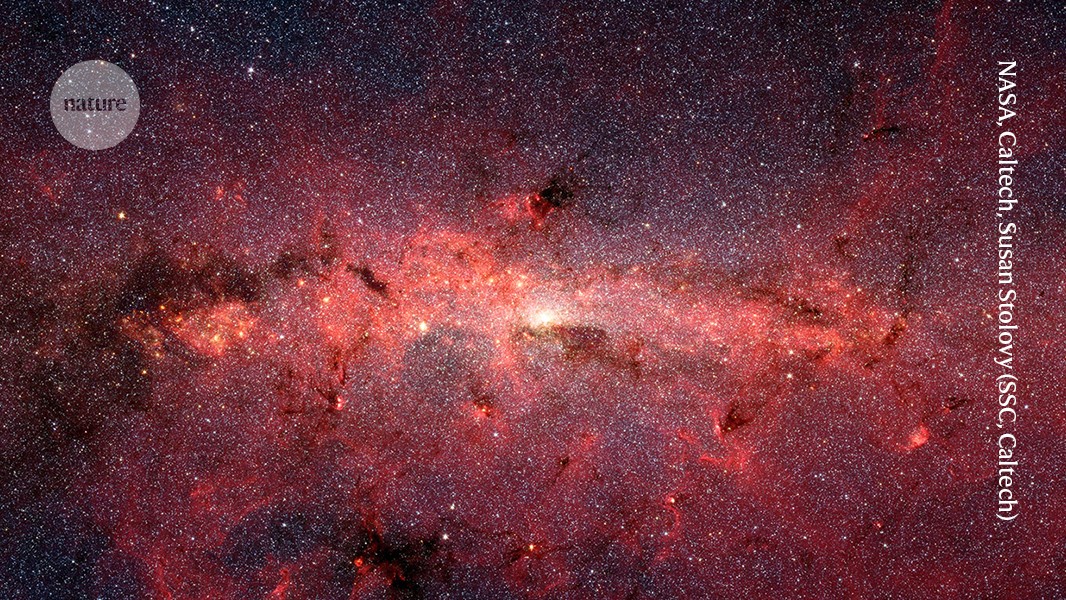

Researchers found a four-carbon sugar called erythrulose in a cloud of gas and dust at the centre of the Milky Way (image from Spitzer Space Telescope shown here).Credit: NASA, Caltech, Susan Stolovy (SSC, Caltech)
Call it an extra-sweet discovery. A group of astronomers has detected a sugar molecule swirling inside a cloud of gas and dust near the centre of our galaxy. They are calling the molecule — a compound with four carbon atoms called erythrulose — the first true sugar spotted in ‘interstellar’ space. The findings, reported today in the journal Nature Astronomy1, could help clarify how life on Earth began.
Asteroid fragments upend theory of how life on Earth bloomed
“This is an incredibly exciting result,” says Brett McGuire, an astrochemist at the Massachusetts Institute of Technology in Cambridge. “Astronomers have, for a very long time, been pushing to detect sugars in space.”
That’s because they’ve already seen hints that sugars on Earth that are essential to life originated in outer space. For instance, the five-carbon sugar ribose was previously found in some multi-billion-year-old meteorite samples2,3, suggesting that space rocks might have smashed into Earth and delivered this and other sugars.
In 2000, astronomers reported the detection of the two-carbon molecule glycolaldehyde — sometimes considered the simplest sugar molecule — in the interstellar space between stars4. But although glycolaldehyde can act similarly to a sugar, “it is not formally a sugar”, McGuire says. True sugars, he adds, must have a backbone of at least three carbon atoms. Astronomers have continued to scan space for these bigger molecules ever since.
A surprise signature
Izaskun Jiménez-Serra, an astronomer at the Spanish National Research Council in Madrid, and her colleagues were among this group, but hadn’t had any luck while scouring the night sky. Then, in 2022, Emilio Cocinero, a physical chemist at the University of the Basque Country in Leioa, Spain, offered to share spectroscopic data for erythrulose — that is, the specific fingerprint of wavelengths that the molecule emits.

Erythrulose has four carbons (grey). Red atoms are oxygens, and white atoms are hydrogens.Source: Ref. 1
“I said, ‘Okay, why don’t you send me the information, and then I’ll check whether we see it in our data’,” Jiménez-Serra says. She was sceptical at first. But to her surprise, the erythrulose fingerprint showed up in the team’s observations of a molecular cloud near the centre of the Milky Way. And using Spain’s Yebes 40-metre and IRAM 30-metre radio telescopes for deeper observations, Jiménez-Serra and her team saw the signal even more clearly.

