


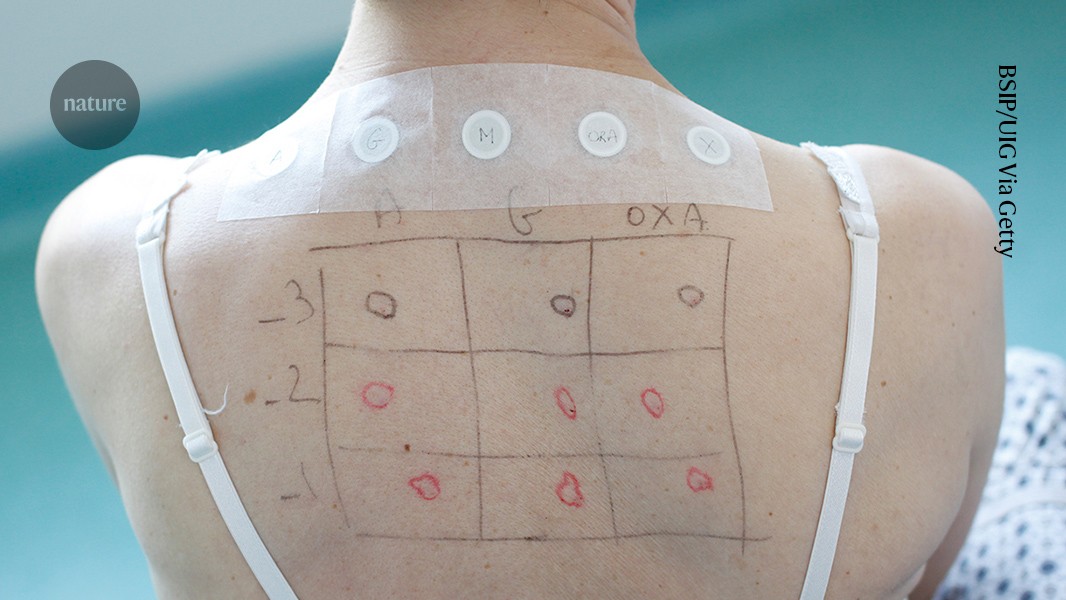

People with food allergies are advised to avoid the allergen because treatments are limited.Credit: BSIP/UIG Via Getty
Six people who were highly allergic to peanuts can tolerate the nut after receiving a faecal transplant, reports a study published on 5 August in Science Translational Medicine.
The small trial1 of 15 people is the first evidence that faecal transplants — the transfer of gut bacteria harvested from the stool samples of healthy donors — can treat a food allergy. “Up until now, it’s been in mouse models. Now we have people. And that’s exciting,” says Cathryn Nagler, an immunology researcher at the University of Chicago in Illinois.
Before taking part in the study, participants could not eat more than 100 milligrams of peanut protein, which is found in less than half a peanut, without developing an immune reaction. Four months after the transplant, one person could consume 300 milligrams of peanut protein and five people could eat 600 milligrams or more, the equivalent of about two and a half peanuts. “Seeing any kind of efficacy in people” is remarkable, adds Nagler.
Treatments for food allergies are limited and the standard advice is for people to avoid the allergen and to carry an adrenaline injection to administer if they are exposed to it and develop an immune reaction.
Physicians say that the sustained effect seen in some of the trial participants is important. “The potential of this type of therapy to have a lasting benefit is really, really exciting,” says Edwin Kim, an allergist at the University of North Carolina at Chapel Hill. “That’s been a struggle that we’ve had with the current other therapies. The benefit wanes and requires continued treatment, continued exposure, to maintain.”
Early clues
Some research2 has linked food allergies with low levels of certain gut bacteria. Research in mice3 has also showed that treating the animals with groups of several gut bacteria species kept food allergies in check. This has led researchers to suggest that faecal transplants from people who do not have food allergies, which contain a broad range of gut bacteria, might dampen the immune system in people with an allergy.
In the new trial, researchers gave participants an odourless and tasteless pill containing gut bacteria from healthy volunteers without a peanut allergy. Most participants received 36 pills in a single day, which did not trigger severe side effects. Five of the participants also received antibiotics for four days before the transplant.
The authors suggest that the bacteria might not have become established in the nine people who didn’t respond to the treatment, possibly because of gender-related differences (five of the six people who responded were men), because the bacteria were delivered on a single day or because most of the people who didn’t respond also didn’t receive antibiotics before the treatment.
The researchers also transplanted gut bacteria from participants’ stool samples into mice and found that bacteria from people who responded to treatment also protected mice from developing allergies to an egg protein. By contrast, mice that received bacteria from people who remained highly sensitive developed allergies to egg protein.
Because the mouse studies tested a different allergen, the faecal transplant treatment is likely to work for more than just peanut allergies, says study co-author Talal Chatila, an immunologist at Harvard Medical School in Boston, Massachusetts.

