



You have full access to this article via your institution.
Hello Nature readers, would you like to get this Briefing in your inbox free every day? Sign up here.
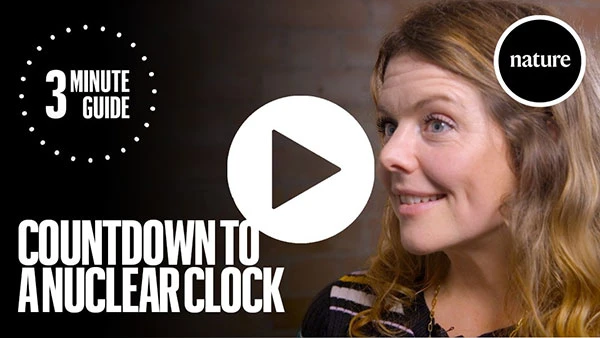
Researchers have been chasing the concept of a nuclear clock for more than 20 years. Last year, Nature reporter Elizabeth Gibney explained how the imminent discovery could improve on state-of-the-art atomic clocks. (Nature | 4 min watch)
Two research teams, one in Europe and one in China, have made the world’s first ‘nuclear’ clocks. These clocks derive their ‘tick’ from the energy that makes protons and neutrons inside the nucleus of thorium-229 shift to a higher energy level. The groups used similar approaches to solve the problem that’s hindered nuclear-clock development in the past: how to keep the clock’s tick speed from drifting over time. Creating a nuclear clock is “a dream come true”, says atomic physicist Thorsten Schumm, a member of the European team. “Now we have a fierce but friendly global competition.”
Reference: arXiv preprint 1 & preprint 2 (not peer reviewed)
The H5N1 strain of avian influenza has been detected in two wild birds in Australia — the first cases of the disease on the continent. There’s no evidence that the virus has killed large groups of birds or mammals, but at least 58 sick or dead birds have been reported on an emergency hotline. Mainland Australia had previously been a stronghold against the virus, but “we all knew we couldn’t be bird flu-free forever”, says Julie Collins, the country’s agricultural minister.
BBC | 4 min read & ABC News | 6 min read
The US National Science Foundation (NSF) announced last week that it will no longer proceed with Trump administration plans to dismantle much of the Ocean Observatories Initiative — a network of hundreds of instruments used to monitor ocean science and climate change. Some devices had already been removed, and the NSF said that it is “developing plans to redeploy the equipment after servicing”. The change came after a bipartisan effort by some lawmakers to stop the system from being taken apart.
The New York Times | 8 min read
Features & opinion
In The Future of the Past, art historian Thijs Weststeijn looks at heritage sites threatened by climate change to explore how the idea of heritage has developed over time. He argues that concepts such as ‘world heritage’ — a term used to designate places on Earth of outstanding universal value to humanity — are rooted in Eurocentric frameworks, which can limit how people respond to cultural loss in other parts of the world. The book “is a valuable contribution to an increasingly necessary debate”, writes archaeologist William Megarry in his review.
“This skull is basically one of the most important Chilotherium specimens currently existing in Europe,” says palaeontologist Panagiotis Kampouridis, referring to a fossil of a hornless rhino that resides in Ukraine’s National Museum of Natural History. The Chilotherium sarmaticum is just one of thousands of specimens and artifacts that museum staff are digitizing so that researchers worldwide can still study them — and before they are potentially destroyed by Russian bombardment. At the same time, some curators struggle to define the value of their work in a time of war.
“We expected a big impact, but the numbers still surprised us,” write wildfire and climate researchers Dmitri Kalashnikov, Cong Yin, Madhulika Gurazada and Mukesh Kumar. Their research found that only a small fraction of ‘warm-season’ days in the western United States count as heat waves, which the team define as three or more consecutive days with temperatures in the top tenth of hottest days. But a huge chunk of the area burned by fires was affected during or immediately after a heat wave. It turns out that heat waves not only create tinder-dry fuel sources, they also limit fire-suppressing humidity at night and promote lightning that can ignite vegetation.
High Country News | 6 min read
Reference: Science Advances paper

(The Conversation (CC-BY-ND))
As chief economist at the retail chain Walmart, John List and his team are running natural field experiments with more than 6,000 suppliers to test which factors will most effectively incentivize reductions in carbon emissions. List argues that such tests, in which researchers vary a feature of the environment and watch how it affects people’s everyday activities, can help tackle the challenge of generalizability: where interventions that worked in one place fail to work in another or when scaled up.
Because Leif Penguinson (and Briefing media maestro Tom Houghton) were on holiday last week, there is no penguin-search solution today.
But I do have the pleasure of bringing you news that is now so frequently reported around the globe that it feels — miraculously — almost commonplace. Another study has confirmed that vaccination against HPV (human papillomavirus) virtually eliminates cases of deadly cervical cancer. This time, it’s England that has reported a precipitous drop in deaths among young women since school-age girls began being offered the vaccine (which also protects boys from other types of cancer). And, “as vaccinated generations grow older, we’ll see many more lives saved”, notes cancer epidemiologist Peter Sasieni, who co-authored the study in The Lancet.
Let me know what good news is buoying you up today, plus any other feedback on this newsletter, at [email protected].
Thanks for reading,
Flora Graham, chief editor, Nature Briefing
With contributions by Jacob Smith
• Nature Briefing: Careers — insights, advice and award-winning journalism to help you optimize your working life
• Nature Briefing: Microbiology — the most abundant living entities on our planet — microorganisms — and the role they play in health, the environment and food systems
• Nature Briefing: Anthropocene — climate change, biodiversity, sustainability and geoengineering
• Nature Briefing: AI & Robotics — 100% written by humans, of course
• Nature Briefing: Cancer — a weekly newsletter written with cancer researchers in mind
• Nature Briefing: Translational Research — covers biotechnology, drug discovery and pharma

