


By Dronelife Features Editor Jim Magill
Faced with growing challenges posed by drones flown by malicious actors, Western European nations are working to ramp up their home-grown production of UAVs and counter-UAS technology and to shorten the supply chains needed to produce that technology.
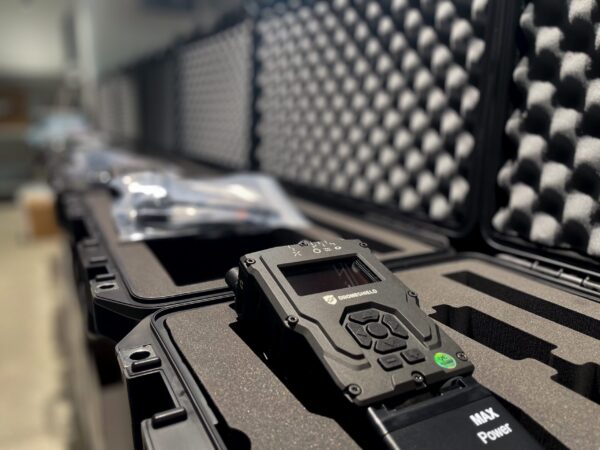
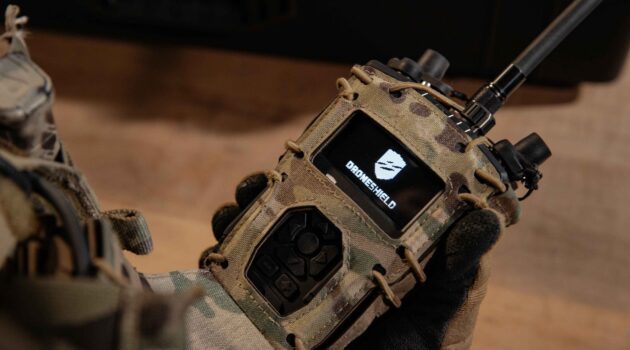
Recognizing the need to site UAS manufacturing in the regions where the demand for the product is high, Australia-based DroneShield this week announced that its first pieces of counter-UAS technology rolled off the production line at its manufacturing facility in an undisclosed European location.
DroneShield Reads the Tea Leaves on European Sovereign Capability
Kacey Lam-Evans, DroneShield’s director of government affairs, said Western European countries are placing a premium on their ability to create their sovereign capability to independently develop and control essential functions, infrastructure and industries without relying on extended and vulnerable supply chains.
“For companies like DroneShield, this has been a signal to us that in order to be more successful in the European markets, we need to read the tea leaves and undertake regional manufacturing,” Lam-Evans said in an interview. “And that’s why we announced a few months ago that we had established our manufacturing footprint in Europe, and we have now seen that come to fruition with the first units coming off that production line.”
DroneShield this week announced the manufacturing milestone on the opening day of Eurosatory 2026, a major international defense and security exhibition in Paris. The company promised that the counter-UAS systems produced in the European plant would deliver “the same proven performance, capability and design as DroneShield’s Australian-built systems.”
Amsterdam HQ and European Manufacturing Mark Expanding Continental Footprint
The move to establish a European manufacturing base is just part of an increasing focus on the continent by DroneShield. In April, the company officially opened its new European headquarters in Amsterdam to strengthen its operational presence across EU and NATO-aligned markets. Just a few weeks earlier, DroneShield had announced it was partnering “with an experienced and established manufacturer,” to begin production of European-made counter-UAS systems.
Lam-Evans said DroneShield’s marketing strategy aligns with Western Europe’s military investments goals outlined under the ReArm Europe Plan/Readiness 2030 Initiative, a landmark €800 billion strategic defense initiative proposed by the European Commission, the executive body of the EU.
In February, the European Commission issued an Action Plan on Drone and Counter Drone Security, calling for EU members to conduct a coordinated response campaign to counter the growing threats arising from maliciously operated drones.
“I think sovereign capability is a phrase that’s thrown around quite often but it really does have real meaning,” Lam-Evans said. “When we have governments wanting to see more resilient delivery of capability, it is important that we are taking into account what this sovereign capability means for different regions.”
European Supply Chain Reduces Risk of Wartime Disruption
DroneShield’s European manufacturing facility, the company’s first outside of Australia, will be supplied with a primarily European supply chain, which helps ensure against supply disruptions in the case of war or other disaster.
“We have been able to replicate what we have achieved in Australia in Europe,” Lam-Evans said. She added that the company is looking to duplicate the manufacturing partnership business model as it expands into other global markets. “This is by no means an exclusive partnership. We are also exploring this sort of model in the US as well.”
Drones Present Multiple Potential Threats
In recent months, Western European countries have seen a growing number of threats from unwanted UAVs, at airports, military bases and infrastructure sites. Countries on the so-called Eastern Flank of Western Europe have experienced numerous cross-border incidents involving UAVs dispatched as part of the Russia-Ukraine war, and countries across the continent contend with encounters with unidentified – and possibly hostile – drones.
“Drone warfare has really changed the way that militaries respond to how they procure capability. And, it’s not only drone warfare, it is a hybrid — or gray zone — warfare where we are seeing drone incursions over critical infrastructure,” Lam-Evans said.
In assessing potential threats from drones, security officials must examine an entire spectrum of threats, everything from hostile UAVs dropping explosive payloads on crowds of civilians to attacks on traditional military targets to less overt, but nonetheless costly, aggressive drone tactics.
“We see nuisance activities such as over airports. Europe has seen this more recently, shutting down airports for hours at a time, causing economic and operational disruption,” she said. In addition, drones equipped with sophisticated cameras and sensors are the ideal platform for conducting espionage, whether sponsored by a nation state or a criminal enterprise.
“So, what we are seeing is that the threat has changed in the way that drones are used. They once were a toy that you could purchase from your local electronics store, but now are being used very differently,” Lam Evans said. “Militaries, law enforcement and critical infrastructure operators across Europe and globally are now starting to see that the need for drone detection in the first instance and defeat where possible.”

