


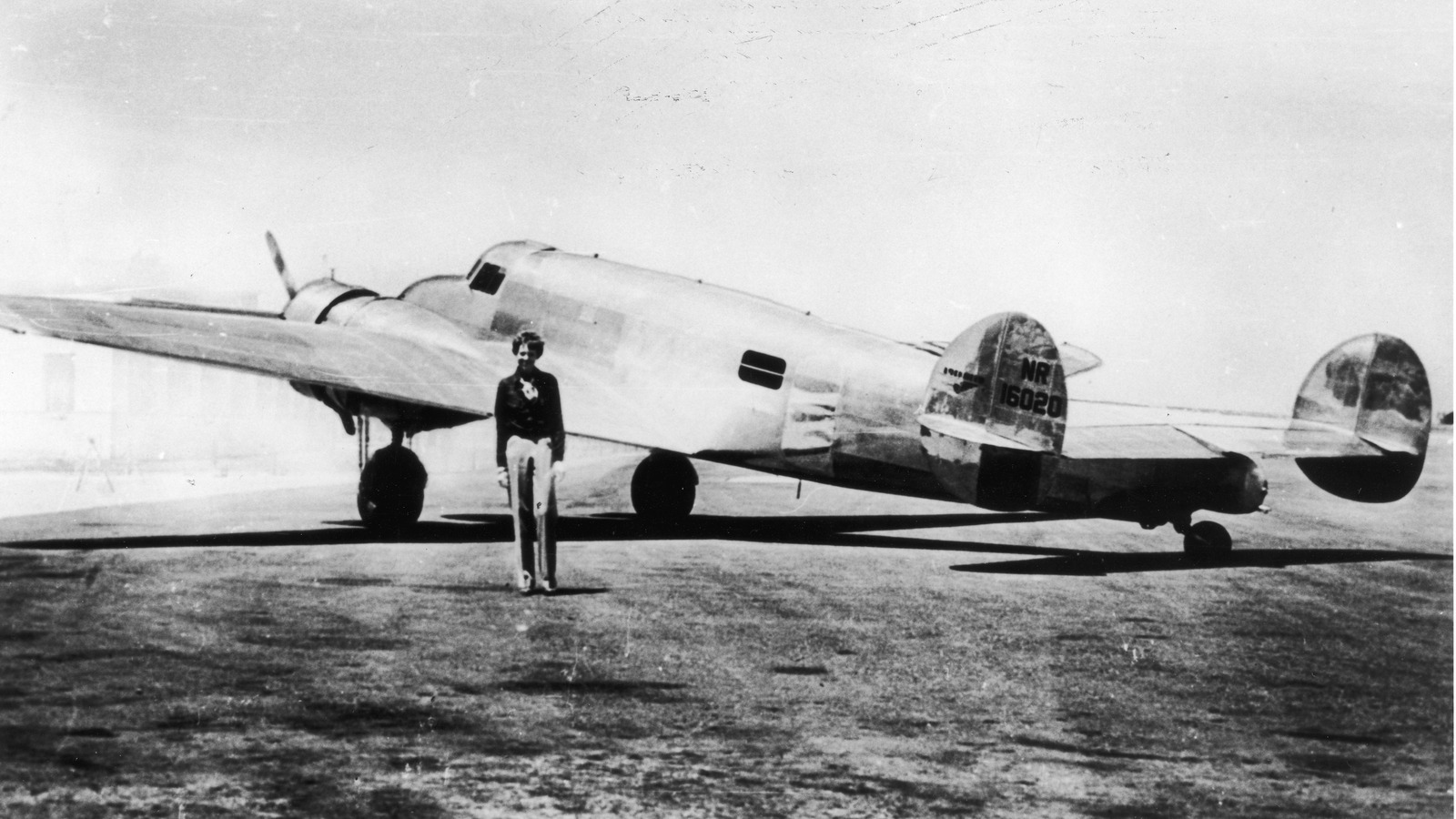
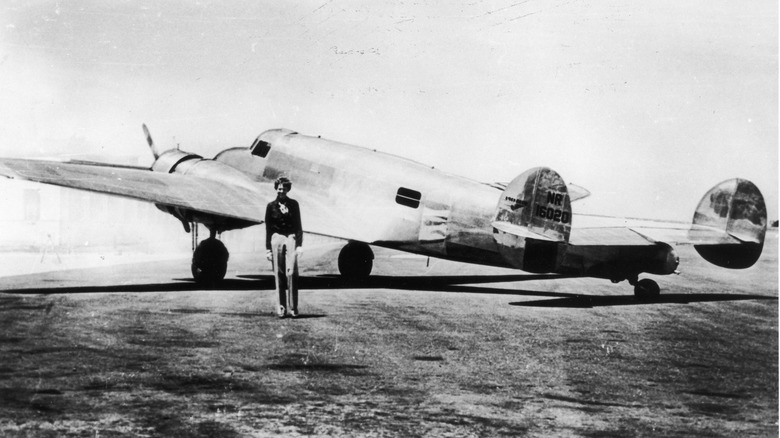
The disappearance of Amelia Earhart and co-pilot Fred Noonan somewhere in the Pacific Ocean is one of the greatest mysteries of the 20th century. A team of 16 researchers will be traveling to the remote Nikumaroro Island in October to determine, once and for all, whether an object that has appeared on and off in satellite images for years is the wreckage of Earhart’s Lockheed Electra 10-E, according to Purdue University.
Multiple theories as to what happened to Earhart and Noonan have been going around ever since their disappearance. The prevailing theory had been that they crashed into the ocean during their flight to Howland Island on July 2, 1937, during their attempted trip around the world. Aircraft wreckage has been found near Howland Island that could be Earhart’s, but it’s never been confirmed. Some believe that Earhart was captured by the Japanese and executed as an American spy, though evidence does not appear to support this.
One intriguing theory is that Earhart survived a soft landing on Nikumaroro Island, and even made some emergency radio transmissions shortly afterward. Directional bearings from her final radio calls converge near the island. Artifacts dating to the 1930s have been found there, including a shoe, a freckle cream jar, a compact case, and a medicine vial, all of which could have belonged to Earhart. Human bones found in the 1940s could have been Earhart’s based on her size and stature, but these have been lost, so modern DNA testing is not possible. So far, no definitive evidence has linked Earhart to Nikumaroro Island with absolute certainty.
The Taraia Object
The most compelling evidence supporting the theory of a soft landing is known as the Taraia Object. It appeared on satellite images of Nikumaroro Island starting in 2015 after a major storm uncovered it, and resembles what could be the wreckage of Earhart’s aircraft. It sank back into the ocean by 2020, but its location does not appear to have changed. In 1991, researchers from The International Group for Historic Aircraft Recovery (TIGHAR) discovered what they believe is a piece of Earhart’s plane on Nikumaroro Island. Its size and shape match a patch panel installed in Miami near the beginning of Earhart’s fateful flight.
The TIGHAR website lists a great deal of evidence supporting the theory that the Taraia Object is Earhart’s plane. However, TIGHAR founder Ric Gillespie has changed his opinion in recent years. He recently told NBC News that he believes the Taraia Object is not Earhart’s aircraft, but a coconut tree. “We’ve looked there in that spot, and there’s nothing there,” he told the Today show in 2025. On the TIGHAR forum, Gillespie shared an email exchange he had with expedition leader Richard Pettigrew:
Gillespie: “If I thought somebody needed to go look, I would go look. We’ve done it before. In 2002 the lead scientist on a New England Aquarium expedition to Niku saw what he believed was an airplane wheel in shallow water near the shore of Tatiman Passage. In 2003 we sent a small expedition to check it out, but by then it was gone, apparently washed away by a storm.”
Pettigrew: “My request to you is to give us your blessing to go back to the island and determine once-and-for-all what the Taraia Object actually is.”
Gillespie: “I do not believe there is sufficient evidence of wreckage at Taraia to merit the expense of an on-site investigation. I can not say otherwise.”
Pettigrew: “I know that people will ask you what you think about our plan. … I hope you will allow for the possibility that we are right and express your hope (if not expectation) that traces of the Electra could actually be found.”
Gillespie: “I would never oppose any responsible archaeological investigation of Niku.”
As Gillespie points out, conditions are constantly changing. A researcher may have seen a wheel in 2002, but it was washed away by 2003. What looks like the wreckage of an airplane became visible in 2014, but sank below the surface again by 2020. The shoreline itself changed quite a bit during that time as well due to storms and erosion. Really, the only way to verify whether the Taraia Object is an airplane or a coconut tree is to make the long trip to Nikumaroro Island and look.
Flight delays

If this sounds like a repeat of Purdue’s last announcement of an expedition to Nikumaroro Island, that’s because it is. The research team discovered they did not have the political connections in the Republic of Kiribati, of which the island is a part, to get permission to go to the island. It’s taken a year of introductions and meetings to get the government’s blessing. Now that the expedition has it, it’s making solid plans:
Some members of the expedition will fly out of the Amelia Earhart Terminal at the Purdue University Airport on Oct. 3 and join the entire 16-person team in Tarawa, Kiribati, on Oct. 6. The team — composed of archaeologists; filmmakers; logistics, scuba and safety personnel; and Kiribati representatives — will depart Tarawa by sea Oct. 7, sail approximately 830 nautical miles to Nikumaroro and then spend several days on the small island in the search effort.
The team will spend time on the ground documenting the site in its present form. Since the Taraia Object has sunk back below the surface, researchers will scan for the aircraft using sonar and magnetometers. Then they will send a hydro probe through the thin layer of silt to make physical contact with the object. After that, they’ll use a hydraulic dredge to carefully uncover and reveal it to make a positive identification. Or, the whole thing could just be a fallen coconut tree in the shape of an airplane. As Pettigrew said, “The only way to answer this question is to go to Nikumaroro, inspect the Taraia Object firsthand and follow the evidence wherever it leads.”

