


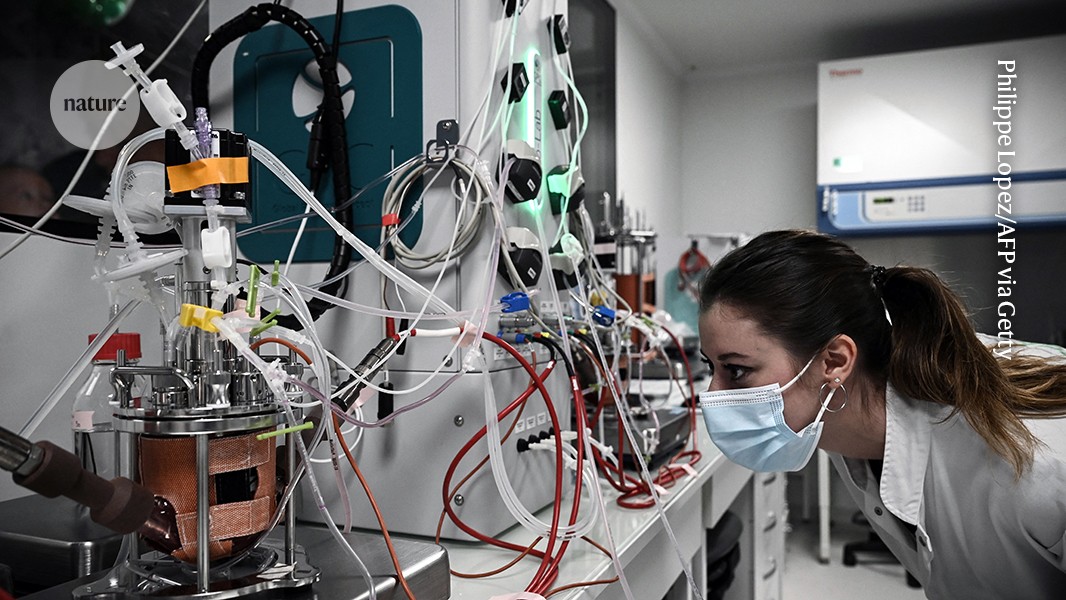

Bioengineering can produce tools for use in cutting-edge cell therapies, among other applications.Credit: Philippe Lopez/AFP via Getty
Europe is losing ground in one of the most innovation-intensive sectors in biomedicine and health care: bioengineering1. Many advances in biomedicine are technologically driven, for example, the use of artificial intelligence to predict protein structures and rapid genome sequencing for precision medicine.
Bioengineering produces technologies that aim to solve medical problems, by merging methods from mathematics, computation, engineering and biomedicine. Many countries, including the United States1, China, Switzerland and the United Kingdom, understand the power of such research. Yet, the European Union has still not caught on.
The EU’s 27 member states (EU27) host fewer than ten fully autonomous bioengineering departments, compared with more than 100 each in the United States and China. Not one EU27 university made it into the 2025 ShanghaiRanking’s top-30 list of biomedical engineering departments, compared with 18 from Asia.
Investment in medical technologies in the EU27 is low (see ‘Untapped potential’). In 2023, biotechnology companies in Europe attracted US$11.5 billion in funding, compared with about $57 billion in the United States and $21 billion China (see go.nature.com/3twrfgr and ref. 2).

Source: European Commission
Concerned about this widening gap, in March, 25 specialists from around the world — including us and our co-signatories (see Supplementary information) — came together at Europe’s life-sciences organization EMBO in Heidelberg, Germany, to find ways to address it. Here, we call on the European Council and relevant EU directorates to adopt a European bioengineering agenda that focuses on three themes.
Build academic excellence
The EU can build on its vibrant life-sciences sector, which contributes €1.5 trillion to its economy and supports 29 million jobs (see go.nature.com/4fr475p). The region has a strong culture of collaborative research, academic–industry partnerships and funding programmes that encourage the development of technologies. For decades it has excelled in other engineering disciplines, from civil to computational. And the EU’s open society, social-security systems, health-care and education infrastructures attract global talent.

Science sleuths raise concerns about scores of bioengineering papers
What’s needed now is coordinated European investment in bioengineering education, research and innovation ecosystems, to create the conditions for globally competitive health-care technology and biotech companies to flourish.
The EU should incentivize national governments to establish dedicated bioengineering departments at their leading universities. Funding programmes should be used to promote bioengineering excellence.
Universities should recruit dedicated bioengineering staff members with a range of expertise to establish world-class curricula. This should be done in a similar way to how electrical and computer-engineering faculties were established originally, by bringing together top researchers from physics, mathematics and other engineering and technology fields.
New bioengineering institutions should teach students how to develop a problem-solving mindset3. This skill can be applied across life-sciences research, including to methodologies that advance biomedical discovery and technologies that improve clinical care.
Curricula should also emphasize medical ethics and regulation, to help students embrace the processes involved in developing successful biomedical technologies. This will help future bioengineers to navigate the rules and market forces that are specific to technology acceptance in medicine, which are different from other engineering products and pipelines.
Engineering resilient food systems in a warming world
Having several such top-level departments will build homegrown expertise and attract medical technology and biotechnology companies. Evidence for this can be found in Boston, Massachusetts, and San Francisco, California. These areas are home to biotechnology and medical-technology hubs, the foundations of which were built on a reputation for education and research excellence, including top-ranking bioengineering departments.
Recognition and celebration of high-achieving bioengineers can enhance the visibility and reputation of the field, initiating a virtuous cycle that makes entering the bioengineering industry more desirable. As the number of bioengineers in Europe grows, these researchers could establish dedicated societies that can present scientific awards, elect fellows, recognize early-career achievements and establish distinguished lectureships, as well as inspire established funders, societies and philanthropists to support bioengineering.
Invest in bioengineers
The EU invests billions of euros annually in biomedical and life-sciences research, including through research funding from the European Research Council and the European Innovation Council. Yet, dedicated review panels for assessing bioengineering grant proposals are absent, and funding proposals are typically assessed by researchers in neighbouring disciplines, such as biology, medicine, physics and engineering. Although reviewers might have relevant expertise, they are likely to evaluate proposals through the lens of their own disciplines.
The EU should establish dedicated funding schemes and review panels for bioengineering research. Experts in the field should also be involved in shaping future initiatives. These include Framework Programme 10 — the EU’s next research and innovation funding programme, which is currently being developed and is scheduled to run from 2028 to 2034.

Tissue bioengineering techniques could improve treatments for congenital heart conditions.Credit: Christophe Archambault/AFP via Getty
To rapidly translate research into marketable products, Europe needs policies that actively engage industry, venture-capital and investment firms. The region cannot establish global leadership in bioengineering while much of its talent is moving abroad and its innovations are being commercialized elsewhere. Dedicated funding programmes, public–private co-investment schemes, tax incentives for investments in technology and reduced administrative barriers to technology transfer are essential at both the EU and national levels. These efforts should be complemented by regulatory pathways that support safe but efficient early approval of technology for use in clinical settings.

