


Noble, T. L. et al. The sensitivity of the Antarctic Ice Sheet to a changing climate: past, present, and future. Rev. Geophys. 58, e2019RG000663 (2020).
Cook, A. J. & Vaughan, D. G. Overview of areal changes of the ice shelves on the Antarctic Peninsula over the past 50 years. Cryosphere 4, 77–98 (2010).
Walker, C. C. et al. Multi-decadal collapse of East Antarctica’s Conger–Glenzer Ice Shelf. Nat. Geosci. 17, 1240–1248 (2024).
Fox-Kemper, B. et al. in Climate Change 2021: The Physical Science Basis (eds Masson-Delmotte, V. et al.) Ch. 9 (Cambridge Univ. Press, 2021).
Oppenheimer, M. et al. in IPCC Special Report on the Ocean and Cryosphere in a Changing Climate (eds Pörtner, H.-O. et al.) 126 (Cambridge Univ. Press, 2019).
DeConto, R. M. et al. The Paris Climate Agreement and future sea-level rise from Antarctica. Nature 593, 83–89 (2021). This study applies the MICI mechanism to project Antarctic Ice Sheet contributions to sea-level rise under Paris Agreement emissions scenarios, providing high-end estimates that have become central to planning for worst-case outcomes.
Otosaka, I. N. et al. Mass balance of the Greenland and Antarctic ice sheets from 1992 to 2020. Earth Syst. Sci. Data 15, 1597–1616 (2023).
Weertman, J. Stability of the junction of an ice sheet and an ice shelf. J. Glaciol. 13, 3–11 (1974).
Nye, J. F. The response of glaciers and ice-sheets to seasonal and climatic changes. Proc. R. Soc. Lond. Math. Phys. Sci. 256, 559–584 (1960).
Pattyn, F. The paradigm shift in Antarctic ice sheet modelling. Nat. Commun. 9, 2728 (2018).
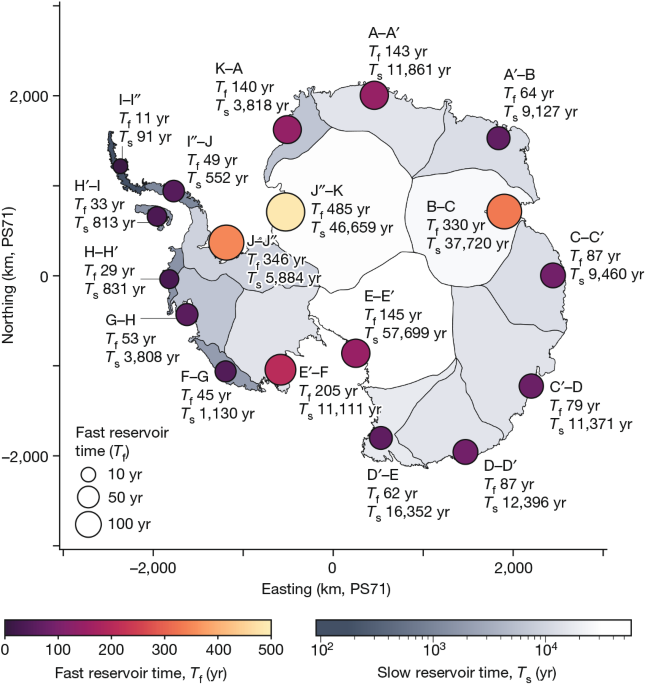
Robel, A. A., Roe, G. H. & Haseloff, M. Response of marine-terminating glaciers to forcing: time scales, sensitivities, instabilities, and stochastic dynamics. J. Geophys. Res. Earth Surf. 123, 2205–2227 (2018). This study establishes the theoretical basis for reservoir time as a fundamental timescale governing how marine-terminating glaciers respond to external forcing, a concept this paper demonstrates is a robust and emergent feature across ISMIP6 models.
Seroussi, H. et al. ISMIP6 Antarctica: a multi-model ensemble of the Antarctic ice sheet evolution over the 21st century. Cryosphere 14, 3033–3070 (2020).
Seroussi, H. et al. Insights into the vulnerability of Antarctic glaciers from the ISMIP6 ice sheet model ensemble and associated uncertainty. Cryosphere 17, 5197–5217 (2023).
Seroussi, H. et al. Evolution of the Antarctic Ice Sheet over the next three centuries from an ISMIP6 model ensemble. Earths Future 12, e2024EF004561 (2024). This study presents the ISMIP6 Antarctic model ensemble used as the primary dataset in this study, making it an essential reference for interpreting the results.
Coulon, V. et al. Disentangling the drivers of future Antarctic ice loss with a historically calibrated ice-sheet model. Cryosphere 18, 653–681 (2024).
Rignot, E., Velicogna, I., van den Broeke, M. R., Monaghan, A. & Lenaerts, J. Acceleration of the contribution of the Greenland and Antarctic ice sheets to sea level rise. Geophys. Res. Lett. 38, L05503 (2011).
Fricker, H. A. et al. Antarctica in 2025: drivers of deep uncertainty in projected ice loss. Science 387, 601–609 (2025).
Bassis, J. & Walker, C. C. Upper and lower limits on the stability of calving glaciers from the yield strength envelope of ice. Proc. R. Soc. A 468, 913–931 (2011).
Adusumilli, S., Fricker, H. A., Medley, B., Padman, L. & Siegfried, M. R. Interannual variations in meltwater input to the Southern Ocean from Antarctic ice shelves. Nat. Geosci. 13, 616–620 (2020).
Smith, B. et al. Pervasive ice sheet mass loss reflects competing ocean and atmosphere processes. Science 368, 1239–1242 (2020).
Badgeley, J. A., Morlighem, M. & Seroussi, H. Increased sea-level contribution from northwestern Greenland for models that reproduce observations. Proc. Natl Acad. Sci. USA 122, e2411904122 (2025).
Choi, Y., Petty, A., Felikson, D. & Poterjoy, J. Estimation of the state and parameters in ice sheet model using an ensemble Kalman filter and Observing System Simulation Experiments. Cryosphere 19, 5423–5444 (2025).
Goldberg, D. N. & Heimbach, P. Parameter and state estimation with a time-dependent adjoint marine ice sheet model. Cryosphere 7, 1659–1678 (2013).
Beckmann, J. et al. Disentangling uncertainty in ISMIP6 Antarctic sub-shelf melting and 2300 sea level rise projections. Preprint at EGUsphere https://doi.org/10.5194/egusphere-2025-4069 (2025).
Brondex, J., Gillet-Chaulet, F. & Gagliardini, O. Sensitivity of centennial mass loss projections of the Amundsen Basin to the friction law. Cryosphere 13, 177–195 (2019).
Sun, S. et al. Antarctic ice sheet response to sudden and sustained ice-shelf collapse (ABUMIP). J. Glaciol. 66, 891–904 (2020).
Yu, H., Rignot, E., Seroussi, H. & Morlighem, M. Retreat of Thwaites Glacier, West Antarctica, over the next 100 years using various ice flow models, ice shelf melt scenarios and basal friction laws. Cryosphere 12, 3861–3876 (2018).
Dow, C. F., Ross, N., Jeofry, H., Siu, K. & Siegert, M. J. Antarctic basal environment shaped by high-pressure flow through a subglacial river system. Nat. Geosci. 15, 892–898 (2022).
Ehrenfeucht, S., Dow, C., McArthur, K., Morlighem, M. & McCormack, F. S. Antarctic wide subglacial hydrology modeling. Geophys. Res. Lett. 52, e2024GL111386 (2025).
Pelle, T., Greenbaum, J. S., Dow, C. F., Jenkins, A. & Morlighem, M. Subglacial discharge accelerates future retreat of Denman and Scott glaciers. East Antarctica. Sci. Adv. 9, eadi9014 (2023).
Kazmierczak, E., Gregov, T., Coulon, V. & Pattyn, F. A fast and simplified subglacial hydrological model for the Antarctic Ice Sheet and outlet glaciers. Cryosphere 18, 5887–5911 (2024).
Zhao, C. et al. Subglacial water amplifies Antarctic contributions to sea-level rise. Nat. Commun. 16, 3187 (2025).
Bradley, A. T. & Hewitt, I. J. Tipping point in ice-sheet grounding-zone melting due to ocean water intrusion. Nat. Geosci. 17, 631–637 (2024).
Rignot, E. et al. Widespread seawater intrusions beneath the grounded ice of Thwaites Glacier, West Antarctica. Proc. Natl Acad. Sci. USA 121, e2404766121 (2024).
Robel, A. A., Wilson, E. & Seroussi, H. Layered seawater intrusion and melt under grounded ice. Cryosphere 16, 451–469 (2022).
Bassis, J. N. et al. Stability of ice shelves and ice cliffs in a changing climate. Annu. Rev. Earth Planet. Sci. 52, 221–247 (2024).
Crawford, A. J. et al. Marine ice-cliff instability modeling shows mixed-mode ice-cliff failure and yields calving rate parameterization. Nat. Commun. 12, 2701 (2021).
Clerc, F., Minchew, B. M. & Behn, M. D. Marine ice cliff instability mitigated by slow removal of ice shelves. Geophys. Res. Lett. 46, 12108–12116 (2019).
Edwards, T. L. et al. Revisiting Antarctic ice loss due to marine ice-cliff instability. Nature 566, 58–64 (2019).
Morlighem, M. et al. The West Antarctic Ice Sheet may not be vulnerable to marine ice cliff instability during the 21st century. Sci. Adv. 10, eado7794 (2024).
Joughin, I., Shean, D. E., Smith, B. E. & Floricioiu, D. A decade of variability on Jakobshavn Isbræ: ocean temperatures pace speed through influence on mélange rigidity. Cryosphere 14, 211–227 (2020).
Ma, Y., Tripathy, C. S. & Bassis, J. N. Bounds on the calving cliff height of marine terminating glaciers. Geophys. Res. Lett. 44, 1369–1375 (2017).
Needell, C. & Holschuh, N. Evaluating the retreat, arrest, and regrowth of Crane Glacier against marine ice cliff process models. Geophys. Res. Lett. 50, e2022GL102400 (2023).
Parizek, B. R. et al. Ice-cliff failure via retrogressive slumping. Geology 47, 449–452 (2019).
Lipscomb, W. H., Behar, D. & Morrison, M. A. Sea-level projections, adaptation planning, and actionable science. Cryosphere 19, 793–803 (2025). This paper demonstrates that sea-level projections must be framed in terms that directly support adaptation decision-making, providing the broader motivation for developing robust, interpretable model diagnostics.
Lhermitte, S. et al. Damage accelerates ice shelf instability and mass loss in Amundsen Sea Embayment. Proc. Natl Acad. Sci. USA 117, 24735–24741 (2020).
Aschwanden, A., Bartholomaus, T. C., Brinkerhoff, D. J. & Truffer, M. A roadmap towards credible projections of ice sheet contribution to sea level. Cryosphere 15, 5705–5715 (2021).
Verjans, V. et al. The Greenland Ice Sheet Large Ensemble (GrISLENS): simulating the future of Greenland under climate variability. Cryosphere 19, 3749–3783 (2025).
Edwards, T. L. et al. Projected land ice contributions to twenty-first-century sea level rise. Nature 593, 74–82 (2021).
Bassis, J. Quit worrying about uncertainty in sea level projections. Eos https://eos.org/opinions/quit-worrying-about-uncertainty-in-sea-level-projections (2021).
Pollard, D., DeConto, R. M. & Alley, R. B. Potential Antarctic Ice Sheet retreat driven by hydrofracturing and ice cliff failure. Earth Planet. Sci. Lett. 412, 112–121 (2015).
Morlighem, M. et al. Deep glacial troughs and stabilizing ridges unveiled beneath the margins of the Antarctic ice sheet. Nat. Geosci. 13, 132–137 (2020).
van Dalum, C. T., van de Berg, W. J., van den Broeke, M. R. & van Tiggelen, M. The surface mass balance and near-surface climate of the Antarctic ice sheet in RACMO2.4p1. Cryosphere 19, 4061–4090 (2025).
Mouginot, J., Scheuchl, B. & Rignot, E. MEaSUREs Antarctic boundaries for IPY 2007–2009 from satellite radar, version 2. NASA National Snow and Ice Data Center Distributed Active Archive Center https://doi.org/10.5067/AXE4121732AD (2017).
Rignot, E. et al. Four decades of Antarctic Ice Sheet mass balance from 1979–2017. Proc. Natl Acad. Sci. USA 116, 1095–1103 (2019).
McCormack, F. Accompanying data for Emergent decadal predictability in Antarctic contribution to sea level rise. Zenodo https://doi.org/10.5281/zenodo.19676446 (2026).

