


About 3% of people diagnosed with non-small-cell lung cancer (NSCLC) have a mutation in the ALK gene. Ten years ago, the best treatment for people with this form of the cancer — who are likely to be young, to have never smoked and to be diagnosed at a very late stage of disease — was chemotherapy. But the treatment halted tumour growth for only about six months.

Nature Outlook: Lung cancer
Over the past decade, several generations of drugs known as tyrosine kinase inhibitors (TKIs) have emerged to better combat this mutation. These TKIs bind to ALK proteins and slow or stop cancer cells’ growth. In 2024, the US Food and Drug Administration (FDA) approved the newest of these TKIs — lorlatinib. The drug has been shown to stop the spread, or metastasis, of cancers with ALK mutations for at least five years.
“We want to get to more than five years, but it’s a big, big jump forward from where we were,” says Julia Rotow, a thoracic oncologist at the Dana-Farber Cancer Institute in Boston, Massachusetts.
Much of the research into therapies for advanced lung cancer has focused on finding new drug targets and refining therapies to outpace drug resistance. Researchers are using therapies to harness the immune system, attack mutations in an innovative way and deliver high doses of targeted chemotherapy. The hope is that advanced-stage therapies that prolong people’s lives will eventually be used to treat early-stage disease as well.
Building immunity
Immunotherapy, which was first used for lung cancer in 2015, is improving survival rates. This is particularly true for NSCLC, the most common type of lung cancer. This type — often caused by smoking but also by exposure to radon and asbestos — accounts for as many as 85% of lung cancers.
The therapy is also potentially effective for small-cell lung cancer (SCLC), which is typically caused by smoking and accounts for only about 15% of lung cancer diagnoses. Therapies for advanced-stage SCLC are particularly important because the disease is highly aggressive and usually not found until it has progressed and is more difficult to treat.
The immunotherapy drug tarlatamab, approved by the FDA in 2025, is the first drug that could replace chemotherapy as a treatment for people with relapsed SCLC.
Tarlatamab’s target is a protein called DLL3. Researchers at the biopharmaceutical company Amgen in Thousand Oaks, California, found that DLL3 was overexpressed in SCLC tumours but not in healthy lung tissue. This made the protein an ideal target for bispecific T-cell engager (BiTE) therapy.
BiTE therapy enlists immune cells known as T cells to destroy cancer cells. It does this through an engager molecule with two arms — one that binds to the protein CD3 on a T cell, and one that binds to DLL3 on SCLC tumours. Once linked, the immune cell can destroy the tumour. The T cells then multiply and attack other nearby cancer cells.
In a study published last year1, 509 people with SCLC who had previously received chemotherapy and whose cancer had progressed took either tarlatamab or received further chemotherapy. People who took tarlatamab had a median overall survival time of 13.6 months, compared with 8.3 months for those treated with chemotherapy.
Angela Coxon, vice-president of research and development and oncology at Amgen, says that the company is undertaking clinical trials to test tarlatamab in early-stage care and to use it in combination with other standards of care. Amgen also manufactures a BiTE therapy for acute lymphoblastic leukaemia called blinatumomab, and is testing another, called AMG509, in clinical trials as a treatment for advanced and early-stage prostate cancer.
Problem solving
Cancer is biologically adaptive and, over time, often develops resistance to therapies. Combating this will require more immunological, targeted and combination therapies.
“Drug development isn’t just about finding new targets,” says Eric Singhi, a thoracic medical oncologist and spokesperson for the American Lung Association. “It’s also trying to stay ahead of what’s happening with the tumour with regards to evolution. And that’s a whole field of research right now; trying to overcome resistance mechanisms that might emerge when a patient is on a targeted therapy.”
For instance, a person who has stage 4 NSCLC and is treated with drugs that inhibit epidermal growth factor receptor (EGFR) — which is linked to NSCLC — is likely to have about 18–20 months “on cruise control” before the cancer starts becoming resistant. Once that happens, other options bring only another six to ten months, Singhi says.
One drug for NSCLC that researchers say is showing promise in slowing resistance is sevabertinib. Sevabertinib is a reversible, small-molecule inhibitor that targets mutations in the protein HER2, which is involved in cell growth and is overproduced in some cancers, including breast, ovarian and stomach cancers. Too much of this protein can cause cancer cells to grow and spread more quickly. The drug was approved for treatment of lung cancer by the FDA in late 2025.
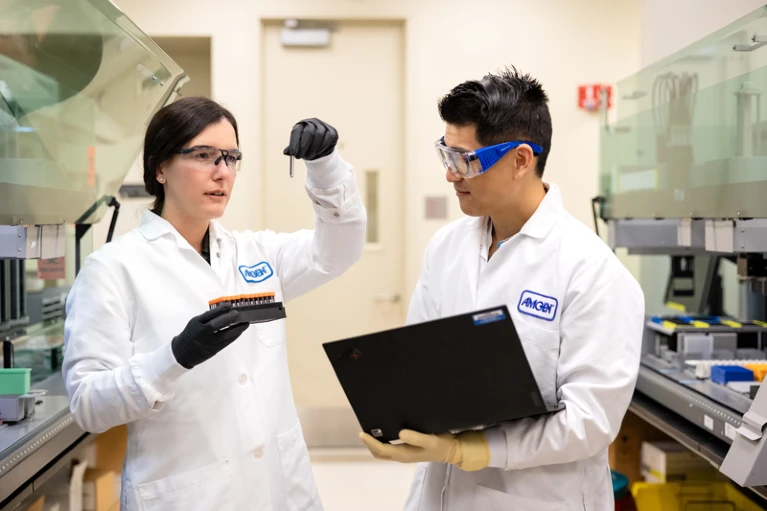
Scientists at Amgen are developing immunotherapy drugs for lung cancer.Credit: Amgen
Sevabertinib binds to the HER2 and EGFR proteins and inhibits their activity. The drug slows the growth of the tumour and stops it from forming blood vessels, which are required for it to grow and replicate2.
What sets sevabertinib apart from other drugs is its reversible bonding. When a drug binds covalently, or irreversibly, to a tumour, the proteins it targets can mutate. The mutation can alter the shape of the binding site, so that the drug can no longer reach its target, contributing to drug resistance. Sevabertinib, however, binds reversibly to the active sites. So, if the proteins mutate, it has no effect on sevabertinib’s ability to bind to the amino acids and inhibit the proteins.
Sevabertinib’s binding to EGFR also helps to reduce drug resistance. When only EGFR is inhibited, HER2 tends to be overexpressed. By blocking both targets, the drug can prevent this ‘bypass signalling’ and reduce the chances of resistance.
In a 2025 study3, 209 people with locally advanced or metastatic HER2-mutant NSCLC received sevabertinib. One cohort had received some therapy, but not HER2-targeted antibody–drug conjugates. Another group had not had any treatments. And a further cohort had previously received HER2-targeted therapy. For people who had not had previous treatment, the response rate was 71%. For those already treated with antibody–drug conjugates, it was 64%, and for those who had received HER2-targeted therapy, it was 38%.
Zongertinib, a HER2 inhibitor approved by the FDA last year for NSCLC, has shown a 75% response rate in people with lung cancer who have received previous therapy (but not an antibody–drug conjugate). That drug is irreversible, however, which could lead to resistance.
Targeted chemotherapy
The first antibody–drug conjugate used to treat NSCLC was fam-trastuzumab deruxtecan-nxki, developed by drug companies Daiichi-Sankyo and AstroZeneca and approved in 2022. This class of drugs solved the decades-long dilemma of how to deliver powerful chemotherapy directly to a tumour and avoid unnecessary harm to the rest of the body.
In 2025, Daiichi-Sankyo’s antibody–drug conjugate datopotamab deruxtecan-dlnk became the first agent targeted at TROP-2 in people with NSCLC. TROP-2 is a glycoprotein found on tumour cells that helps them to regenerate. Datopotamab was approved for people with EGFR mutations who had previously been treated with chemotherapy.
Datopotamab’s payload is unique for two reasons, says Abderrahmane Laadem, head of late-stage oncology clinical development at Daiichi-Sankyo in Princeton, New Jersey. First, the potency of the chemotherapy is ten-times greater than the drug SN-38, which is used in some antibody–drug conjugates and has been shown to inhibit SCLC cells, but is unstable and causes severe side effects. Datopotamab has a very stable linker, and so has fewer side effects, Laadem says. Second, the drug has a short half-life and is membrane permeable. This means that the chemotherapy is released into the surrounding tumour environment, killing not only targeted cells but also neighbouring, or bystander, cells in the same tumour4.
“Deruxtecan-based therapies have specifically designed payloads and linkers to allow a local bystander effect,” Laadem says. “There are other TROP2-directed antibody–drug conjugates that are also membrane permeable, but not all have this attribute.”
In one trial, people were treated with either datopotamab and the immunotherapy drug pembrolizumab, or with a combination of chemotherapy, datopotamab and pembrolizumab. Overall, the tumours of around 55% of the people taking either two or three therapies responded5. Another trial found that participants who took datopotamab had a 25% greater chance of living longer without their cancer growing than did those who had conventional chemotherapy. Overall survival, however, was the same for both medications.
Laadem says that people can be treated for longer with datopotamab than they can with conventional chemotherapy, the cumulative toxicity of which limits treatment to four to six cycles.
Combination therapy
For many thoracic oncologists, the benefit of a consistent pipeline of therapies is that they can be combined, especially during advanced stages of cancer treatment.
Conventionally, people with late-stage cancers are not typically offered surgery, Singhi says, because the cancer has already spread to other areas of the body. But when someone has responded well to systemic therapy, and has residual disease, physicians are now considering supplementing treatment with surgery or radiation directed at the main tumours. This is unlikely to cure the disease, but the surgery could help to control it for longer, Singhi says.
This is possible only because people are living longer owing to the newer treatments. These therapies can also shrink tumours, making it easier for surgery and radiation to manage small areas of residual disease in later stages.
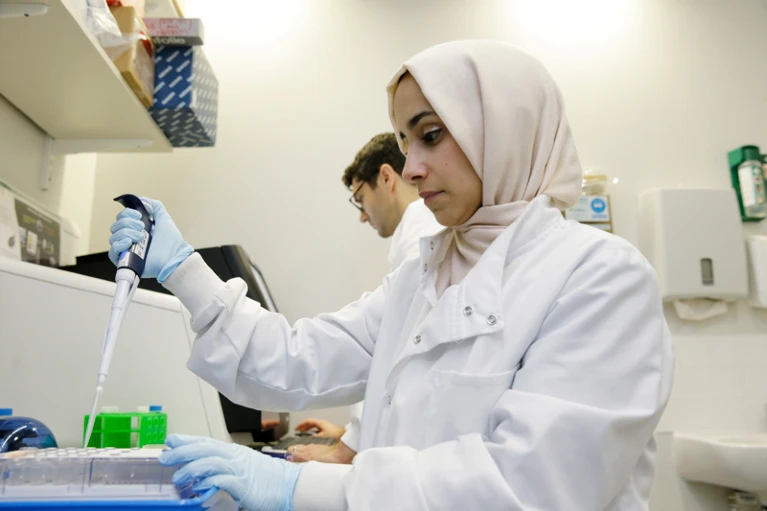
Mariam Jamal-Hanjani is helping to lead testing of a potential vaccine called LungVax.Credit: Cancer Research UK/Patrick Harrison
This is particularly true for tumours with EGFR mutations. Singhi points to a study from 2025 that investigated whether local consolidation therapy — surgery, radiation or a combination of the two — at sites of residual disease would slow tumour progression in people with later stage EGFR-mutated NSCLC6.
All of the more than 100 participants took the targeted drug osimertinib, and half were also offered one, or both, localized therapies. The period without tumour progression was eight months longer in people receiving extra therapy than in those who only took the medication — 25 months, compared with 17 months.
“It has not been the standard for stage 4, because we haven’t thought the patients would benefit from local therapies like surgery or radiation,” Singhi says. Now the drugs are keeping people alive for longer, these local interventions might be worthwhile. “If they still have some residual disease after benefiting from the drugs, does it make sense to pull in a surgeon?”
Working toward prevention
Research on a vaccine for lung cancer is in its early stages. There are just a handful of vaccines being studied for use therapeutically, typically in clinical trials with participants with late-stage disease. So far, the results have shown little benefit in small sample populations7. Mariam Jamal-Hanjani, a thoracic oncologist at the University College London Cancer Institute, has higher hopes for LungVax, a potentially preventative lung cancer vaccine.
Jamal-Hanjani is lead researcher for the phase I and II trial of LungVax, scheduled to begin this summer. Similar to other vaccines being tested, the trial will focus on treating people with stage I tumours to prevent a relapse after surgery. But it will also include some people who are at high risk of developing lung cancer. The UK National Health Service has a robust lung cancer screening programme and some people being screened will be offered the vaccine to gauge its potential as a preventative treatment.
LungVax was created by analysing public data sets to identify mutations in NSCLC that were highly predictive of red-flag proteins, or neoantigens, found on cancer cells. This sets it apart from other vaccines being tested because it is meant to target and kill these abnormal cells before they turn cancerous. (Other vaccines being tested for lung cancer focus on antigens such as HER2, MUC1 and CLDN6.) Alongside immunologists at the University of Oxford, UK, researchers targeted mutations with a viral vector similar to that used in COVID-19 vaccines but with fewer side effects.
Participants with stage 1 tumours will receive the vaccine within three months of surgery to help destroy lingering small cancer cells that scans don’t catch. Between 20% and 30% of people have relapses within three years, Jamal-Hanjani says, and LungVax could help to stop the cancer returning in these cases.
All of this work on therapies does not change the underlying fact that lung cancer kills more people than any other type of cancer worldwide. Five-year survival rates range from about 9% for SCLC to 32% for NSCLC. The effectiveness of treatments typically boils down to the months that they can add to a person’s life. Some people might get to add years. Most researchers are hesitant to even broach the idea of treatments being curative.
But progress is nevertheless encouraging. Researchers are increasingly able to find and inhibit the growth of different subtypes of cancer. Therapies are increasingly targeted to a person’s particular condition. And vaccines are on the way that might lengthen the time before relapse — and perhaps even prevent cancer from occurring in the first place.
There’s a long road ahead. A diagnosis of lung cancer might still produce a feeling of dread. But researchers, armed with more refined knowledge of this disease, are steadily building an array of treatments that might vanquish the most deadly oncological foe.

