


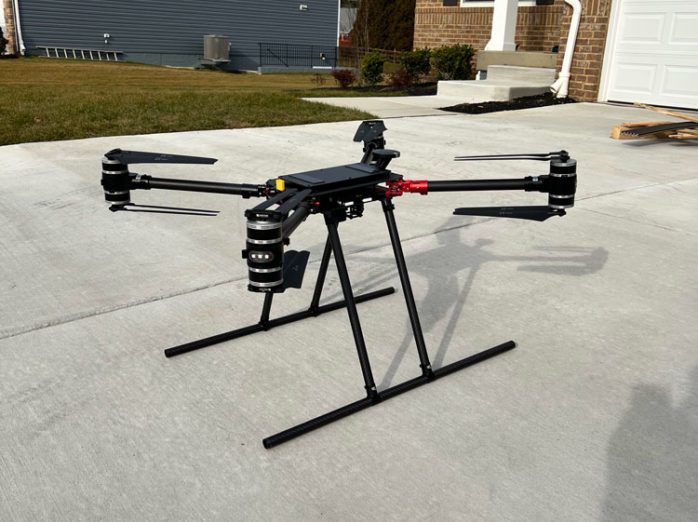
As demand accelerates, drone companies are scaling by building flexible engineering teams instead of trying to do everything in-house.
The drone industry – in the US and around the world – is entering a new phase. Government policy, national security priorities, and rising commercial demand are pushing manufacturers to move from prototype to production faster than ever before.
That challenge is changing more than supply chains. It is changing how companies build products.
Rather than developing every capability internally, many manufacturers are assembling specialized teams that can solve specific problems quickly. The result is a more flexible and agile approach to manufacturing, where software engineering, systems integration, and testing have become just as important as the airframe itself.
According to Godfrey Nolan, President of RIIS, that evolution has accelerated over the past several years.
“When we first started advertising on DRONELIFE, most of the work centered on mobile apps for DJI drones,” Nolan said. “Then the industry shifted to Drone as First Responder programs built around the DJI Dock and Cloud API. After that came PX4, ATAK plugins, drone docks, and a wave of agricultural applications based on ArduPilot. Today, we’re seeing renewed focus on PX4 and the Drone Dominance initiative.”
The projects themselves have also become far more sophisticated.
“The market has matured well beyond mobile apps,” Nolan said. “We’re now building command-and-control platforms for industries like oil pipelines and utilities, where we’re involved in the entire workflow, from data ingestion through customer reporting. And increasingly, we’re working with VTOL aircraft rather than quadcopters.”
That evolution reflects a broader shift across the industry. As manufacturers race to deliver secure, domestically developed aircraft, success increasingly depends on integrating hardware, flight software, ground control systems, communications, sensors, and operational workflows into a reliable product.
The New Bottleneck
Much of the discussion around strengthening the U.S. drone industry focuses on manufacturing capacity and replacing foreign-made components.
Those challenges are real. But Nolan argues that engineering capacity, particularly software integration, has become an equally important constraint.
“It’s not just about manufacturing or sourcing NDAA-compliant components anymore,” he said. “The bigger challenge is software and systems integration.”
Many companies assemble strong aerospace and hardware teams before discovering they lack expertise in flight stack customization, ground control software, testing infrastructure, or deployment pipelines.
Testing is another common obstacle.
“Teams that don’t invest in simulation often spend weeks discovering in flight what a software-in-the-loop or hardware-in-the-loop simulator would have identified in a matter of hours,” Nolan said.
Modern software development practices such as simulation, automated testing, and continuous integration have become essential tools for companies trying to shorten development cycles while maintaining reliability.
That discipline becomes especially important as government programs demand rapid production.
“That’s what ‘speed of relevance’ really looks like,” Nolan said. “If you’re participating in programs like Drone Dominance, you may need to deliver more than 100 production aircraft in just a few weeks. You simply can’t achieve that with a flight-test-and-pray development process.”
Scaling Without Building Everything Yourself
One lesson emerging from today’s market is that successful manufacturers are not necessarily the ones with the largest engineering organizations.
Instead, many are selectively bringing in specialized expertise where it creates the greatest advantage.
“One pattern we see repeatedly is companies trying to hire specialists from a very small talent pool before they consider bringing in outside expertise,” Nolan said.
For many startups, that approach slows development during a period when speed matters.
“One of our OEM customers put it well,” Nolan said. “Working with us allowed them to get a better product into their customers’ hands faster.”
He believes many companies are rethinking what it means to build an engineering organization.
“A drone startup doesn’t need to build a 20-person software organization to compete,” Nolan said. “It needs the right four people for the right six months.”
That flexible model mirrors a broader trend in advanced manufacturing, where specialized partners help companies accelerate development without permanently increasing headcount.
Every New Component Creates New Software Work
As manufacturers replace foreign components with NDAA-compliant alternatives, software integration becomes even more important.
“Replacing a Chinese component with an NDAA-compliant alternative isn’t simply a procurement exercise,” Nolan said. “It’s a systems integration project. Every hardware change touches software.”
In other words, domestic manufacturing is no longer simply about sourcing compliant hardware. It also requires adapting flight software, validating new systems, and ensuring the complete aircraft continues to operate reliably.
Building Systems, Not Just Aircraft
Looking ahead, Nolan expects the industry’s next wave of innovation to center on software readiness for beyond visual line of sight operations, including autonomy, detect-and-avoid integration, fleet management, onboard object detection, and resilient navigation in GPS-denied environments.
He also expects drones to become increasingly connected within larger autonomous systems.
“We’re moving toward drones that operate as nodes within larger robotic systems rather than as standalone aircraft,” Nolan said. “Technologies like PX4, ROS 2, and eventually large language models will make those systems increasingly autonomous.”
Despite rapid advances in aircraft design, Nolan believes one misconception continues to slow companies entering the market.
“Building the drone isn’t the finish line,” he said. “It’s the starting point.”
“The real challenge is turning an aircraft into a complete operational system. The airframe matters, but success depends on integrating the flight stack, payload, ground control software, telemetry, data pipeline, compliance requirements, and operator workflow into a reliable whole.”
As the U.S. drone industry moves toward higher production volumes and greater domestic capability, that perspective is becoming increasingly important. The companies most likely to succeed may not be those that try to do everything themselves, but those that combine strong hardware with agile engineering, specialized expertise, and the flexibility to adapt as technology, policy, and customer requirements continue to evolve.
Read more:

Miriam McNabb is the Editor-in-Chief of DRONELIFE and CEO of JobForDrones, a professional drone services marketplace, and a fascinated observer of the emerging drone industry and the regulatory environment for drones. Miriam has penned over 3,000 articles focused on the commercial drone space and is an international speaker and recognized figure in the industry. Miriam has a degree from the University of Chicago and over 20 years of experience in high tech sales and marketing for new technologies.
For drone industry consulting or writing, Email Miriam.
TWITTER:@spaldingbarker
Subscribe to DroneLife here.

