



Mullin says feds still ‘a little behind’ in counter-UAS prep
By DRONELIFE Features Editor Jim Magill
(Editor’s note: This story is part of a series of reports on efforts to establish new counter-UAS protocols in the U.S. to protect high-profile sporting events and critical infrastructure from the potential threats posed by drones flown by careless or hostile actors.)
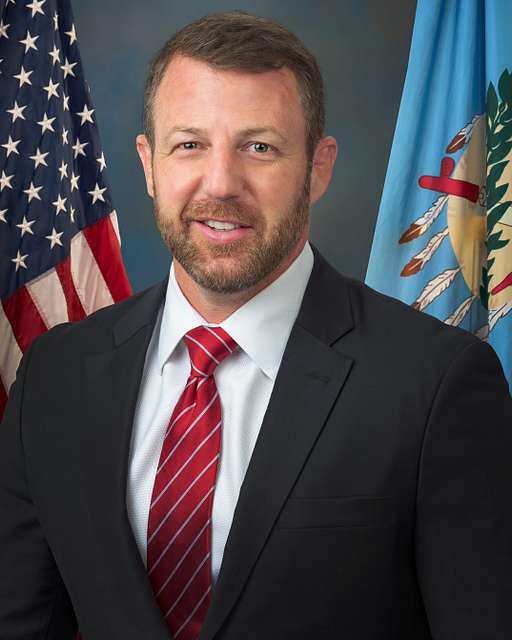 About a week before the kick-off of the first match, U.S. Secretary of Homeland Security Markwayne Mullin testified that federal security agencies and their partners still are “a little behind” in standing up counter-UAS capabilities at all planned sites in U.S. cities hosting FIFA World Cup tournament events.
“We have spent a tremendous amount of ability and money to be able to be very offensive with drones. But on the counter-drone measures everybody’s a little behind,” Mullin said June 3 at a hearing of the U.S. House Homeland Security Committee on the Department of Homeland Security’s budget request.
“Our countermeasures with drones, is — I wouldn’t say a vulnerability — but it is one of the areas that we are struggling with every single day,” he said.
Over the past year, DHS, the FBI and other federal agencies have worked for countless hours and spent millions of dollars to attempt to establish counter-UAS capabilities in the 11 American cities hosting World Cup events. In his testimony, Mullin said the potential threat of unwanted drones in the airspace over FIFA activities is his biggest security concern, as the nation prepares to host what is being billed as the largest sporting event in history.
He said DHS agencies, including Customs and Border Patrol and the U.S. Coast Guard, would oversee counter-drone operations at eight of the stadiums scheduled to host World Cup matches beginning on June 11. Meanwhile, the FBI will provide counter-UAS protection at three stadiums holding FIFA matches.
Mullin said that in recent weeks, DHS has improved its counter-drone capabilities at large-scale events. He said officials were able to successfully ground eight drones that have violated restricted airspace during the Miami Grand Prix F1 Race held last month. He said officials were able to identify and arrest the pilots of at least some of those UAVs.
“During the Augusta golf tournament, we had 12 that entered a no-fly zone. We were able to bring those down, too,” he said.
“Every single day we improve, but that is a huge concern that we have within the stadiums. I also have concerns outside the stadiums, in the FanFest area and the soft areas that’re outside security.”
Mullin said providing counter-drone protections for these so-called “soft areas” has been one of his biggest concerns as DHS works to ensure the safety of all World Cup-related site.
“When we start talking about the soft areas, having great cooperation with local law enforcement is vitally important to us,” he said. “We’ve asked for some states to help with National Guard. They could use it for a training event if they wanted to on some of these weekends.”
Mullin blamed the partial government shutdown as having had a big impact on the department’s ability to prepare counter-UAS operations in time for the start of the World Cup games. The shutdown, which took place from February 14 to April 30, resulted in the closure of most non-essential DHS operations and slowed the department’s efforts to fund counter-UAS programs.
“We had to start prioritizing when we came back alive after 76 days of being shut down,” he said. As a result of the shutdown, DHS didn’t have the employees needed for the department to be able to issue the $250 million FEMA grant money that had been earmarked for FIFA host cities and for the Washington, D.C. region, where many America250 events are slated to take place.
He said that as a result of the slowdown in funding, DHS has had to delay its longer-term plans to stand up the counter-UAS operations it plans to put in place in time for the 2028 Olympics to be held in Las Angeles.
“We’re not totally caught up, but we’re close to being caught up. And as soon as FIFA’s over, July 19, we will be able to start focusing on the Olympics again,” he said.
Role played by National Counter UAS Training Center
Mullin praised the role the FBI’s National Counter UAS Training Center at Redstone Arsenal in Huntsville; Alabama is playing in the development of DHS’s broader counter-drone strategy. The NCUTC has trained 60 state and local law enforcement officers from all over the country and qualified them in the use of drone-mitigation technology.
“Quite frankly, we’re going to be bringing people from all over the world, to be able to train in this facility,” Mullin stated.
Representative Michael McCaul, a senior member and former chairman of the Homeland Security Committee, questioned Mullin as to whether DHS was prepared to deal with potential drone threats from terrorist organizations or rogue state actors.
“My biggest concern are the drone threats as we’ve seen from Iranian Shahed drones,” the Texas Republican said. He added that he feared that the type of drone warfare seen in Ukraine and Russia could be duplicated with a similar attack on U.S soil.
Mullin said that such attacks were a major concern of his as well, and that federal security and intelligence agencies are working tirelessly to forestall such a scenario. But he also said he was worried about the potential harm that could be inflicted by a single misguided drone operator.
“The lone individual that’s got this crazy mindset about him — maybe it’s because of too much alcohol, maybe it’s because of the temperature, maybe it’s because his team lost, maybe because he’s too excited — whatever it is, those areas do concern me,” he said. “But we have a lot of partnerships with our local law enforcement that are going to be out there in those areas to make them as hardened as they can be and to take the soft look away.”
Read more:
 Jim Magill is a Houston-based writer with almost a quarter-century of experience covering technical and economic developments in the oil and gas industry. After retiring in December 2019 as a senior editor with S&P Global Platts, Jim began writing about emerging technologies, such as artificial intelligence, robots and drones, and the ways in which they’re contributing to our society. In addition to DroneLife, Jim is a contributor to Forbes.com and his work has appeared in the Houston Chronicle, U.S. News & World Report, and Unmanned Systems, a publication of the Association for Unmanned Vehicle Systems International.

