


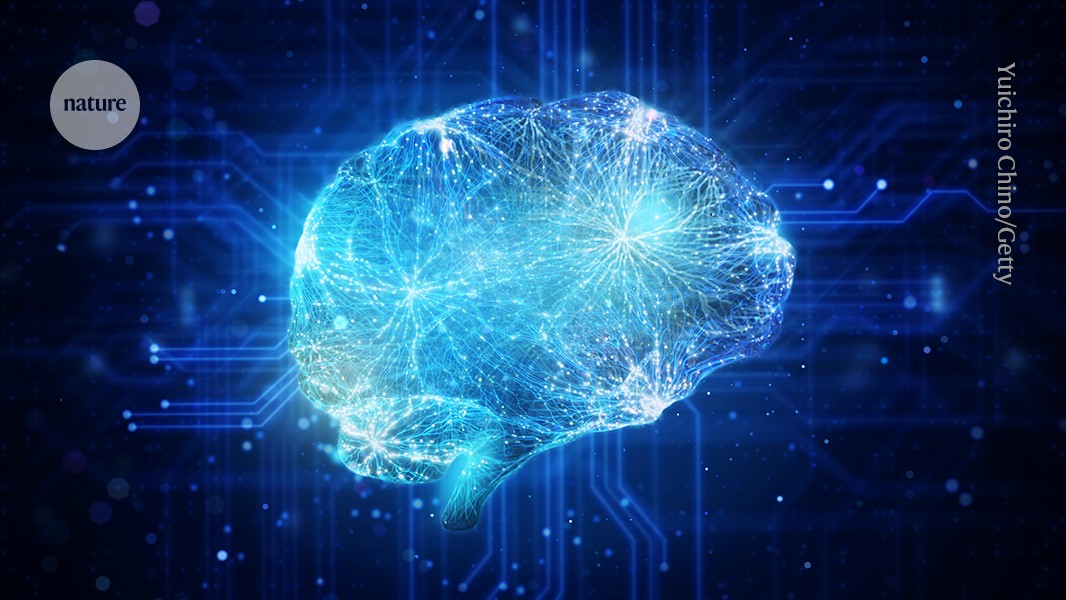

Researchers are studying whether artificial intelligence systems can become conscious.Credit: Yuichiro Chino/Getty
As artificial-intelligence systems become more and more sophisticated, the question of whether they might become conscious is capturing the public’s attention — and is sending tech firms to hire philosophers. The problem is, researchers still haven’t agreed on what gives rise to consciousness in humans, let alone an AI chatbot.
If AI becomes conscious: here’s how researchers will know
So some scientists who study human consciousness — the subjective state of being aware of yourself and your surroundings — worry that all the hype will make it harder to find answers. “What we might see is a sort of capture of consciousness research by the AI sector, where less emphasis is placed on the neuroscience and philosophy of how consciousness happens in real brains, and more on looking for computational ‘signatures’ of consciousness in AI,” says Anil Seth, a consciousness scientist at the University of Sussex near Brighton, UK. Seth and others think that consciousness is very unlikely outside of biological organisms and are frustrated by the focus on AI. Some are suspicious of AI firms’ hype, and think that there should be more investigation of how the humanization of chatbots could affect people negatively.
But there are researchers who think that tech firms’ obsession with consciousness is a boon for a field that was not taken seriously as a scientific endeavour for years. They see the hype as bringing more interest and, importantly, more funding.
Running into problems
Earlier this month, it became clear that determining whether an AI system is sentient will be extremely challenging without knowing more about human consciousness. Researchers at AI firm Anthropic, in San Francisco, California, posted a non-peer-reviewed study suggesting that they had found something in the company’s large language model (LLM) Claude that is comparable to conscious thoughts in humans.
Consciousness theory slammed as ‘pseudoscience’ — sparking uproar
By measuring patterns in Claude’s processing, they uncovered words that Claude ‘thought’ about as it worked through a request but did not necessarily include in its output. The authors compare this internal activity with the brain’s ‘global workspace’, a concept borrowed from one of the most popular theories of human consciousness. The global workspace theory (GWT) posits that information enters human consciousness when it is broadcast across the brain, in a type of processing hub for the mind.
The researchers don’t claim that their finding means Claude is capable of subjective experience. But critics were quick to point out that consciousness researchers don’t all agree on the existence of a global workspace in humans. The GWT also doesn’t formally define global workspace, which makes it hard to identify the phenomenon in entities such as chatbots, wrote Tim Bayne, a philosopher at Monash University in Melbourne, Australia, in an article about the Anthropic work for The Conversation.
Some in the field, including Erik Hoel, a consciousness researcher and lead scientist at non-profit research organization Bicameral Labs, in Boston, Massachusetts, say that running into such roadblocks can be a good thing for science. “Let’s use the problems in AI consciousness research to figure out what’s wrong with the stuff in [human] consciousness research and fix it,” Hoel wrote in a blogpost on 13 July.

