


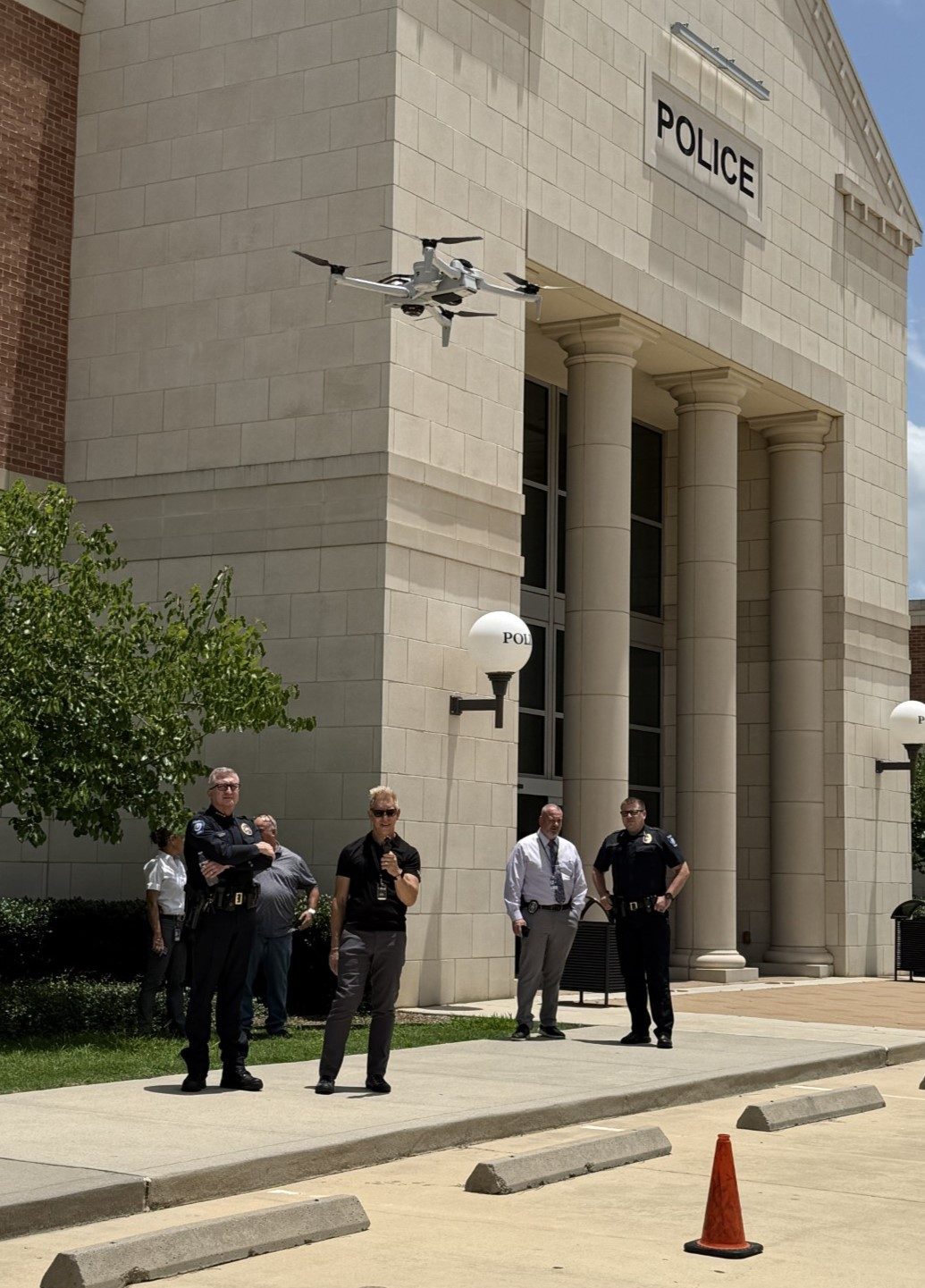
City’s DFR program financed by asset forfeiture funds
By DRONELIFE Features Editor Jim Magill
Images: Jim Magill
When the city of Conroe, Texas was considering establishing a Drones as First Responders (DFR) program, cost was a major issue. The city’s leaders solved that problem by arranging to have the bad guys pay for the program.
In a recent press conference announcing the launch of the department’s DFR program, Conroe Police Chief Jon Buckholtz said that last December the Conroe City Council authorized the department to purchase two Skydio X10 drones and two Skydio docking stations using money generated by the seizure of assets in criminal cases.
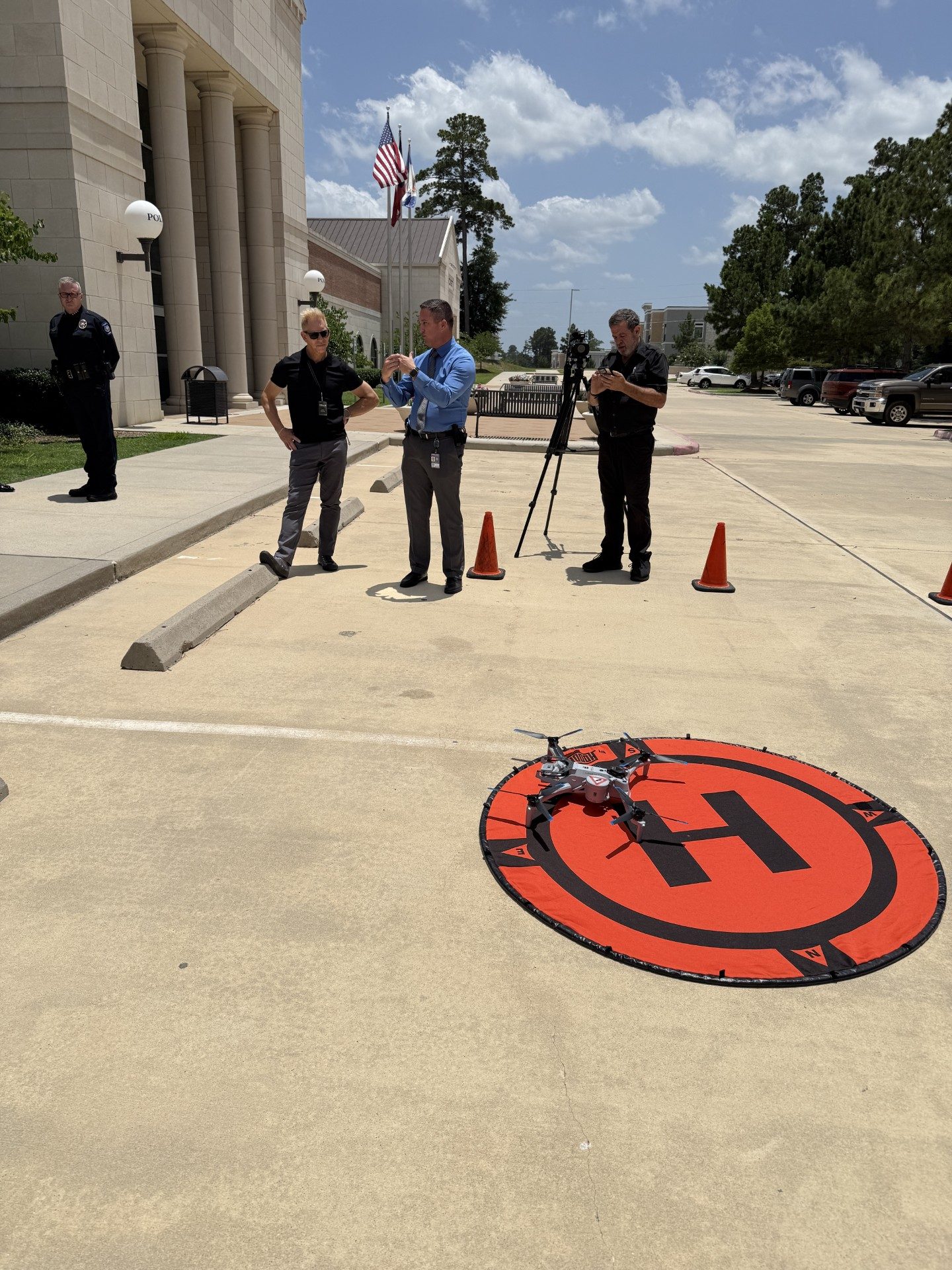
“In other words, we purchased this with money that was seized from criminals, in order to fight criminals,” he said. Plans call for the department to operate the initial program under a one-year trial, after which the program could be expanded to include more drones and docks in order allow the police to be able to cover a larger portion of the city.
Under the initial program, the two drone docks will be sited on the roof of City Hall in the center of town. From there, the drones can be dispatched to arrive at a scene in the most heavily trafficked sectors of the city within minutes, usually before officers in patrol cars can arrive.
Chief Pilot Nathan Crenshaw said that once a drone is dispatched it can arrive on site in those sectors of the city where most crimes or accidents take place within two minutes, giving responding officers an eye in the sky and allowing them to assess the situation and adjust their response to it before their own arrival on the scene.
Currently, the department’s average response time for high-priority calls is four minutes and 21 seconds. “Drones can fly safely to accidents directly, avoiding traffic delays and arriving ahead of officers with flight times expected to be significantly quicker, Chief Buckholtz said.
The UAVs are equipped with a camera array featuring thermal cameras and digital optical-zoom cameras capable of reading the license plate of a car from 800 feet away, he said.
“This technology enhances situational awareness, supports safer decision-making, and enables more efficient use of police resources,” Chief Buckholtz said. “We can send a link to the officers on the street. They can actually see what the drone sees before they’re actually on scene.”
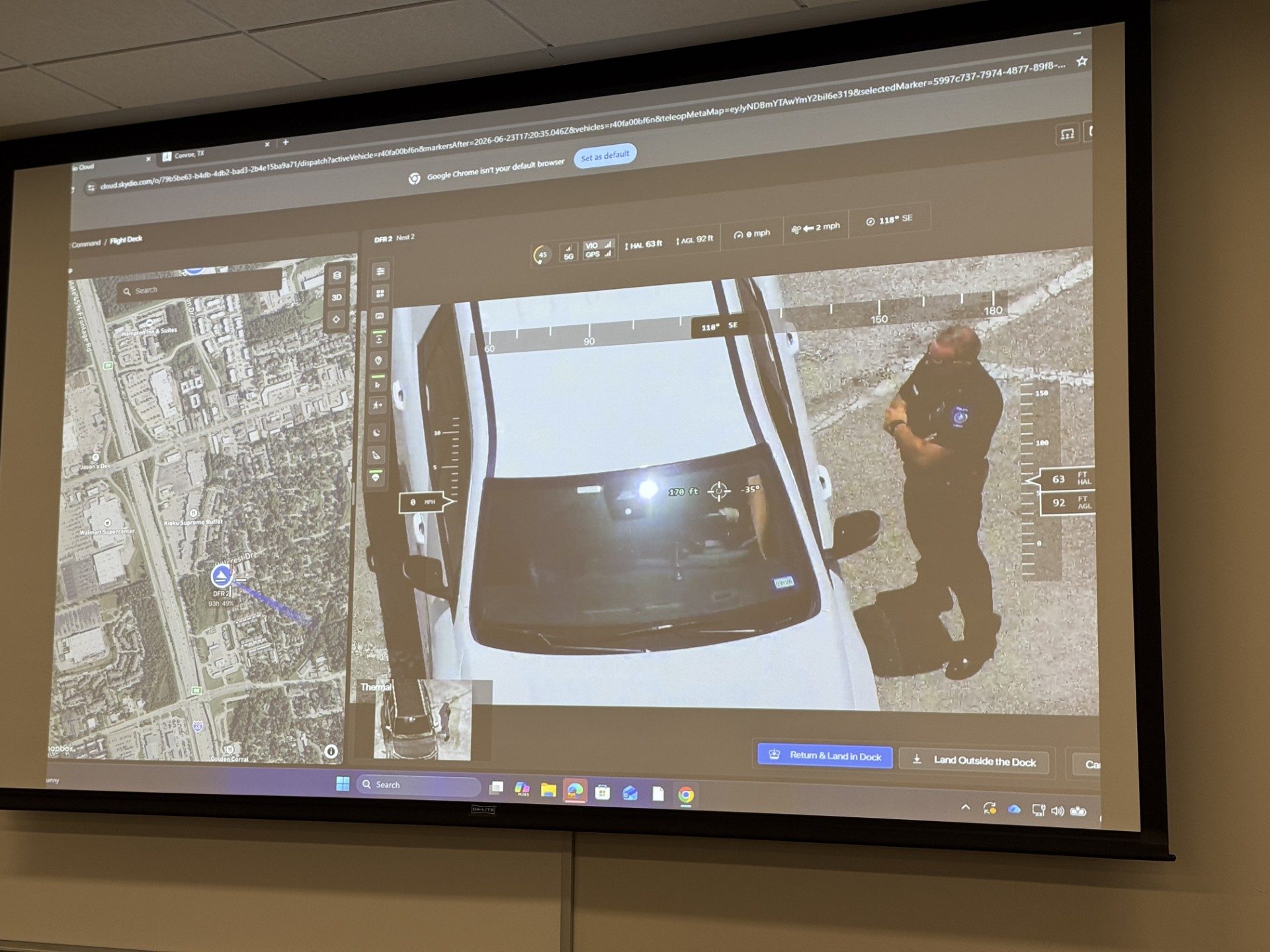
The city’s new DFR program is expected to result in improved crime response, assisting officers in locating suspects involved in criminal activity, and in tracking suspects attempting to flee the scene of a crime. The department also hopes to use the new system to aid in search and rescue operations, Buckholtz said.
“This is a really important part for us. We have situations where we have lost children, we have silver alerts, we have people that are have wandered away for various reasons. This tool is going to allow us to have a different response to that rather than to just be on the ground searching,” he said.
Under the DFR program, trained dispatchers will decide whether an incoming call for service merits dispatching a UAV.
“Efficient call handling allows officers to assess certain calls, such as suspicious activity or hazards, remotely, potentially resolving them without even dispatching an officer,” he said. In its study of other police agencies with existing DFR programs, Conroe officials found that in a high percentage of calls in which a drone was dispatched, the call was successfully resolved without having to send officers to the scene.
Program to adhere to all existing laws and standards
Buckholtz said the department will run its DFR program using certified pilots operating in full compliance with all applicable laws and regulations. The Conroe PD currently has 13 FAA-certified Part 107 pilots trained to operate the UAVs.
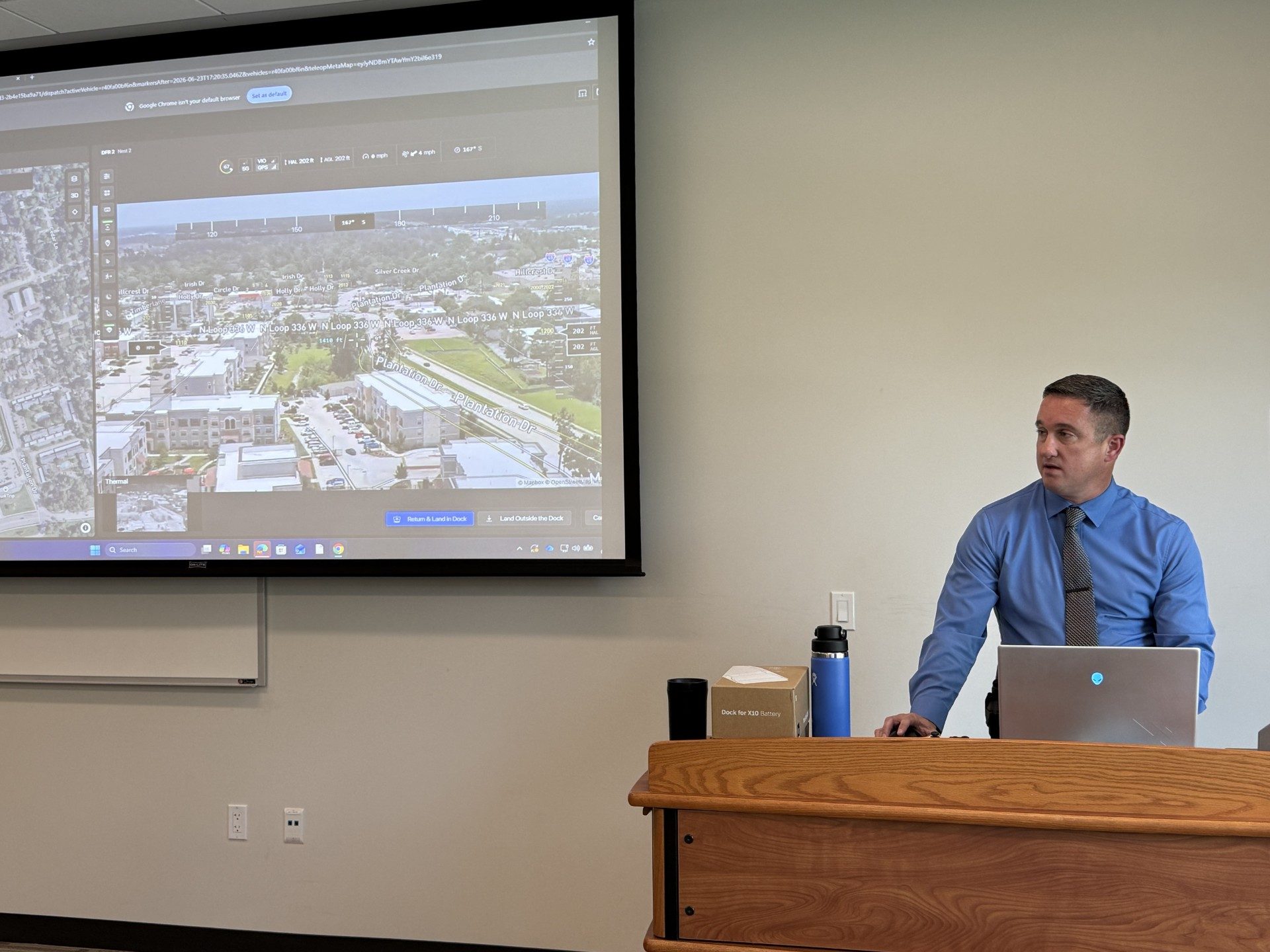
“The department is committed to maintaining transparency, while safeguarding the community’s privacy and civil liberties. There will be a link on the Conroe Police Department webpage that describes the DFR program, provides access to transparency portal, and it shows recent drone flight paths,” he said.
In addition to its use by the police department, officials expect that the DFR program will be used to aid area firefighters.
“With our thermal technology, we’ll be able to assist the fire department with their own link so that they can see what they’re getting into. They can see the source of the heat in a building,” Buckholtz said. “We anticipate this being useful to more than just the police department.”
Once the dispatcher receives a call, the call location pops up on a screen and the drone is sent to that site. Crenshaw said the system is designed to allow the drones to fly autonomously at about 45 mph to the site of an emergency call.
While in flight, the drone’s camera is focused on the horizon to avoid collecting images of the homes and people on the ground that it flies over.
In a recent demonstration, a drone flew from its base at City Hall in downtown Conroe to the Conroe PD headquarters, a distance of about 2.7 miles, in about three minutes. “Normally it takes about nine to 10 minutes to drive here,” Crenshaw said.
He added that the Skydio X10 vehicles are equipped with parachutes for safety purposes. “So, if it recognizes a rapid descent, or if something goes wrong, it will deploy the parachute,” he said.
Buckholz said the DFR program is focused on enhancing the safety of citizens and in reducing crime. “You’re going to have to be a really quick bad guy, to get away with a crime when we have this operational,” he said.
Read more:

Jim Magill is a Houston-based writer with almost a quarter-century of experience covering technical and economic developments in the oil and gas industry. After retiring in December 2019 as a senior editor with S&P Global Platts, Jim began writing about emerging technologies, such as artificial intelligence, robots and drones, and the ways in which they’re contributing to our society. In addition to DroneLife, Jim is a contributor to Forbes.com and his work has appeared in the Houston Chronicle, U.S. News & World Report, and Unmanned Systems, a publication of the Association for Unmanned Vehicle Systems International

