


Quetelet, A. Research on the Propensity for Crime at Different Ages (Anderson, 1831).
Dent, B. D. in Atlas of Crime: Mapping the Criminal Landscape (eds Turnbull, L. S. et al.) 4–21 (Oryz, 2000).
Sherman, L. W., Gartin, P. R. & Buerger, M. E. Hot spots of predatory crime: routine activities and the criminology of place. Criminology 27, 27–56 (1989).
Johnson, S. D. A brief history of the analysis of crime concentration. Eur. J. Appl. Math. 21, 349–370 (2010).
Weisburd, D. The law of crime concentration and the criminology of place. Criminology 53, 133–157 (2015).This seminal paper presents evidence for the law of crime concentration.
Braga, A. A. & Clarke, R. V. Explaining high-risk concentrations of crime in the city: social disorganization, crime opportunities, and important next steps. J. Res. Crime Delinq. 51, 480–498 (2014).
Morenoff, J. D., Sampson, R. J. & Raudenbush, S. W. Neighborhood inequality, collective efficacy, and the spatial dynamics of urban violence. Criminology 39, 517–558 (2001).
Peterson, R. D. & Krivo, L. J. Divergent Social Worlds: Neighborhood Crime and the Racial-Spatial Divide (Russell Sage Foundation, 2010).
Sampson, R. J. Great American City: Chicago and the Enduring Neighborhood Effect (Univ. Chicago Press, 2013).This influential book focuses on the roles of communities and neighbourhoods in a variety of social phenomena, including crime.
Zimring, F. E. The City That Became Safe: New York’s Lessons for Urban Crime and Its Control (Oxford Univ. Press, 2013).
Sharkey, P. Uneasy Peace: The Great Crime Decline, the Renewal of City Life, and the next War on Violence (WW Norton & Company, 2018). This book presents the effects of generalized reductions in violence in US cities.
Department of Economic and Social Affairs, Population Division. World Urbanization Prospects: The 2018 Revision (ST/ESA/SER.A/420) (United Nations, 2018)
Glaeser, E. L. & Sacerdote, B. Why is there more crime in cities? J. Polit. Econ. 107, S225–S258 (1999). This article investigated the mechanisms behind higher crime rates in urban areas compared to small cities or rural contexts.
Kneebone, E. & Steven, R. City and suburban crime trends in metropolitan America. Brookings Institution https://www.brookings.edu/articles/city-and-suburban-crime-trends-in-metropolitan-america/ (2011).
USAFacts Team. Where are crime victimization rates higher: urban or rural areas? USAFacts https://usafacts.org/articles/where-are-crime-victimization-rates-higher-urban-rural-areas/ (2023).
Smith, G. J. D., Bennett Moses, L. & Chan, J. The challenges of doing criminology in the big data era: towards a digital and data-driven approach. Br. J. Criminol. 57, 259–274 (2017).
Campedelli, G. M. Machine Learning for Criminology and Crime Research: At the Crossroads (Routledge, 2022). This book reviews the history of the dialogue between AI and crime research, with reflections on future directions.
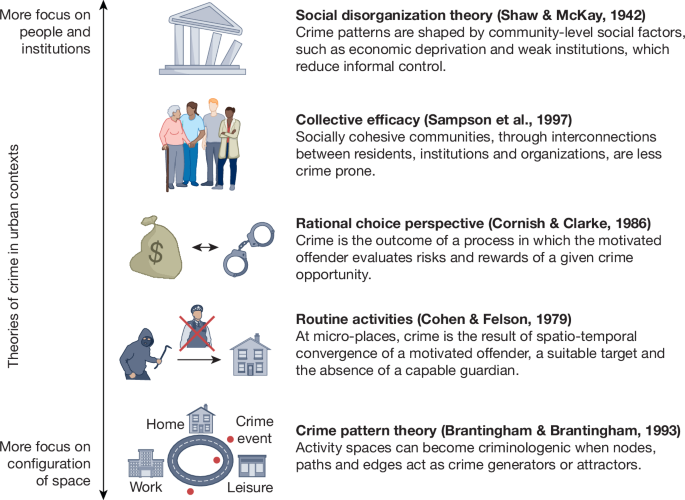
Shaw, C. R. & McKay, H. D. Juvenile Delinquency and Urban Areas: A Study of Rates of Delinquents in Relation to Differential Characteristics of Local Communities in American Cities (Univ. Chicago Press, 1942).
Park, R. E. & Burgess, E. W. The City (Univ. Chicago Press, 2019).
Kawachi, I., Kennedy, B. P. & Wilkinson, R. G. Crime: social disorganization and relative deprivation. Soc. Sci. Med. 48, 719–731 (1999).
Kubrin, C. E. & Weitzer, R. New directions in social disorganization theory. J. Res. Crime Delinq. 40, 374–402 (2003).
Andresen, M. A. Environmental Criminology: Evolution, Theory, and Practice (Routledge, 2023). This book provides an in-depth overview of the various theories that emerged in environmental criminology.
Sampson, R. J., Raudenbush, S. W. & Earls, F. Neighborhoods and violent crime: a multilevel study of collective efficacy. Science 277, 918–924 (1997). This article introduced the collective efficacy paradigm.
Sampson, R. J. in Taking Stock: The Status of Criminological Theory (eds Cullen, F. T. et al.) Ch. 5 (Routledge, 2008).
Sharkey, P., Torrats-Espinosa, G. & Takyar, D. Community and the crime decline: the causal effect of local nonprofits on violent crime. Am. Sociol. Rev. 82, 1214–1240 (2017).
Bursik, R. J. & Grasmick, H. G. Neighborhoods and Crime: the Dimensions of Effective Community Control (Bloomsbury, 2002).
Vargas, R. Gangstering grants: bringing power to collective efficacy theory. City Community 18, 369–391 (2019).
Weisburd, D., Zastrow, T., Kuen, K. & Andresen, M. A. Crime concentrations at micro places: a review of the evidence. Aggress. Violent Behav. 78, 101979 (2024).
Cohen, L. E. & Felson, M. Social change and crime rate trends: a routine activity approach. Am. Sociol. Rev. 44, 588–608 (1979). This seminal paper introduced the routine activity approach.
Lemieux, A. M. & Felson, M. Risk of violent crime victimization during major daily activities. Violence Vict. 27, 635–655 (2012).
Felson, M. & Boivin, R. Daily crime flows within a city. Crime Sci. 4, 31 (2015).
Cornish, D. B. & Clarke, R. V. eds. The Reasoning Criminal: Rational Choice Perspectives on Offending (Springer, 1986). This influential volume presented the rational choice approach, one of the fundamental approaches in environmental criminology.
Clarke, R. V. & Felson, M. in The Origins of American Criminology (Cullen, F. T. et al.) Ch. 11 (Routledge, 2011). This chapter discusses the origins of routine activity approach, one of the core approaches in environmental criminology.
Brantingham, P. L. & Brantingham, P. J. Nodes, paths and edges: considerations on the complexity of crime and the physical environment. J. Environ. Psychol. 13, 3–28 (1993). This influential paper introduced crime pattern theory, one of the fundamental theories in environmental criminology.
Andresen, M. A. in Classics in Environmental Criminology (eds Andresen, M. A. et al.) Ch. 1 (Routledge, 2010).
Muhammad, K. G. The Condemnation of Blackness: Race, Crime, and the Making of Modern Urban America (Harvard Univ. Press, 2019).
Drake, S. C. & Cayton, H. R. Black Metropolis: A Study of Negro Life in a Northern City (Harcourt, Brace & Co., 1945).
Massey, D. S. & Denton, N. A. American Apartheid: Segregation and the Making of the Underclass (Harvard Univ. Press, 2003).
Sampson, R. J. & Wilson, W. J. Toward a Theory of Race, Crime, and Urban Inequality. in Crime and Inequality (eds Hagan, J. & Peterson, R. D.) 37–56 (Stanford Univ. Press, 1995).
Messner, S. F. When West meets East: generalizing theory and expanding the conceptual toolkit of criminology. Asian J. Criminol. 10, 117–129 (2015).
Agozino, B. Counter-Colonial Criminology: A Critique of Imperialist Reason (Pluto, 2003).
Carrington, K., Hogg, R. & Sozzo, M. Southern Criminology. Br. J. Criminol. 56, 1–20 (2016).
Cunneen, C. & Tauri, J. Indigenous Criminology (Policy, 2016).
Zhang, L., Messner, S. F. & Liu, J. A multilevel analysis of the risk of household burglary in the city of Tianjin, China. Br. J. Criminol. 47, 918–937 (2007).
Zhang, L., Messner, S. F. & Zhang, S. Neighborhood social control and perceptions of crime and disorder in contemporary urban China. Criminology 55, 631–663 (2017).
Liu, J. The Asian criminological paradigm and how it links global north and south: combining an extended conceptual toolbox from the north with innovative Asian contexts. Int. J. Crime Justice Soc. Democr. 6, 73–87 (2017).
Lynch, J. Not even our own facts: criminology in the era of big data. Criminology 56, 437–454 (2018).
Solymosi, R. & Bowers, K. in The Oxford Handbook of Environmental Criminology (eds Bruinsma, J. N. & Johnson, S. D.) Ch. 11 (Oxford Univ. Press, 2018).
Tayebi, M. A., Glasser, U. & Andresen, M. in Big Data (eds Leclerc, B. & Cale, J.) Ch. 4 (Routledge, 2020).
Browning, C. R., Pinchak, N. P. & Calder, C. A. Human mobility and crime: theoretical approaches and novel data collection strategies. Annu. Rev. Criminol. 4, 99–123 (2021). This article discusses how novel data can contribute to the understanding of people’s mobility in criminology.
Snaphaan, T. & Hardyns, W. Environmental criminology in the big data era. Eur. J. Criminol. 18, 713–734 (2021).
Skogan, W. Reporting crimes to the police: the status of world research. J. Res. Crime Delinq. 21, 113–137 (1984).
MacDonald, Z. Revisiting the dark figure: a microeconometric analysis of the under-reporting of property crime and its implications. Br. J. Criminol. 41, 127–149 (2001).
O’Brien, D. T. The Pointillistic City: How Microspatial Inequities Affect Well-Being in Our Communities, and What We Can Do about It (MIT Press, 2025).
Warner, B. D. Community characteristics and the recording of crime: police recording of citizens’ complaints of burglary and assault. Justice Q. 14, 631–650 (1997).
Richardson, R., Schultz, J. & Crawford, K. Dirty data, bad predictions: how civil rights violations impact police data, predictive policing systems, and justice. NYUL Rev. Online 94, 15 https://ssrn.com/abstract=3333423 (2019).
Lazer, D., Kennedy, R., King, G. & Vespignani, A. The parable of Google flu: traps in big data analysis. Science 343, 1203–1205 (2014).
Recchi, E. & Tittel, K. in Handbook of Computational Social Science for Policy (eds Bertoni, E. et al.) 437–464 (Springer, 2023).
Kaplan, R. M., Chambers, D. A. & Glasgow, R. E. Big data and large sample size: a cautionary note on the potential for bias. Clin. Transl. Sci. 7, 342–346 (2014).
Hargittai, E. Is bigger always better? potential biases of big data derived from social network sites. Ann. Am. Acad. Pol. Soc. Sci. 659, 63–76 (2015).
Li, Z., Ning, H., Jing, F. & Lessani, M. N. Understanding the bias of mobile location data across spatial scales and over time: a comprehensive analysis of SafeGraph data in the United States. PLoS ONE 19, e0294430 (2024).
Luca, M., Campedelli, G. M., Centellegher, S., Tizzoni, M. & Lepri, B. Crime, inequality and public health: a survey of emerging trends in urban data science. Front. Big Data 6, 1124526 (2023).
Brazil, N. Environmental inequality in the neighborhood networks of urban mobility in US cities. Proc. Natl Acad. Sci. USA 119, e2117776119 (2022).
Athey, S., Ferguson, B., Gentzkow, M. & Schmidt, T. Estimating experienced racial segregation in US cities using large-scale GPS data. Proc. Natl Acad. Sci. USA 118, e2026160118 (2021).
Nilforoshan, H. et al. Human mobility networks reveal increased segregation in large cities. Nature 624, 586–592 (2023).
Chang, S. et al. Mobility network models of COVID-19 explain inequities and inform reopening. Nature 589, 82–87 (2021).
Bogomolov, A. et al. Once upon a crime: towards crime prediction from demographics and mobile data. In Proc. 16th International Conference on Multimodal Interaction https://doi.org/10.1145/2663204.2663254 (ACM, 2014).
Traunmueller, M., Quattrone, G. & Capra, L. Mining mobile phone data to investigate urban crime theories at scale. In Social Informatics (eds Aiello, L. M. & McFarland, D.) 396–411 (Springer, 2014).
De Nadai, M., Xu, Y., Letouzé, E., González, M. C. & Lepri, B. Socio-economic, built environment, and mobility conditions associated with crime: a study of multiple cities. Sci. Rep. 10, 13871 (2020).
Lazer, D. et al. Computational social science. Science 323, 721–723 (2009).
Kadar, C. & Pletikosa, I. Mining large-scale human mobility data for long-term crime prediction. EPJ Data Sci. 7, 7 (2018).
Hipp, J. R., Christopher, B., Moshe, L. & Smyth, P. Using social media to measure temporal ambient population: does it help explain local crime rates? Justice Q. 36, 718–748 (2019).
Tucker, R. et al. Who ‘tweets’ where and when, and how does it help understand crime rates at places? Measuring the presence of tourists and commuters in ambient populations. J. Quant. Criminol. 37, 333–359 (2021).
Wo, J. C., Rogers, E. M., Berg, M. T. & Koylu, C. Recreating human mobility patterns through the lens of social media: using Twitter to model the social ecology of crime. Crime Delinq. 70, 1943–1970 (2024).
Freelon, D. Computational research in the post-API age. Polit. Commun. 35, 665–668 (2018).
Tromble, R. Where have all the data gone? A critical reflection on academic digital research in the post-API age. Soc. Media Soc. 7, 2056305121988929 (2021).
Wu, Q., Williams, L. K., Simpson, E. & Semaan, B. Conversations about crime: re-enforcing and fighting against platformed racism on Reddit. Proc. ACM Hum. Comput. Inter. 6, 54 (2022).
Raento, M., Oulasvirta, A. & Eagle, N. Smartphones: an emerging tool for social scientists. Sociol. Methods Res. 37, 426–454 (2009).
Edelmann, A., Wolff, T., Montagne, D. & Bail, C. A. Computational social science and sociology. Annu. Rev. Sociol. 46, 61–81 (2020).
Wang, H., Kifer, D., Graif, C. & Li, Z. Crime rate inference with big data. In Proc. 22nd ACM SIGKDD International Conference on Knowledge Discovery and Data Mining 635–644 (ACM, 2016).
Huang, C., Zhang, J., Zheng, Y. & Chawla, N. V. in Proc. 27th ACM International Conference on Information and Knowledge Management 1423–1432 (ACM, 2018).
Zhao, X. & Tang, J. Modeling temporal-spatial correlations for crime prediction. In Proc. 2017 ACM Conference on Information and Knowledge Management 497–506 (ACM, 2017).
Albors Zumel, A., Tizzoni, M. & Campedelli, G. M. Deep learning for crime forecasting: the role of mobility at fine-grained spatiotemporal scales. J. Quant. Criminol. https://doi.org/10.1007/s10940-025-09629-3 (2025).
Massenkoff, M. & Chalfin, A. Activity-adjusted crime rates show that public safety worsened in 2020. Proc. Natl Acad. Sci. USA 119, e2208598119 (2022).
Liu, L., Zhou, H. & Lan, M. Agglomerative effects of crime attractors and generators on street robbery? An assessment by Luojia 1-01 satellite nightlight. Ann. Am. Assoc. Geogr. 112, 350–367 (2022).
Zheng, Y., Capra, L., Wolfson, O. & Yang, H. Urban computing: concepts, methodologies, and applications. ACM Trans. Intell. Syst. Technol. 5, 38 (2014).
Diao, M., Kong, H. & Zhao, J. Impacts of transportation network companies on urban mobility. Nat. Sustain. 4, 494–500 (2021).
Ceccato, V. & Uittenbogaard, A. C. Space–time dynamics of crime in transport nodes. Ann. Assoc. Am. Geogr. 104, 131–150 (2014).
Wuschke, K., Andresen, M. A. & Brantingham, P. L. Pathways of crime: measuring crime concentration along urban roadways. Can. Geogr. 65, 267–280 (2021).
Hanson, S. & Hanson, P. The travel-activity patterns of urban residents: dimensions and relationships to sociodemographic characteristics. Econ. Geogr. 57, 332–347 (1981).
Wang, H., Yao, H., Kifer, D., Graif, C. & Li, Z. Non-stationary model for crime rate inference using modern urban data. IEEE Trans. Big Data 5, 180–194 (2019).
Rosés, R., Kadar, C., Gerritsen, C. & Rouly, O. C. Simulating offender mobility: modeling activity nodes from large-scale human activity data. J. Artif. Intell. Res. 68, 541–570 (2020).
Zhang, X., Xu, Y., Tu, W. & Ratti, C. Do different datasets tell the same story about urban mobility — a comparative study of public transit and taxi usage. J. Transp. Geogr. 70, 78–90 (2018).
Wang, Y. et al. Exploring biases in travel behavior patterns in big passively generated mobile data from 11 U.S. cities. J. Transp. Geogr. 123, 104108 (2025).
Jean, N. et al. Combining satellite imagery and machine learning to predict poverty. Science 353, 790–794 (2016).
Yeh, C. et al. Using publicly available satellite imagery and deep learning to understand economic well-being in Africa. Nat. Commun. 11, 2583 (2020).
Mueller, H., Groeger, A., Hersh, J., Matranga, A. & Serrat, J. Monitoring war destruction from space using machine learning. Proc. Natl Acad. Sci. USA 118, e2025400118 (2021).
Najjar, A., Kaneko, S. & Miyanaga, Y. Crime mapping from satellite imagery via deep learning. Preprint at https://doi.org/10.48550/arXiv.1812.06764 (2018).
Xu, C. et al. Are villages in the city and segregation associated with crime in Chinese cities? An assessment of burglary in ZG city using satellite images and big data. Cities 149, 104979 (2024).
He, Q. et al. Greener the safer? Effects of urban green space on community safety and perception of safety using satellite and street view imagery data. J. Crim. Justice 97, 102372 (2025).
Ceccato, V. & Ioannidis, I. Using remote sensing data in urban crime analysis: a systematic review of English-language literature from 2003 to 2023. Int. Crim. Justice Rev. https://doi.org/10.1177/10575677241237960 (2024).
Sreenu, G. & Saleem Durai, M. A. Intelligent video surveillance: a review through deep learning techniques for crowd analysis. J. Big Data 6, 48 (2019).
Piza, E. L., Connealy, N. T., Sytsma, V. A. & Chillar, V. F. Situational factors and police use of force across micro-time intervals: A video systematic social observation and panel regression analysis. Criminology 61, 74–102 (2023).
Hipp, J. R., Lee, S., Ki, D. & Kim, J. H. Measuring the built environment with Google Street View and machine learning: consequences for crime on street segments. J. Quant. Criminol. 38, 537–565 (2022).
He, Z. et al. Measuring the causal effect of urban environments on crime with street view images and points of interest. Cities 168, 106399 (2026).
Scott, J. C. Seeing Like a State: How Certain Schemes to Improve the Human Condition Have Failed (Yale Univ. Press, 2020).
Brayne, S. Big data surveillance: the case of policing. Am. Sociol. Rev. https://doi.org/10.1177/0003122417725865 (2017).
Ward, T. W. Gangsters Without Borders: An Ethnography of a Salvadoran Street Gang (Oxford Univ. Press, 2013).
Buettner, E. What – and who – is ‘European’ in the Postcolonial eu? BMGN Low Ctries. Hist. Rev. 133–134, 132–148 (2018).
Jerven, M. Poor Numbers (Cornell Univ. Press, 2013).
Wang, C. et al. HAGEN: homophily-aware graph convolutional recurrent network for crime forecasting. In Proc. AAAI Conference on Artificial Intelligence 36, 4193–4200 (AAAI, 2022).
Xia, L. et al. Spatial-temporal sequential hypergraph network for crime prediction with dynamic multiplex relation learning. In Proc. 30th International Joint Conference on Artificial Intelligence https://doi.org/10.24963/ijcai.2021/225 (Curran Associates, 2021).
Birks, D. & Davies, T. Street network structure and crime risk: an agent-based investigation of the encounter and enclosure hypotheses. Criminology 55, 900–937 (2017).
Hipp, J. R. & Williams, S. A. Advances in spatial criminology: the spatial scale of crime. Annu. Rev. Criminol. 3, 75–95 (2020). This review presents and discusses recent advances in spatial methods for studying criminal phenomena.
Butts, K. Difference-in-differences estimation with spatial spillovers. Preprint at https://doi.org/10.48550/arXiv.2105.03737 (2023).
Barabási, A.-L. Network science. Philos. Trans. R. Soc. Math. Phys. Eng. Sci. 371, 20120375 (2013).
Krebs, V. Uncloaking terrorist networks. First Monday https://doi.org/10.5210/fm.v7i4.941 (2002).
Carley, K. M. Destabilization of covert networks. Comput. Math. Organ. Theory 12, 51–66 (2006).
Morselli, C. Inside Criminal Networks (Springer, 2009).
Papachristos, A. V., Hureau, D. M. & Braga, A. A. The corner and the crew: the influence of geography and social networks on gang violence. Am. Sociol. Rev. 78, 417–447 (2013).
Brazil, N., Candipan, J., Levy, B. & Tom, T. Beyond the residential neighborhood: A scoping review of research on urban neighborhood networks. Soc. Sci. Med. 372, 117945 (2025).
Graif, C., Gladfelter, A. S. & Matthews, S. A. Urban poverty and neighborhood effects on crime: incorporating spatial and network perspectives. Sociol. Compass 8, 1140–1155 (2014).
Browning, C. R., Calder, C. A., Boettner, B. & Smith, A. Ecological networks and urban crime: the structure of shared routine activity locations and neighborhood-level informal control capacity. Criminology 55, 754–778 (2017).
Graif, C. et al. Network spillovers and neighborhood crime: a computational statistics analysis of employment-based networks of neighborhoods. Justice Q. 38, 344–374 (2021).
Levy, B. L., Phillips, N. E. & Sampson, R. J. Triple disadvantage: neighborhood networks of everyday urban mobility and violence in U.S. cities. Am. Sociol. Rev. 85, 925–956 (2020).
Faust, K. & Tita, G. E. Social networks and crime: pitfalls and promises for advancing the field. Annu. Rev. Criminol. 2, 99–122 (2019).
Ouellet, M., Bouchard, M. & Charette, Y. One gang dies, another gains? The network dynamics of criminal group persistence. Criminology 57, 5–33 (2019).
Calderoni, F., Campedelli, G. M., Szekely, A., Paolucci, M. & Andrighetto, G. Recruitment into organized crime: an agent-based approach testing the impact of different policies. J. Quant. Criminol. 38, 197–237 (2022).
Nieto, A., Davies, T. & Borrion, H. Examining the importance of existing relationships for co-offending: a temporal network analysis in Bogotá, Colombia (2005–2018). Appl. Netw. Sci. 8, 4 (2023).
Smith, C. M. & Papachristos, A. V. Trust thy crooked neighbor: multiplexity in Chicago organized crime networks. Am. Sociol. Rev. 81, 644–667 (2016).
Dong, Z., Mateu, J. & Xie, Y. Spatio-temporal-network point processes for modeling crime events with landmarks. Preprint at https://doi.org/10.48550/arXiv.2409.10882 (2024).
Bonabeau, E. Agent-based modeling: methods and techniques for simulating human systems. Proc. Natl Acad. Sci. USA 99, 7280–7287 (2002).
Birks, D., Groff, E. R. & Malleson, N. Agent-based modeling in criminology. Annu. Rev. Criminol. 8, 75–95 (2025).
Axtell, R. L. & Farmer, J. D. Agent-based modeling in economics and finance: past, present, and future. J. Econ. Lit. 63, 197–287 (2025).
Macy, M. W. & Willer, R. From factors to actors: computational sociology and agent-based modeling. Annu. Rev. Sociol 28, 143–166 (2002).
Birks, D., Townsley, M. & Stewart, A. Generative explanations of crime: using simulation to test criminological theory. Criminology 50, 221–254 (2012).
Johnson, S. D. & Groff, E. R. Strengthening theoretical testing in criminology using agent-based modeling. J. Res. Crime Delinq. 51, 509–525 (2014).
Weisburd, D., Braga, A. A., Groff, E. R. & Wooditch, A. Can hot spots policing reduce crime in urban areas? An agent-based simulation. Criminology 55, 137–173 (2017).
Cerdá, M., Tracy, M. & Keyes, K. M. Reducing urban violence: a contrast of public health and criminal justice approaches. Epidemiology 29, 142–150 (2018).
Tracy, M., Cerdá, M. & Keyes, K. M. Agent-based modeling in public health: current applications and future directions. Annu. Rev. Public Health 39, 77–94 (2018).
Rosés, R., Kadar, C. & Malleson, N. A data-driven agent-based simulation to predict crime patterns in an urban environment. Comput. Environ. Urban Syst. 89, 101660 (2021).
Rosés, R., Kadar, C., Gerritsen, C. & Rouly, C. in Proc. 17th International Conference on Autonomous Agents and MultiAgent Systems 804–812 (ACM, 2018).
Groff, E. R., Johnson, S. D. & Thornton, A. State of the art in agent-based modeling of urban crime: an overview. J. Quant. Criminol. 35, 155–193 (2019).
Wu, Z. et al. Smart agent-based modeling: on the use of large language models in computer simulations. Preprint at https://doi.org/10.48550/arXiv.2311.06330 (2023).
Guo, T. et al. Large language model based multi-agents: a survey of progress and challenges. Preprint at https://doi.org/10.48550/arXiv.2402.01680 (2024).
Berk, R. A. Artificial intelligence, predictive policing, and risk assessment for law enforcement. Annu. Rev. Criminol. 4, 209–237 (2021).
Mitchell, T. M. Machine Learning (McGraw-Hill, 1997).
Goodfellow, I., Bengio, Y. & Courville, A. Deep Learning (MIT Press, 2016).
Lawlor, R. C. What computers can do: analysis and prediction of judicial decisions. Am. Bar Assoc. J. 49, 337–344 (1963).
Icove, D. J. Automated crime profiling. FBI Law Enforc. Bull. 55, 27–30 (1986).
Zhao, X., Fan, W., Liu, H. & Tang, J. Multi-type urban crime prediction. Proc. AAAI Conf. Artif. Intell. 36, 4388–4396 (2022).
Wang, S. et al. in Proc. 30th ACM SIGKDD Conference on Knowledge Discovery and Data Mining 3212–3221 (ACM, 2024).
Liang, K. et al. Hawkes-enhanced spatial-temporal hypergraph contrastive learning based on criminal correlations. Proc. AAAI Conf. Artif. Intell. 38, 8733–8741 (2024).
Naik, N., Kominers, S. D., Raskar, R., Glaeser, E. L. & Hidalgo, C. A. Computer vision uncovers predictors of physical urban change. Proc. Natl Acad. Sci. USA 114, 7571–7576 (2017).
Hwang, J. & Naik, N. Systematic social observation at scale: using crowdsourcing and computer vision to measure visible neighborhood conditions. Sociol. Methodol. 53, 183–216 (2023).
Angwin, J., Larson, J., Mattu, S. & Kirchner, L. Machine Bias. ProPublica https://www.propublica.org/article/machine-bias-risk-assessments-in-criminal-sentencing (2016).
Heaven, W. D. Predictive policing algorithms are racist. They need to be dismantled. MIT Technology Review https://www.technologyreview.com/2020/07/17/1005396/predictive-policing-algorithms-racist-dismantled-machine-learning-bias-criminal-justice/ (2020).
Ferguson, A. G. The Rise of Big Data Policing: Surveillance, Race, and the Future of Law Enforcement (NYU Press, 2017).
Brayne, S. Predict and Surveil: Data, Discretion, and the Future of Policing (Oxford Univ. Press, 2021).
Haeck, P. The EU’s AI bans come with big loopholes for police. Politico https://www.politico.eu/article/ai-deepseek-chatgpt-openai-eu-bans-series-of-ai-practices-but-with-loopholes/ (2025).
Mullainathan, S. & Spiess, J. Machine learning: an applied econometric approach. J. Econ. Perspect. 31, 87–106 (2017).
Open Science Collaboration Estimating the reproducibility of psychological science. Science 349, aac4716 (2015).
Christensen, G. & Miguel, E. Transparency, reproducibility, and the credibility of economics research. J. Econ. Lit. 56, 920–980 (2018).
Angrist, J. D. & Pischke, J.-S. Mostly Harmless Econometrics: An Empiricist’s Companion (Princeton Univ. Press, 2009).
Huntington-Klein, N. et al. The influence of hidden researcher decisions in applied microeconomics. Econ. Inq. 59, 944–960 (2021).
Silberzahn, R. et al. Many analysts, one data set: making transparent how variations in analytic choices affect results. Adv. Methods Pract. Psychol. Sci. 1, 337–356 (2018).
Chin, J. M., Pickett, J. T., Vazire, S. & Holcombe, A. O. Questionable research practices and open science in quantitative criminology. J. Quant. Criminol. 39, 21–51 (2023). This paper analyses the extant issues affecting criminology in terms of transparency, replicability and open science.
Nelson, M. S., Wooditch, A. & Dario, L. M. Sample size, effect size, and statistical power: a replication study of Weisburd’s paradox. J. Exp. Criminol. 11, 141–163 (2015).
Gelman, A., Skardhamar, T. & Aaltonen, M. Type M error might explain Weisburd’s paradox. J. Quant. Criminol. 36, 295–304 (2020).
Simmons, J. P., Nelson, L. D. & Simonsohn, U. False-positive psychology: undisclosed flexibility in data collection and analysis allows presenting anything as significant. Psychol. Sci. 22, 1359–1366 (2011).
Nosek, B. A., Ebersole, C. R., DeHaven, A. C. & Mellor, D. T. The preregistration revolution. Proc. Natl Acad. Sci. USA 115, 2600–2606 (2018).
Ludwig, J., Mullainathan, S. & Spiess, J. Augmenting pre-analysis plans with machine learning. AEA Pap. Proc. 109, 71–76 (2019).
Simonsohn, U., Simmons, J. P. & Nelson, L. D. Specification curve analysis. Nat. Hum. Behav. 4, 1208–1214 (2020).
Steegen, S., Tuerlinckx, F., Gelman, A. & Vanpaemel, W. Increasing transparency through a multiverse analysis. Perspect. Psychol. Sci. 11, 702–712 (2016).
Lu, X. & White, H. Robustness checks and robustness tests in applied economics. J. Econom. 178, 194–206 (2014).
Tibshirani, R. Regression shrinkage and selection via the lasso. J. R. Stat. Soc. B 58, 267–288 (1996).
Urminsky, O., Hansen, C. & Chernozhukov, V. Using double-lasso regression for principled variable selection. SSRN https://doi.org/10.2139/ssrn.2733374 (2016).
Masur, P. K. & Scharkow, M. specr: conducting and visualizing specification curve analyses. R project; https://CRAN.R-project.org/package=specr (2020).
Lundberg, S. M. & Lee, S.-I. A unified approach to interpreting model predictions. In Proc. 31st International Conference on Neural Information Processing Systems (eds von Luxburg, U. et al.) 4768–4777 (ACM, 2017).
Jelveh, Z. & Chalfin, A. Perils and Pitfalls in the Use of Synthetic Control Methods to Study Public Safety Interventions. Working paper; https://achalfin.weebly.com/uploads/8/5/4/8/8548116/perils_pitfalls.pdf (2024).
Peng, S., Kalliamvakou, E., Cihon, P. & Demirer, M. The impact of AI on developer productivity: evidence from GitHub copilot. Preprint at https://doi.org/10.48550/arXiv.2302.06590 (2023).
Liao, Z. et al. LLMs as research tools: a large scale survey of researchers’ usage and perceptions. Preprint at https://doi.org/10.48550/arXiv.2411.05025 (2024).
Chernozhukov, V. et al. Double/debiased machine learning for treatment and structural parameters. Econom. J. 21, C1–C68 (2018).
Wager, S. & Athey, S. Estimation and inference of heterogeneous treatment effects using random forests. J. Am. Stat. Assoc. 113, 1228–1242 (2018). This article presents methods to estimate heterogeneous treatment effects via machine learning.
Tang, C. et al. Debiased causal tree: heterogeneous treatment effects estimation with unmeasured confounding. Adv. Neural Inf. Process. Syst. 35, 5628–5640 (2022).
Feuerriegel, S. et al. Causal machine learning for predicting treatment outcomes. Nat. Med. 30, 958–968 (2024).
Tahamont, S., Jelveh, Z., Chalfin, A., Yan, S. & Hansen, B. Dude, where’s my treatment effect? Errors in administrative data linking and the destruction of statistical power in randomized experiments. J. Quant. Criminol. 37, 715–749 (2021).
Lahiri, P. & Larsen, M. D. Regression analysis with linked data. J. Am. Stat. Assoc. 100, 222–230 (2005).
Tahamont, S. et al. No ground truth? No problem: Improving administrative data linking using active learning and a little bit of guile. PLoS ONE 18, e0283811 (2023). This article demonstrates how machine learning can be effectively used to improve administrative data linking.
Balietti, S., Mäs, M. & Helbing, D. On disciplinary fragmentation and scientific progress. PLoS ONE 10, e0118747 (2015).
Campedelli, G. M. Where are we? Using Scopus to map the literature at the intersection between artificial intelligence and research on crime. J. Comput. Soc. Sci. 4, 503–530 (2021).
Lazer, D. M. J. et al. Computational social science: obstacles and opportunities. Science 369, 1060–1062 (2020). This article surveyed challenges and promising opportunities for the study of human behaviour through novel datasets and computational approaches from a variety of different disciplinary perspectives.
Baker, M. 1,500 scientists lift the lid on reproducibility. Nature 533, 452–454 (2016).
Vilhuber, L. Reproducibility and replicability in economics. Harv. Data Sci. Rev. https://doi.org/10.1162/99608f92.4f6b9e67 (2020).
Ankel-Peters, J., Fiala, N. & Neubauer, F. Do economists replicate?. J. Econ. Behav. Organ. 212, 219–232 (2023).
Hoynes, H. Reproducibility in economics: status and update. Harv. Data Sci. Rev. https://doi.org/10.1162/99608f92.80a1b88b (2023).
Weeden, K. A. Crisis? What crisis? Sociology’s slow progress toward scientific transparency. Harv. Data Sci. Rev. https://doi.org/10.1162/99608f92.151c41e3.
Hutson, M. Artificial intelligence faces reproducibility crisis. Science 359, 725–726 (2018).
Gundersen, O. E., Cappelen, O., Mølnå, M. & Nilsen, N. G. The unreasonable effectiveness of open science in AI: a replication study. Preprint at https://doi.org/10.48550/arXiv.2412.17859 (2024).
Zhang, F. J. Political endorsement by Nature and trust in scientific expertise during COVID-19. Nat. Hum. Behav. 7, 696–706 (2023).
Cologna, V. et al. Trust in scientists and their role in society across 68 countries. Nat. Hum. Behav. 9, 713–730 (2025).

