


Buesseler, K. O. Next steps for assessing ocean iron fertilization for marine carbon dioxide removal. Front. Clim. 6, 1430957 (2024).
Doney, S. C., Wolfe, W. H., McKee, D. C. & Fuhrman, J. G. The science, engineering, and validation of marine carbon dioxide removal and storage. Annu. Rev. Mar. Sci. 17, 55–81 (2025).
Morrison, T. H. et al. Governing novel climate interventions in rapidly changing oceans. Science 389, eadq0174 (2025).
Ogier, E. M. et al. Novel marine-climate interventions hampered by low consensus and governance preparedness. Nat. Clim. Change 15, 375–384 (2025).
Yu, J. et al. Simulating marine ecosystem dynamics and biogeochemical cycling with multiple plankton functional types. J. Adv. Model. Earth Syst. 17, e2024MS004521 (2025).
Cannon, A. J. Twelve months at 1.5 °C signals earlier than expected breach of Paris Agreement threshold. Nat. Clim. Change 15, 266–269 (2025).
Bevacqua, E., Schleussner, C.-F. & Zscheischler, J. A year above 1.5 °C signals that Earth is most probably within the 20-year period that will reach the Paris Agreement limit. Nat. Clim. Change 15, 262–265 (2025).
Boyd, P. W. et al. Mesoscale iron enrichment experiments 1993-2005: synthesis and future directions. Science 315, 612–617 (2007).
Buesseler, K. O. et al. Ocean iron fertilization–moving forward in a sea of uncertainty. Science 319, 162–162 (2008).
Yoon, J. E. et al. Reviews and syntheses: ocean iron fertilization experiments – past, present, and future looking to a future Korean Iron Fertilization Experiment in the Southern Ocean (KIFES) project. Biogeosciences 15, 5847–5889 (2018).
Tagliabue, A. et al. Ocean iron fertilization may amplify climate change pressures on marine animal biomass for limited climate benefit. Global Change Biol. 29, 5250–5260 (2023).
Bach, L. T. et al. Identifying the most (cost-)efficient regions for CO2 removal with iron fertilization in the Southern Ocean. Global Biogeochem. Cycles 37, e2023GB007754 (2023).
Jiang, H.-B. et al. Complexities of regulating climate by promoting marine primary production with ocean iron fertilization. Earth Sci. Rev. 249, 104675 (2024).
Sarmiento, J. L., Slater, R. D., Dunne, J., Gnanadesikan, A. & Hiscock, M. R. Efficiency of small scale carbon mitigation by patch iron fertilization. Biogeosciences 7, 3593–3624 (2010).
Gnanadesikan, A., Sarmiento, J. L. & Slater, R. D. Effects of patchy ocean fertilization on atmospheric carbon dioxide and biological production. Global Biogeochem. Cycles 17, 1050 (2003).
Fripiat, F. et al. Nitrogen isotopic constraints on nutrient transport to the upper ocean. Nat. Geosci. 14, 855–861 (2021).
Bach, L. T. et al. Dissecting the impact of CO2 and pH on the mechanisms of photosynthesis and calcification in the coccolithophore Emiliania huxleyi. New Phytol. 199, 121–134 (2013).
Moore, J. K. & Doney, S. C. Iron availability limits the ocean nitrogen inventory stabilizing feedbacks between marine denitrification and nitrogen fixation. Global Biogeochem. Cycles 21, GB2001 (2007).
Bonnet, S. et al. Natural iron fertilization by shallow hydrothermal sources fuels diazotroph blooms in the ocean. Science 380, 812–817 (2023).
Buesseler, K. O. et al. Paths Forward for Exploring Ocean Iron Fertilization (Woods Hole Oceanographic Institution, 2023).
Martiny, A. C. et al. Biogeochemical controls of surface ocean phosphate. Sci. Adv. 5, eaax0341 (2019).
Murphy, G. E. P., Romanuk, T. N. & Worm, B. Cascading effects of climate change on plankton community structure. Ecol. Evol. 10, 2170–2181 (2020).
Qiu, Y. Iron fertilization from Asian dust drives tertiary-level productivity of Pacific salmon. Prog. Oceanogr. 237, 103514 (2025).
Oschlies, A., Koeve, W., Rickels, W. & Rehdanz, K. Side effects and accounting aspects of hypothetical large-scale Southern Ocean iron fertilization. Biogeosciences 7, 4017–4035 (2010).
Moore, J. K., Doney, S. C., Lindsay, K., Mahowald, N. & Michaels, A. F. Nitrogen fixation amplifies the ocean biogeochemical response to decadal timescale variations in mineral dust deposition. Tellus B 58, 560–572 (2006).
Michaels, A. F., Karl, D. M. & Capone, D. G. Element stoichiometry, new production and nitrogen fixation. Oceanography 14, 68–77 (2001).
Wallace, D. et al. Ocean fertilization: a scientific summary for policy makers. UNESCO https://unesdoc.unesco.org/ark:/48223/pf0000190674 (2010).
Hodgson, D., McDonald, J. L. & Hosken, D. J. What do you mean, ‘resilient’? Trends Ecol. Evol. 30, 503–506 (2015).
Bonan, G. B. & Doney, S. C. Climate, ecosystems, and planetary futures: the challenge to predict life in Earth system models. Science 359, eaam8328 (2018).
Flynn, K. J. et al. More realistic plankton simulation models will improve projections of ocean ecosystem responses to global change. Nat. Ecol. Evol. 9, 1562–1570 (2025).
de Baar, H. J. W., Gerringa, L. J. A., Laan, P. & Timmermans, K. R. Efficiency of carbon removal per added iron in ocean iron fertilization. Mar. Ecol. Prog. Ser. 364, 269–282 (2008).
Coale, K. H. et al. A massive phytoplankton bloom induced by an ecosystem-scale iron fertilization experiment in the equatorial Pacific Ocean. Nature 383, 495–501 (1996).
Coale, K. H. et al. Southern Ocean iron enrichment experiment: carbon cycling in high- and low-Si waters. Science 304, 408–414 (2004).
Ward, C., Lee Pereira, R. J., Foteinis, S. & Renforth, P. Techno-economic analysis of ocean iron fertilization. Front. Clim. 7, 1509367 (2025).
Wiseman, N. A., Moore, J. K., Twining, B. S., Hamilton, D. S. & Mahowald, N. M. Acclimation of phytoplankton Fe:C ratios dampens the biogeochemical response to varying atmospheric deposition of soluble iron. Global Biogeochem. Cycles 37, e2022GB007491 (2023).
U.S. Geological Survey. Mineral Commodity Summaries 2020: Iron Ore https://doi.org/10.3133/mcs2020 (2020).
Boyd, P. W. et al. The role of biota in the Southern Ocean carbon cycle. Nat. Rev. Earth Environ. 5, 390–408 (2024).
Long, M. C. et al. Simulations with the Marine Biogeochemistry Library (MARBL). J. Adv. Model. Earth Syst. 13, e2021MS002647 (2021).
Wang, W.-L., Moore, J. K., Martiny, A. C. & Primeau, F. W. Convergent estimates of marine nitrogen fixation. Nature 566, 205–20 (2019).
Atkinson, A. et al. Steeper size spectra with decreasing phytoplankton biomass indicate strong trophic amplification and future fish declines. Nat. Commun. 15, 381 (2024).
World Bank. Tuna Fisheries. Pacific Possible Background Paper No. 3. https://documents1.worldbank.org/curated/en/966441503678446432/pdf/119107-WP-PUBLIC-P154324-133p-PPTunafisheriesbackgroundfinal.pdf (2016).
National Academies of Sciences, Engineering, and Medicine. Negative Emissions Technologies and Reliable Sequestration: A Research Agenda https://doi.org/10.17226/25259 (National Academies Press, 2019).
Heck, V., Gerten, D., Lucht, W. & Popp, A. Biomass-based negative emissions difficult to reconcile with planetary boundaries. Nat. Clim. Change 8, 151–155 (2018).
Gnanadesikan, A. & Marinov, I. Export is not enough: Nutrient cycling and carbon sequestration. Mar. Ecol. Prog. Ser. 364, 289–294 (2008).
Grubert, E. & Talati, S. The distortionary effects of unconstrained for-profit carbon dioxide removal and the need for early governance intervention. Carbon Manag. 15, 2292111 (2024).
Cullenward, D., Badgley, G. & Chay, F. Carbon offsets are incompatible with the Paris Agreement. One Earth 6, 1085–1088 (2023).
Nissen, C. & Vogt, M. Factors controlling the competition between Phaeocystis and diatoms in the Southern Ocean and implications for carbon export fluxes. Biogeosciences 18, 251–283 (2021).
Buesseler, K. O. et al. The case for ocean iron fertilization field trials. Dialog. Clim. Change https://doi.org/10.1177/29768659261420631 (2026).
Busecke, J. J. M., Resplandy, L., Ditkovsky, S. J. & John, J. G. Diverging fates of the Pacific Ocean oxygen minimum zone and its core in a warming world. AGU Adv. 3, e2021AV000470 (2022).
Moore, J. K. et al. Sustained climate warming drives declining marine biological productivity. Science 359, 1139–1142 (2018).
Liu, Y., Moore, J. K., Primeau, F. & Wang, W. L. Reduced CO2 uptake and growing nutrient sequestration from slowing overturning circulation. Nat. Clim. Change 13, 83–90 (2023).
McCrackin, M. L., Jones, H. P., Jones, P. C. & Moreno-Mateos, D. Recovery of lakes and coastal marine ecosystems from eutrophication: a global meta-analysis. Limnol. Oceanogr. 62, 507–518 (2017).
Allison, S. D. & Martiny, J. B. H. Resistance, resilience, and redundancy in microbial communities. Proc. Natl Acad. Sci. 105, 11512–11519 (2008).
Karki, L. et al. Potentials and barriers to land-based mitigation technologies and practices (LMTs)—a review. Environ. Res. Lett. 18, 093003 (2023).
Randerson, J. T. et al. The weak land carbon sink hypothesis. Sci. Adv. 11, eadr5489 (2025).
Carton, W., Hougaard, I.-M., Markusson, N. & Lund, J. F. Is carbon removal delaying emission reductions? Wiley Interdiscip. Rev. Clim. Change 14, e826 (2023).
Arcusa, S. H. & Lackner, K. S. Carbon sequestration ought to be permanent on climate-relevant timescales. Environ. Sci. Policy 173, 104223 (2025).
Shindell, D. & Rogelj, J. Preserving carbon dioxide removal to serve critical needs. Nat. Clim. Change 15, 452–457 (2025).
Danabasoglu, G. et al. The Community Earth System Model Version 2 (CESM2). J. Adv. Model. Earth Syst. 12, e2019MS001916 (2020).
Ibarbalz, F. M. et al. Global trends in marine plankton diversity across kingdoms of life. Cell 179, 1084–1097 (2019).
Basterretxea, G., Font-Muñoz, J. S., Hernández-Carrasco, I. & Sañudo-Wilhelmy, S. A. Global variability of high-nutrient low-chlorophyll regions using neural networks and wavelet coherence analysis. Ocean Sci. 19, 973–990 (2023).
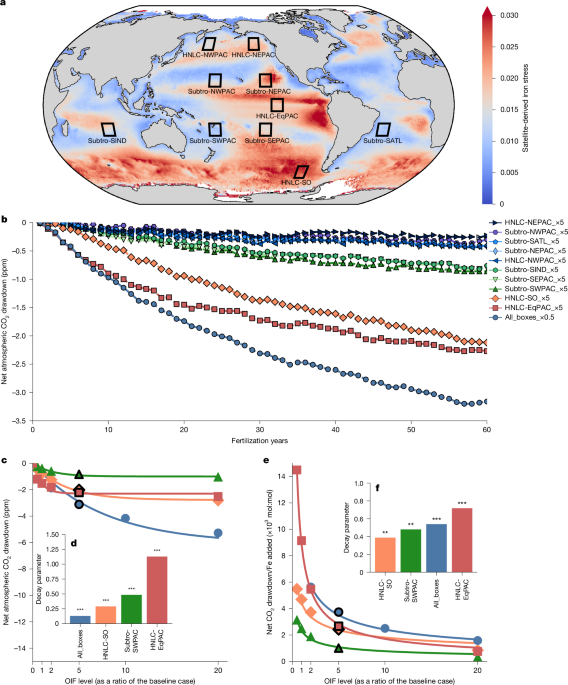
Nuno, A. G. et al. Planetary diagnosis of phytoplankton iron stress. ESS Open Archive https://doi.org/10.22541/essoar.15001989/v1 (2026).
Schwinger, J., Bourgeois, T. & Rickels, W. On the emission-path dependency of the efficiency of ocean alkalinity enhancement. Environ. Res. Lett. 19, 074067 (2024).
Tsujino, H. et al. JRA-55 based surface dataset for driving ocean–sea-ice models (JRA55-do). Ocean Model. 130, 79–139 (2018).
Dee, L. E. et al. Quantifying disturbance effects on ecosystem services in a changing climate. Nat. Ecol. Evol. 9, 436–447 (2025).
Fisher, C. K. & Mehta, P. The transition between the niche and neutral regimes in ecology. Proc. Natl Acad. Sci. 111, 13111–13116 (2014).
Chavez, F. P., Ryan, J., Lluch-Cota, S. E. & Niquen, M. From anchovies to sardines and back: multidecadal change in the Pacific Ocean. Science 299, 217–221 (2003).
Benedetti, F., Wydler, J. & Vogt, M. Copepod functional traits and groups show divergent biogeographies in the global ocean. J. Biogeogr. 50, 8–22 (2023).
Gaüzère, P., Doulcier, G., Devictor, V. & Kéfi, S. A framework for estimating species-specific contributions to community indicators. Ecol. Indic. 99, 74–82 (2019).
Wilcox, R. R. Introduction to Robust Estimation and Hypothesis Testing (Academic Press, 2012).
Huber, P. J. & Ronchetti, E. M. Robust Statistics 2nd edn (Wiley, 2009).
Donald, B. R. The Bayesian bootstrap. Ann. Stat. 9, 130–134 (1981).
Yu, J. Data and plotting scripts for the article entitled “Climate Benefit and Ecological Cost Trade-offs for Ocean Iron Fertilization”. Zenodo https://doi.org/10.5281/zenodo.20500155 (2026).
Aumont, O. & Bopp, L. Globalizing results from ocean in situ iron fertilization studies. Global Biogeochem. Cycles 20, GB2017 (2006).

