


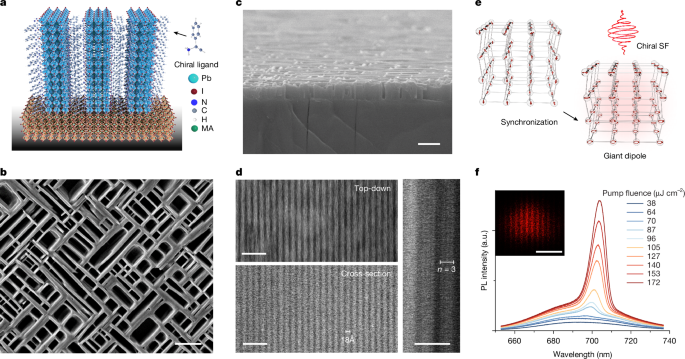
Synthesis of achiral and chiral quasi-2D perovskite superlattices
Chemicals
Hydroiodic acid (Sigma Aldrich, 57% w/w in H2O, 99.9%), hypophosphorous acid (Avra, 50% w/w H2O), R-(+)-α-methyl benzylamine (RMBA, Sigma Aldrich, 99%) and S-(−)-α-methylbenzylamine (SMBA, Sigma Aldrich, 99%) were used.
Synthesis of MAPbBr3 single-crystal substrate
A stoichiometric mixture of MABr (1 mmol) and PbBr2 (1 mmol) was dissolved in dimethylformamide (DMF) at room temperature. The solution was filtered through a 0.1-μm polytetrafluoroethylene (PTFE) membrane filter. High-quality MAPbBr3 single crystals were grown using inverse temperature crystallization by maintaining the filtered solution at 60 °C in an oven.
Synthesis of chiral (S/R)MBA ligands
In a 100-ml three-necked round-bottom flask cooled in an ice bath, (S/R)MBA (39 mmol, 5 ml) were mixed with anhydrous ethanol (15 ml). Hydrochloric acid (6.6 ml, 58 mmol) was added dropwise under vigorous stirring, and the reaction mixture was stirred overnight. The solution was then heated to 80 °C for 30 min to evaporate the solvent completely. The resulting yellowish residue was dissolved in hot ethanol (5 ml) and refrigerated for 24 h to induce recrystallization. The obtained crystals were washed repeatedly with diethyl ether until colourless, then vacuum-dried overnight to yield white (S/R)MBA crystals.
Synthesis of quasi-2D (PEA)2(MA)2Pb3I10 single crystals
A precursor solution was prepared by dissolving MAI (5 mmol), PEA (7 mmol) and PbO powder (10 mmol) in a mixture of 57% w/w aqueous HI solution (10.0 ml, 76 mmol) and 50% aqueous H3PO2 (1.7 ml, 15.5 mmol) with heating until complete dissolution. The solution was cooled to room temperature for crystallization. The resulting crystals were washed with diethyl ether and vacuum-dried overnight.
Synthesis of quasi-2D (PEA)1.2((S/R)MBA)0.8(MA)2Pb3I10 single crystals
PbO powder (10 mmol), MAI (5 mmol), (S/R)MBA (2.8 mmol) and PEA (4.2 mmol) were dissolved in the same acid mixture as in the previous section (10.0 ml HI + 1.7 ml H3PO2) with heating. After cooling to room temperature, the precipitated crystals were washed with diethyl ether and vacuum-dried overnight. It should be noted that the inclusion of achiral PEA ligands is essential for stabilizing the quasi-2D phase39.
Epitaxial growth of PEA, (S/R)MBA perovskite superlattices
The epitaxial growth precursor solution was prepared by dissolving quasi-2D perovskite single crystals (achiral PEA only or PEA mixed with (S/R)MBA, as described in the previous sections) in γ-butyrolactone (GBL) to obtain a concentration of 1 M. This non-volatile solvent was selected to enable controlled crystallization during subsequent processing. Each solution was subjected to spin-coating onto pristine MAPbBr3 single-crystal substrates at 2,000 rpm for 30 s, followed by annealing at 180 °C to form PEA, SMBA and RMBA superlattices, respectively.
Structure and morphological characterizations
STEM specimens were prepared using a dual-beam focused ion beam system (Helios 600i, Thermo Fisher Scientific). High-angle annular dark-field STEM imaging was performed using an aberration-corrected STEM microscope (Spectra 300 (S)TEM).
Two-dimensional grazing-incidence wide-angle X-ray scattering (GIWAXS) measurements were performed using an XEUSS 3.0 UHR SAXS/WAXS system (Xenocs) equipped with an Eiger2 R 1M 2D detector (75 μm × 75 μm pixel size) operating in integration mode. The sample-to-detector distance was set at 100 mm and precisely calibrated using a silver behenate standard. Measurements used Cu Kα radiation (8 keV) with a 0.5 mm × 0.5 mm beam spot, providing sufficient q-space coverage. GIWAXS patterns were corrected for missing wedge effects to obtain the qr and qz coordinates. The optimal incident angle of 0.7° was determined by maximizing sample scattering intensity while minimizing substrate contributions, ensuring the X-rays propagated as an evanescent wave along the sample surface.
PL and time-resolved PL spectroscopy
The sample was excited by a femtosecond laser system consisting of a Ti:sapphire oscillator (Coherent Vitesse, 80 MHz) seeding a regenerative amplifier (Coherent Libra, 800 nm central wavelength, 50 fs pulse duration, 1 kHz repetition rate). The vertically polarized pump beam was frequency-tuned using an optical parametric amplifier (OperASolo) and focused to a 1-mm spot on the sample (point excitation configuration).
Time-integrated PL spectra were collected from the sample in a backscattering geometry using a pair of lenses, then directed to a monochromator (Acton Spectra Pro 2500i) coupled to an EMCCD detector (Princeton Instruments Pixis). For magneto-PL measurements, the magnetic field was applied parallel to the substrate of the crisscross superlattices (that is, perpendicular to the SF direction), as shown in Fig. 4a.
Time-resolved PL was characterized using a streak camera (Optronis, OptoScope SC unit, temporal resolution of around 10 ps under the fast sweep unit SSU11-10) coupled with a monochromator triggered with pump fs laser, and each time-resolved PL image datum was obtained by adding 150 frames of streak camera images. Unless otherwise specified (for example, the stability test in vacuum), all measurements were performed at room temperature in ambient air (relative humidity of about 50%).
Transient absorption spectroscopy
TA spectroscopy was performed on perovskite superlattice transferred from a single-crystal MAPbBr3 substrate to the quartz substrate (Supplementary Fig. 16). The vertically polarized pump beam was generated by an optical parametric amplifier (OperASolo) pumped with the aforementioned Ti:sapphire femtosecond laser and modulated using a mechanical chopper. The horizontally polarized probe beam (spot diameter 0.5 mm on the sample) passed through the pump-excited region (pump spot diameter 1 mm on the sample) and was collected by a CMOS (complementary metal-oxide-semiconductor) sensor in a Helios spectrometer (Ultrafast Systems). The TA signal was recorded as a function of probe delay, controlled by a retroreflector mounted on a motorized linear stage with a minimum step size of 2.8 fs, to resolve carrier dynamics. All measurements were conducted at room temperature in ambient air.
Theoretical modelling of chiral superfluorescence
Conjugation of the chiral quantum-well spacers to the perovskite superlattices results in a net crystallographic helicity according to the chirality of ligand25 (see Supplementary Note 2 and circular dichroism spectra in Supplementary Fig. 20). As a result, the crystal structure of each vertically oriented superlattice exhibits a screw axis parallel to the direction of SF emission. A minimal model of chiral SF must extend the canonical two-level SF model to include the influence of mirror symmetry breaking on the polarization of the emitted light. We first write down the combined dipole–field Hamiltonian
$$H=\omega _\mathop\sum \limits_j=1^N\sigma _j^\mathrmee+ck_\sum _\lambda a_\lambda ^\dagger a_\lambda -\mathop\sum \limits_j=1^N\bfp_j\cdot \bfE(\bfr_j)$$
(4)
where \(\sigma _j^\rmee=|e_j\rangle \langle e_j|\) is the population operator for the excited state |ej⟩ of emitter j, ω0 is the frequency of the dipole transition, \(a_\lambda ^\dagger \) and \(a_\lambda \) are bosonic creation and annihilation operators for polarization λ with \([a_\lambda ,\,a_\lambda ^\prime ^\dagger ]=\delta _\lambda \lambda ^\prime \), c is the speed of light, and k0 = ω0/c is the photonic wavevector (assumed to be on resonance with the dipole transition). Notice that, in contrast to the usual single-mode SF model, we explicitly retain both field polarizations. The dipole operator for each two-level emitter is given in the main text as \(\bfp_j=\wp _j(\sigma _j^\mathrmge+\sigma _j^\mathrmeg)\), and the transition dipole moments for a 1D lattice that reflect the screw axis symmetry of the chiral superlattices are given by equation (1). Applying the definition of the field operator in equation (2) and neglecting the energy non-conserving terms \(\propto \sigma _j^\mathrmgea_\lambda \) and \(\propto \sigma _j^\mathrmega_\lambda ^\dagger \) in the interaction Hamiltonian yields equation (3).
Because the cavity mode is assumed to be on resonance with the dipole transition, Hint remains time-independent in the interaction picture representation, and we can neglect the free evolution of the dipole and field Hamiltonians (first two terms in equation (4)). Following ref. 37, we trace over the field mode in the bad cavity limit to arrive at a Markovian master equation for the dipole reduced density matrix
$$\frac\rmd\rho \rmdt=\frac\varGamma 2\sum _q=k_\pm p(2S_q^-\rho S_q^+-\S_q^+S_q^-,\rho \)$$
(5)
where Γ is the cavity-mediated decay rate (assumed to be 1/1,500 ps−1 based on our measurements). Equation (5) consists of two copies of the usual SF master equation—one for each quasimomentum and photon polarization. For simplicity, we make the approximation \([S_q^+,S_q^\prime ^-]=2S^z\delta _qq^\prime \), where \(S^z=\sum _j\sigma _j^z/2=\sum _j(\sigma _j^\mathrmee-\sigma _j^\mathrmgg)/2\). In other words, we assume collective modes with opposite circular polarization are uncoupled, except through their mutual contribution to the total dipole inversion.
To account for the influence of room-temperature lattice vibrations on each dipole, we add to equation (5) the pure dephasing Lindbladian
$$\mathcalL_\phi [\rho ]=\frac\gamma _\phi 2\mathop\sum \limits_j=1^N(\sigma _j^z\rho \sigma _j^z-\rho ).$$
(6)
Applying the standard quasi-classical approximation \(\langle (S^z)^2\rangle \approx \langle S^z\rangle ^2\), equations (5) and (6) yield the following coupled differential equations for the average dipole inversion and the radiation intensity \(I_q(t)=\varGamma \langle S_q^+S_q^-\rangle \) of each mode
$$\frac\rmd\rmdt\langle S^z\rangle =-I(t)$$
(7)
$$\frac\rmd\rmdtI_q(t)=2\varGamma I_q(t)\left[\langle S^z\rangle -\left(\frac12+\frac\gamma _\phi \varGamma \right)\right]+\varGamma \gamma _\phi (2\langle S^z\rangle +N).$$
(8)
These equations can be solved numerically, together with the total-intensity constraint \(I(t)=\sum _qI_q(t)\) and the initial SF conditions \(\langle S^z(0)\rangle =N/2\) and I(0) = ΓN. Because of the spin–orbit coupling present in equation (3), the solutions for the two different collective modes q correspond to ILCP(t) and IRCP(t), respectively. In the pure SF regime, where ΓN ≫ γϕ, these equations admit the analytical result
$$I_q(t)=\fracI_q(0)I(0)\left(\fracN+12\right)^2\varGamma \sec \rmh^2\left(\fract-\tau _\rmD\tau _\rmP\right)$$
(9)
where τD = (1/Γ)ln(N)/(N + 1) is the delay time and τP =2τD/ln(N) is the SF pulse width. Equation (9) is identical to the canonical, unpolarized SF intensity37, except for the initial mode-weighting factor Iq(0)/I(0). This limit corresponds to the high pump fluence regime, in which the photo excited dipole density is large and the system behaves as a coherent and collectively enhanced circularly polarized dipole. Conversely, the low pump fluence regime is described by the opposite limit ΓN ≪ γϕ in which dynamical dephasing by equation (6) is the dominant process. In this regime, phase coherence is rapidly lost, giving rise to unpolarized spontaneous emission from independent emitters.
To facilitate a quantitative comparison to our experimental measurements, we first determined the relationship between the number of excited dipoles N and the pump fluence P in µJ cm−2. Using the known linear dependence of the photoluminescence intensity on the dipole density in the spontaneous emission regime, we fit the relationship ISE = βPα based on the data in Fig. 2c for the SMBA sample and Extended Data Fig. 7 for the RMBA sample. This yields the relationship N = bPα for unknown parameter \(b\). The parameter \(b\) was determined by fitting the delay time data (Fig. 2c for SMBA, Supplementary Fig. 17e for RMBA) with the relationship τD = (1/Γ)ln(bPα)/(bPα + 1). In this way, the parameters α and b for each sample are fixed by the experimental data. This allows for a numerical solution of ILCP(t) and IRCP(t) with only two free parameters: the initial mode imbalance at t = 0 and the dephasing rate γϕ.
DFT calculations
All calculations were performed using the projector augmented wave pseudopotentials with the exchange and correlation in the Perdew–Burke–Ernzerhof formalism of DFT as implemented in the Vienna ab initio simulation package. The crystal structure was obtained by Pyrovskite code based on experimental XRD parameters. Geometry optimizations were performed before single-point energy calculations, and the self-consistent convergence accuracy was set at 1 × 10⁻⁵ eV per atom. The convergence criterion for the maximal force on atoms was set to 0.02 eV Å–1. The cutoff energy of the plane-wave basis was set at 500 eV. For the 2D bulk system, a 4 × 4× 1 Monkhorst–Pack k-point mesh was used. For the edge structure, which was extended along the Cartesian x-axis, a 1 × 4 × 1 mesh was adopted for Brillouin zones sampling. Dipole correction was included for the edge structure. Spin−orbit coupling was included for electronic structure calculations but not for structural relaxation and total energy calculations.

