


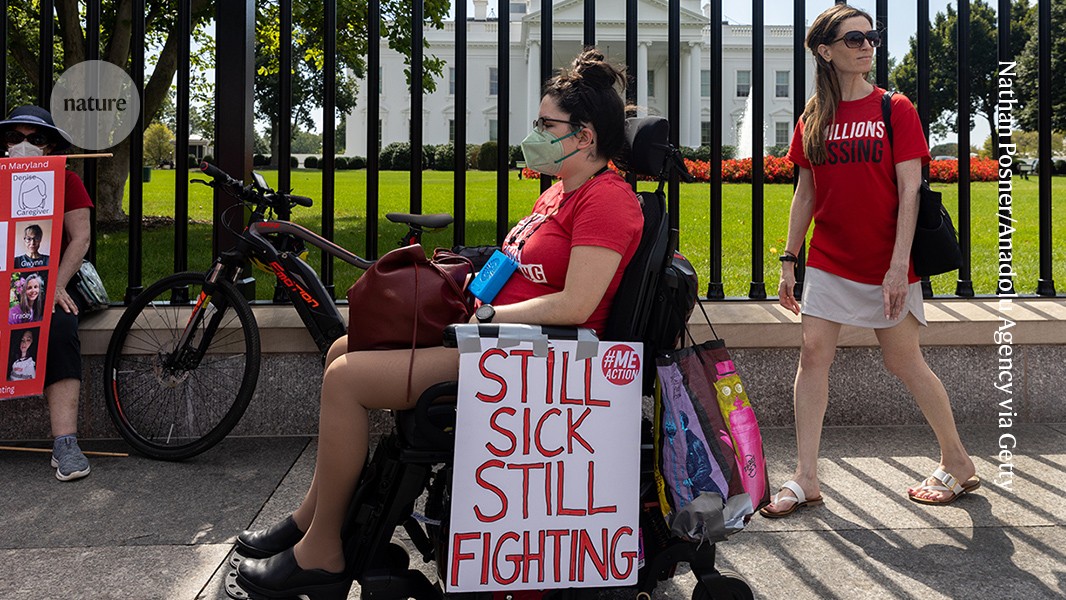

Millions of people globally have the chronic condition long COVID.Credit: Nathan Posner/Anadolu Agency via Getty
Growing evidence suggests that a diabetes drug and one used to treat mild-to-moderate COVID-19 can prevent the infection from developing into long COVID, a chronic condition that affects millions of people worldwide. In response to promising clinical-trial results, some physicians say that they will start prescribing the medications, but others are not convinced by the latest evidence.
There is no universally agreed definition of long COVID, but it usually refers to symptoms that persist for more than three months after infection with the coronavirus SARS-CoV-2. The most common symptoms are fatigue, shortness of breath and cognitive impairment.
Observational studies have suggested that the antiviral Paxlovid1 and the diabetes drug metformin2 can reduce the risk of some long COVID symptoms. But until now, the drugs had not been tested in randomized, placebo-controlled trials in a broader group of participants — the gold standard for evaluating treatment efficacy.
“Having a good placebo-controlled trial makes my heart happy,” says David Smith, an infectious-disease physician at the University of California, San Diego.
Paxlovid shows promise
The Paxlovid trial involved 144 people who had SARS-CoV-2 and investigated their risk of developing long COVID after three months. The drug reduced that risk by 40%, compared with a placebo. The study was published on 16 July in The Lancet Infectious Diseases3.
“It’s a seminal paper,” says Timothy Henrich, an infectious-disease physician at the University of California, San Francisco. “If you reduce viral burden during those initial, critical few weeks of acute infection, you can reduce the long-term morbidity from infection,” he adds.
Smith says the findings are consistent with previous retrospective analyses1 that suggest Paxlovid can lower the risk of long COVID. He discusses these analyses with people he treats, who are often immunocompromised , when helping them to decide whether to take Paxlovid.
Myron Cohen, an infectious-disease physician at the University of North Carolina at Chapel Hill, says that unless people have a good reason for not wanting to use Paxlovid — such as taking immunosuppressive drugs that make it unsafe — he’s going to recommend it. “The risk of the drug itself is low,” he adds.
Other physicians are not as convinced by the latest results. For instance, the definition of long COVID in the study was based on whether participants self-reported either fatigue, shortness of breath or memory and concentration problems three months after infection. In the control group, 43% of participants met this definition, compared with 26% for the group receiving the treatment. Long COVID is not that prevalent, so those percentages are “not realistic,” says Walid Gellad, an internal-medicine physician at the University of Pittsburgh in Pennsylvania.
A previous analysis of data found that 8% of placebo participants self-reported long COVID symptoms at three months. “I wouldn’t recommend Paxlovid to prevent long COVID,” says Gellad. “I don’t think the evidence is sufficient at this point.”
The discrepancy could be because participants in the latest study were asked specifically whether they were experiencing each of four common long-COVID symptoms, which would have prompted them to self-report even if a symptom was mild, says study author Nina Langeland, an infectious-disease physician at the University of Bergen in Norway.
More data on metformin
A separate trial of 2,983 people has reported that metformin cuts the risk of physician-diagnosed long COVID at six months after infection by around half. The study was published in Clinical Infectious Diseases on 4 June4.
The metformin data are “more convincing”, says Gellad, because the reported long COVID rates are more consistent with those in other studies.

