


You have full access to this article via your institution.
Hello Nature readers, would you like to get this Briefing in your inbox free every day? Sign up here.

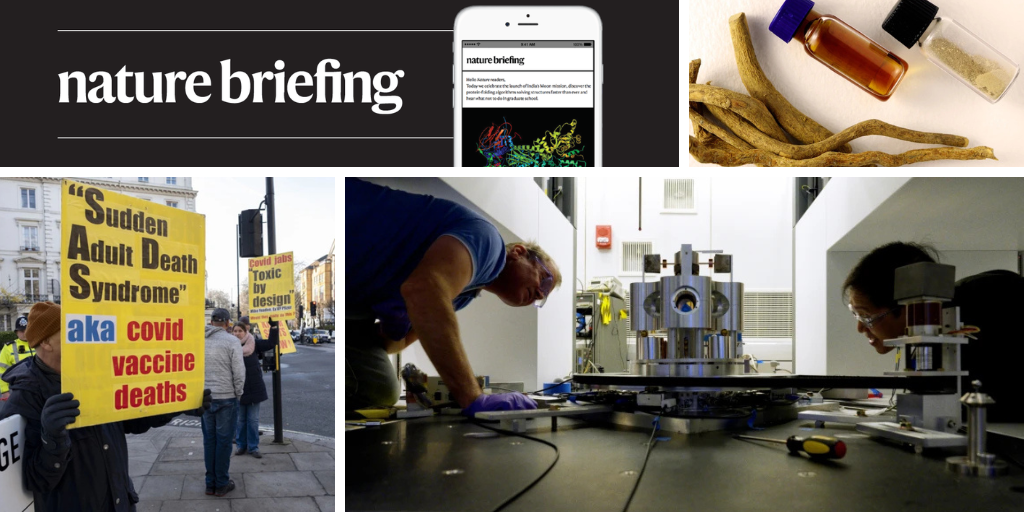
Stephan Schlamminger (left) and colleague Vincent Lee with the equipment used to measure big G.Credit: R. Eskalis/NIST
The results of a decade-long experiment have brought scientists no closer to pinning down the value of Big G, the constant that describes the gravitational pull between objects. The experiment aimed to replicate research published in 2013, but resulted in a number that disagreed with those results and with the value that’s considered the best current estimate of G. The work is “soul draining”, says physicist Stephan Schlamminger, co-author of the latest study. But he is driven by the challenge. “It must be possible for humans to measure this number.”
US President Donald Trump signed an executive order to streamline research into psychedelic compounds and to make it easier for people with certain illnesses to access these drugs. It calls out by name the potent and long-lasting psychedelic ibogaine, which is something of a scientific mystery, in part because it is one of the most tightly controlled drugs in the United States. The move has been welcomed by researchers who see potential for drugs, including psilocybin and MDMA, in treating conditions such as addiction, depression and post-traumatic stress disorder. But scientists are also concerned about possible side effects, and the impact on health services if the drugs are approved.
Infographic of the week

Source: 2026 Edelman Trust Barometer report
More than two-thirds of the public believe at least one false or unproven health claim, according to a survey across 16 countries. People who believed three or more of the claims were as likely to have attended university and more likely to consume health news than were those who believed fewer of them, suggesting that a proliferation of conflicting information is a bigger problem than simply being ill-informed. (Nature | 7 min read)
Reference: 2026 Edelman Trust Barometer (Source: 2026 Edelman Trust Barometer report)
Features & opinion
A rising wave of evidence is showing that genes on the sex chromosomes — usually XX in women and XY in men — can have a substantial impact on health and disease. Genes that escape the ‘silencing’ process on one X chromosome seem to be a key reason why around 80% of people with autoimmune disease are women, for example. The escapees could also have a protective effect: they could help to explain why autism is more common in males than in females, for example. Meanwhile, X’s diminutive partner, Y, might be contributing to more than just sex determination.
More young people are getting cancer — so countries including Australia, Canada andSouth Korea are lowering the screening age for breast, colorectal and other cancers. But screening is expensive, and isn’t without risks: it can turn up false positives and lead to unnecessary treatments. “It’s a teachable moment for the public about screening,” says physician and medical historian Barron Lerner. Meanwhile, in low- and middle-income countries, which account for the majority of new cancer cases and deaths worldwide, cancer screening is often limited, even for the most at-risk patients.
Three researchers who were on a team that analysed how to protect Venice from sea-level rise say that “radical measures may be necessary” to save the iconic canal city. If rising waters — and the fact that the land itself is sinking under its own weight — overwhelm the current system of mobile barriers, the city might have to be ringed in dykes or even relocated altogether. Measures to raise the city, such as by injecting sea water into the rocks deep underground, could keep the current barriers effective at up to a metre of sea-level rise, but that looks unlikely to be sufficient.
Reference: Scientific Reports paper
I’m enjoying Earth day by getting an astronauts-eye-view of our home from the International Space Station thanks to Sen, Sen, the first continuous 4K video livestream from space. Since January of last year, Sen has been broadcasting about 20 hours a day of our planet’s infinite beauty. Here’s a particularly stunning view of the home of Nature, the United Kingdom, captured earlier today.
While I try to spot Briefing towers, why not send me your feedback on this newsletter? Your e-mails are always welcome at [email protected].
Thanks for reading,
Flora Graham, senior editor, Nature Briefing
With contributions by Jacob Smith
• Nature Briefing: Careers — insights, advice and award-winning journalism to help you optimize your working life
• Nature Briefing: Microbiology — the most abundant living entities on our planet — microorganisms — and the role they play in health, the environment and food systems
• Nature Briefing: Anthropocene — climate change, biodiversity, sustainability and geoengineering
• Nature Briefing: AI & Robotics — 100% written by humans, of course
• Nature Briefing: Cancer — a weekly newsletter written with cancer researchers in mind
• Nature Briefing: Translational Research — covers biotechnology, drug discovery and pharma

