


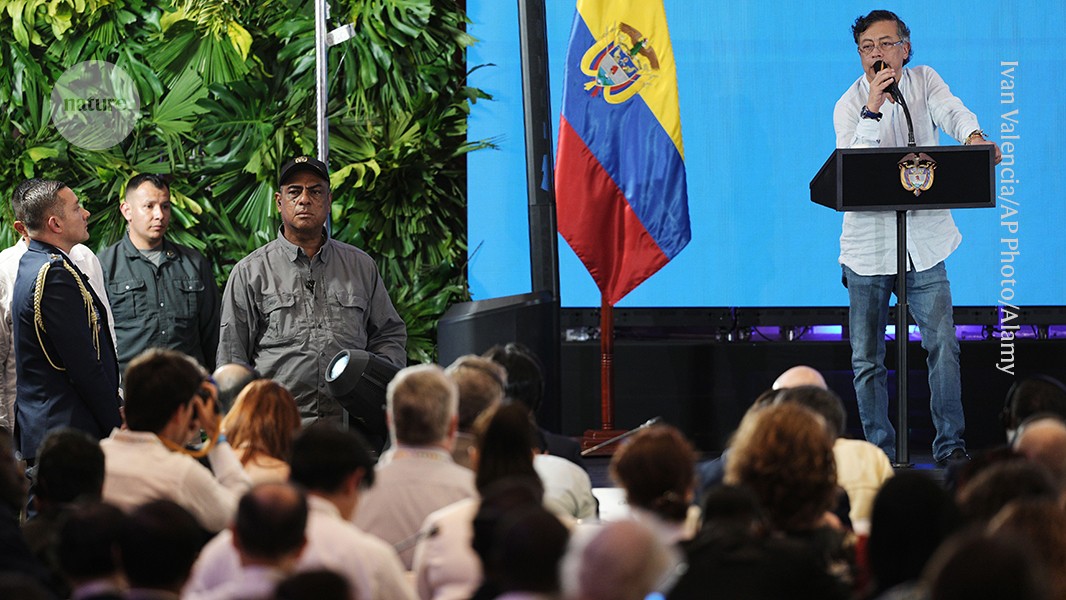

Colombian President Gustavo Petro spoke on 28 April at a climate summit hosted by his country.Credit: Ivan Valencia/AP Photo/Alamy
Climate scientists, who have warned of the dangers of global warming for decades, have found some countries to listen. This week, representatives of more than 50 nations gathered in Santa Marta, Colombia, at what was billed as the first global summit on phasing out fossil fuels. One of the first orders of business was to launch a panel of scientists that will advise those countries on how to shift to clean energy.
How to fight climate change without the US: a guide to global action
“Here, you have a coalition of governments that decided they actually want to be informed by the science,” says Margaretha Wewerinke-Singh, an international climate-change law specialist at the University of Amsterdam.
The landmark meeting, which began on 24 April and concluded yesterday, was proposed during last year’s United Nations COP30 climate summit in Belém, Brazil. Oil-producing nations such as Saudi Arabia reportedly opposed attempts at that gathering to create a road map to cut the use of fossil fuels, which are the main source of global greenhouse-gas emissions and the largest contributor to climate change.
Frustrated, the governments of Colombia and the Netherlands announced that they would host the First Conference on Transitioning Away from Fossil Fuels this year, independent of the UN’s COP climate summits. Countries that have expressed an openness to creating a road map — including Australia, Cambodia and Mexico — were invited. Oil-producing nations that have opposed such efforts were not.
In Santa Marta, not only was the new panel — called the Science Panel for the Global Energy Transition (SPGET) — launched, but a separate group of researchers also took centre stage on 24 April to release a report listing 12 high-level actions that nations can take to support a fossil-fuel phaseout.
Researchers say it’s refreshing to have an international forum where they are free to make ambitious recommendations. What happens at the UN climate summits is that, “because the governments are the final decision makers on what goes out to the public, there is a lot of filtering” of science advice, says Gilberto Jannuzzi, an energy-transition specialist at the State University of Campinas in São Paulo, Brazil. “At the end, I think we found a smaller audience, but an audience that considers that we have something relevant to them.”
Practical solutions
The report, crafted by 24 researchers in consultation with hundreds of other scientists from several countries over the three months leading up to the meeting, does not attempt to systematically synthesize all of the scientific knowledge on transitioning to clean energy, says Frank Jotzo, a climate-change economist at the Australian National University in Canberra, who was part of the editorial team. That’s the role of the UN Intergovernmental Panel on Climate Change (IPCC), which produces reports that are meant to be neutral and inform policy without directly making recommendations. “We’re not trying to replicate the IPCC here. We’re trying to give some practical policy insights” based on science, Jotzo says.

Global greenhouse-gas emissions are still rising: when will they peak?
For example, the report recommends that countries ban new fossil fuel infrastructure and phase out fossil-fuel subsidies, such as tax breaks or funding that lower the cost of producing oil, gas and coal. At the same time, it calls for financial incentives to put clean-energy sources in place.

