


You have full access to this article via your institution.
Hello Nature readers, would you like to get this Briefing in your inbox free every day? Sign up here.

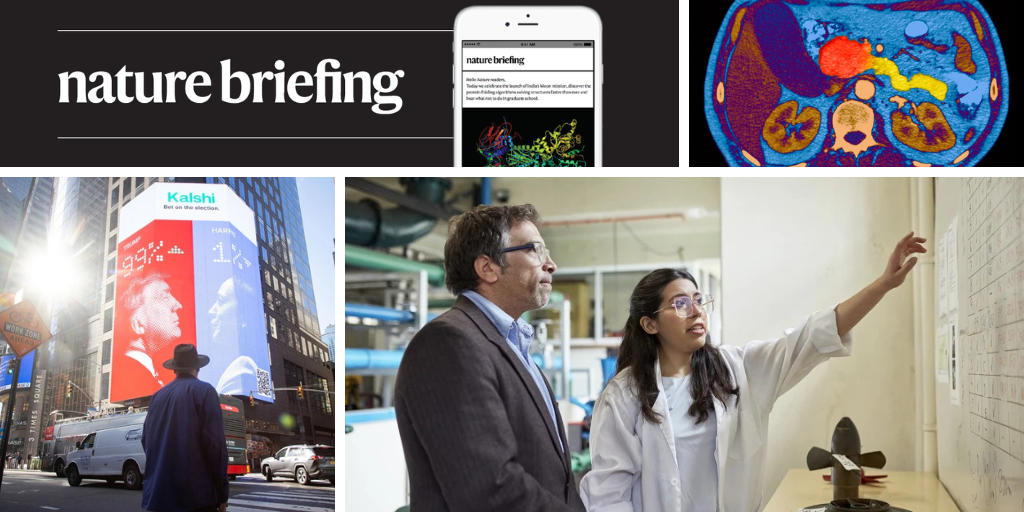
Pancreatic-head tumours (red, artificially coloured) have proved highly resistant to treatment, but a new drug nearly doubles the lifespan of people with this type of cancer.Credit: PNMB/Science Photo Library
A drug that targets a so-called ‘undruggable’ family of proteins has nearly doubled survival in people with an advanced form of pancreatic cancer. The experimental drug, daraxonrasib, disarms all three RAS proteins, which are linked to some of the deadliest cancers. In a trial of 500 people with advanced pancreatic cancer, those who received daraxonrasib lived another 13.2 months, compared with 6.7 months for those treated with chemotherapy. Researchers hope that combining the drug with other treatments could produce longer-lasting benefits.
Reference: New England Journal of Medicine paper
Bad experiences with supervisors are one of the leading reasons that early-career researchers leave academia. In a survey of more than 2,600 researchers, almost 40% of respondents said that their supervisor was disorganized and poor at communication and at least 30% reported issues concerning their supervisor’s behaviour, such as abrupt attitude changes and a lack of empathy. Of the 206 respondents who identified themselves as former researchers, nearly half cited negative experiences with their supervisors as a factor in their decision to leave academic research.
Reference: bioRxiv preprint (not peer reviewed)
Prediction markets such as Polymarket and Kalshi let people gamble on everything from the progress of disease outbreaks to the outcomes of quantum-computing research. But some researchers are not convinced that the ‘wisdom of crowds’ reflected by these platforms can rival the work of expert scientists. There are also growing concerns about market manipulation and insider trading — for example, officials who oversee the Nobel Peace Prize are investigating a surge in bets for Venezuelan opposition leader Maria Corina Machado hours before she was awarded the prize.
A US judge has blocked moves by the administration of US President Donald Trump to divest key parts of the US National Center for Atmospheric Research (NCAR), a world-leading weather and climate research lab in Colorado. The administration’s efforts to transfer NCAR’s supercomputing centre in Wyoming to a university are “capricious, an abuse of discretion, or otherwise not in accordance with law”, according to the ruling. The scientific consortium that runs NCAR and brought the case claims that the Trump administration is taking revenge against Colorado, which is led by Trump’s political opponents.
Read more: Global ‘mothership’ of climate science takes Trump administration to court (Nature | 8 min read, from May)
Image of the week

This tree clinging to a cliff face on Robinson Crusoe Island, Chile, is the last of its kind in the wild. Conservationists collected 29 seeds from the Dendroseris neriifolia and brought them to the Millennium Seed Bank in the United Kingdom, where 8 have been germinated into seedlings. (Royal Botanical Gardens, Kew press release | 14 min read) (Gonzalo Rojas)
Features & opinion
A rise in the use of artificial intelligence in social-science research is threatening to muddy the data and analysis on which the field relies. Some researchers are finding survey responses generated by large language models, and others worry that AI-assisted analyses might generate spurious findings that pollute journals — both problems that risk eroding trust in the field. But other scientists are choosing to look on the bright side. AI systems could bolster social science by making its findings more robust and helping to analyse complex datasets, they say.
The lack of diagnostic tests and approved treatments for the species of Ebola that is currently circulating in central Africa reflects a sluggish attitude toward pandemic preparedness worldwide, argues virologist Kevin Ariën. Although the Bundibugyo species is relatively rare, this outbreak isn’t unprecedented, and a failure by governments and health officials to invest in diagnostics in advance has left them playing catch-up. “This outbreak must be a wake-up call,” Ariën writes. “Preparedness has been too narrow, too reactive and too dependent on tools designed for the last outbreak rather than for the next one.”
Nature’s careers team has handpicked the best science-themed page-turners to read now (even if it’s winter — I see you, Southern Hemisphere). They include a rom-com set against the drama of a PhD programme, a Booker-Prize-shortlisted exploration of race and sexuality in science and a satirical novel that wrings laughter out of climate change.
Our best efforts to penetrate the deep Earth merely scratch the surface, writes science and environmental journalist James Dinneen. The deepest hole ever drilled, the Kola Superdeep Borehole in Russia, delves less than 13 kilometres. The side-effects of human activity on the surface can have far more severe consequences: for example, a vast irrigation project that virtually emptied the Aral Sea “provoked a rebound response all the way down in the upper mantle”. Nevertheless, “the great majority of Earth — down through the expanse of the upper and lower mantle, through the liquid outer core, and the solid inner core — has no clue that humans exist, and probably never will,” Dinneen writes.
When I’m looking for a low-stakes argument to enjoy with my friends these days, my go-to is laundry — a near-universal experience that most adults have a strong, often untapped, opinion about. Don’t believe me? Check out the r/laundry chat on Reddit, where almost 900,000 people discuss stains every week and its star poster, Kismai, just got a book deal. Now I’m more prepared than ever thanks to Chemical & Engineering News, which has an in-depth analysis of the latest solid-detergent chemistry and technology that is going to help me blow my liquid-loving friends out of the water.
Let me know about your favourite chemistry-based conversational gambit — and any other feedback on this newsletter — at [email protected].
Thanks for reading,
Flora Graham, senior editor, Nature Briefing
With contributions by Jacob Smith
• Nature Briefing: Careers — insights, advice and award-winning journalism to help you optimize your working life
• Nature Briefing: Microbiology — the most abundant living entities on our planet — microorganisms — and the role they play in health, the environment and food systems
• Nature Briefing: Anthropocene — climate change, biodiversity, sustainability and geoengineering
• Nature Briefing: AI & Robotics — 100% written by humans, of course
• Nature Briefing: Cancer — a weekly newsletter written with cancer researchers in mind
• Nature Briefing: Translational Research — covers biotechnology, drug discovery and pharma

