


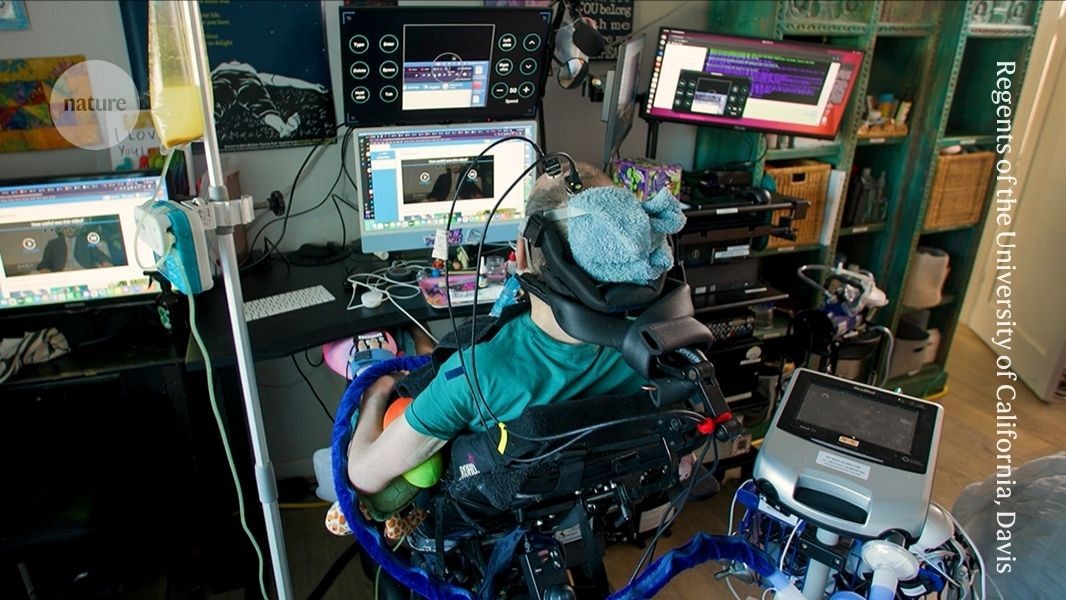

Casey Harrell using the brain-computer interface at his home. Credit: Regents of the University of California, Davis
A brain implant is helping a man with paralysis to communicate with his family and friends and to use his personal computer at home.
The brain–computer interface (BCI) has given 48-year-old study participant Casey Harrell, who was diagnosed with a type of motor neuron disease called amyotrophic lateral sclerosis six years ago, the ability to communicate with an average speed of 56 words per minute. It translates neural activity into text that appears on a computer screen and allows him to operate a computer, send text messages and e-mails and continue his job working in climate advocacy.
It is “nothing short of revolutionary”, says Harrell, who is based in Oakland, California. “This has allowed me to keep working and earn money and insurance for my family. This is reconnecting me with friends and family who are too shy or too afraid to come over and not be able to understand me.”
The study, published in Nature Medicine on 15 June1, analysed Harrell’s home use of the BCI for nearly two years and is “the most extensive data set and the longest running speech communication of anyone” with such an implant, says co-author Sergey Stavisky, a neuroscientist at the University of California, Davis.
Previous studies of participants testing BCIs at home showed that the devices had limited efficiency, and more-advanced devices have been tested only in the laboratory. “This is actually helping the patient in day-to-day life,” says Christian Herff, a computational neuroscientist at Maastricht University in the Netherlands. BCIs are “really becoming a medical device instead of a research tool”, he adds.
Remarkable quality
In 2023, Harrell had 256 microelectrodes implanted in his brain’s speech motor cortex. The electrodes were connected to electronic recording devices through titanium pedestals attached to his skull. He began to use the BCI device to decode his speech in the lab with the help of Stavisky and his colleagues. The researchers then trained Harrell and his care partners to operate the BCI system at home. After roughly 40 weeks, he began using the device independently and is still using it today. The device also has a text-to-speech system that can read completed sentences aloud using a synthesized version of Harrell’s voice from before he was diagnosed.

Brain implant translates thoughts to speech in an instant
The study, which included results up to nearly 23 months after surgery, reported that Harrell used the BCI at home on 364 of 397 days. He communicated 183,060 sentences, of which he labelled 92% as being decoded at least mostly correctly. The BCI also picked up neural signals for attempted hand movements to control a computer mouse, which helped Harrell to use his computer.
“The quality of the speech decoding is quite remarkable,” says Herff. And “the information transfer rate is several orders of magnitude faster” than previous efforts to deploy BCIs at patients’ homes, he adds.
The system had an optional ‘privacy mode’ which allowed Harrell to stop the data from the BCI being sent to the researchers.
“We wanted to add this privacy feature to set a good example for what a speech BCI might include in future forms as companies start to expand on it,” explains study co-author Nicholas Card, a neural engineer at the University of California, Davis.

