


Ding, Y. et al. The impact of elevated CO2 on methanogen abundance and methane emissions in terrestrial ecosystems: a meta-analysis. iScience 27, 111504 (2024).
Costa, K. C. et al. Protein complexing in a methanogen suggests electron bifurcation and electron delivery from formate to heterodisulfide reductase. Proc. Natl Acad. Sci USA 107, 11050–11055 (2010).
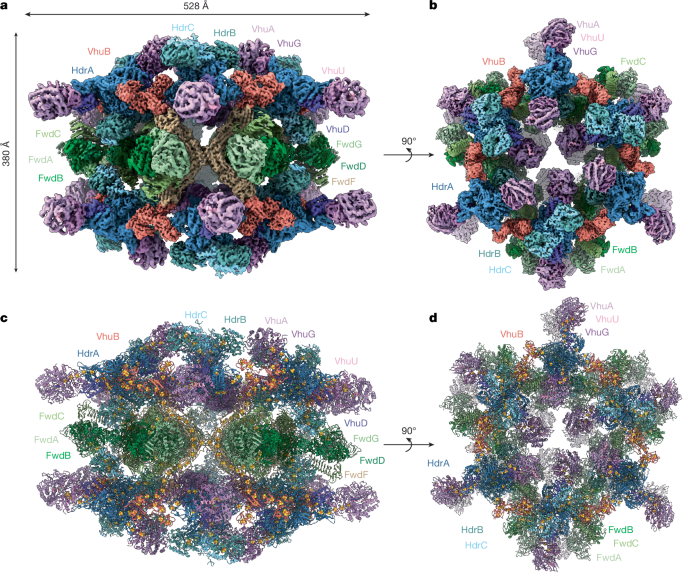
Watanabe, T. et al. Three-megadalton complex of methanogenic electron-bifurcating and CO2-fixing enzymes. Science 373, 1151–1156 (2021).
Buan, N. R. Methanogens: pushing the boundaries of biology. Emerg. Top. Life Sci. 2, 629–646 (2018).
Borrel, G., Adam, P. S. & Gribaldo, S. Methanogenesis and the Wood–Ljungdahl pathway: an ancient, versatile, and fragile association. Genome Biol. Evol. 8, 1706–1711 (2016).
Kurth, J. M., Op den Camp, H. J. M. & Welte, C. U. Several ways one goal—methanogenesis from unconventional substrates. Appl. Microbiol. Biotechnol. 104, 6839–6854 (2020).
Thauer, R. K. The Wolfe cycle comes full circle. Proc. Natl Acad. Sci. USA 109, 15084–15085 (2012).
Laird, M. G., Adlung, N., Koivisto, J. J. & Scheller, S. Thiol-disulfide exchange kinetics and redox potential of the coenzyme M and coenzyme B heterodisulfide, an electron acceptor coupled to energy conservation in methanogenic archaea. ChemBioChem 25, e202300595 (2024).
Kaster, A.-K., Moll, J., Parey, K. & Thauer, R. K. Coupling of ferredoxin and heterodisulfide reduction via electron bifurcation in hydrogenotrophic methanogenic archaea. Proc. Natl Acad. Sci. USA 108, 2981–2986 (2011).
Buckel, W. & Thauer, R. K. Flavin-based electron bifurcation, ferredoxin, flavodoxin, and anaerobic respiration with protons (Ech) or NAD+ (Rnf) as electron acceptors: a historical review. Front. Microbiol. 9, 401 (2018).
Karrasch, M., Börner, G., Enßle, M. & Thauer, R. K. Formylmethanofuran dehydrogenase from methanogenic bacteria, a molybdoenzyme. FEBS Lett. 253, 226–230 (1989).
Wagner, T., Ermler, U. & Shima, S. Formyl-methanofuran dehydrogenase. Encycl. Inorg. Bioinorg. Chem. https://doi.org/10.1002/9781119951438.eibc2621 (2018).
Gunsalus, R. P. et al. Complete genome sequence of Methanospirillum hungatei type strain JF1. Stand. Genom. Sci. 11, 2 (2016).
Wagner, T., Koch, J., Ermler, U. & Shima, S. Methanogenic heterodisulfide reductase (HdrABC-MvhAGD) uses two noncubane [4Fe-4S] clusters for reduction. Science 357, 699–703 (2017).
Bapteste, E., Brochier, C. & Boucher, Y. Higher-level classification of the Archaea: evolution of methanogenesis and methanogens. Archaea 1, 353–363 (2005).
Lyu, Z. & Lu, Y. Metabolic shift at the class level sheds light on adaptation of methanogens to oxidative environments. ISME J. 12, 411–423 (2018).
Petitjean, C., Deschamps, P., López-García, P., Moreira, D. & Brochier-Armanet, C. Extending the conserved phylogenetic core of archaea disentangles the evolution of the third domain of life. Mol. Biol. Evol. 32, 1242–1254 (2015).
Prondzinsky, P., Toyoda, S. & McGlynn, S. E. The methanogen core and pangenome: conservation and variability across biology’s growth temperature extremes. DNA Res. 30, dsac048 (2023).
Galagan, J. E. et al. The genome of M. acetivorans reveals extensive metabolic and physiological diversity. Genome Res. 12, 532–542 (2002).
Li, J. et al. Genetic and metabolic engineering of Methanococcus spp. Curr. Res. Biotechnol. 5, 100115 (2023).
Costa, K. C., Lie, T. J., Xia, Q. & Leigh, J. A. VhuD facilitates electron flow from H2 or formate to heterodisulfide reductase in Methanococcus maripaludis. J. Bacteriol. 195, 5160–5165 (2013).
Hendrickson, E. L. et al. Complete genome sequence of the genetically tractable hydrogenotrophic methanogen Methanococcus maripaludis. J. Bacteriol. 186, 6956–6969 (2004).
Dodsworth, J. A. & Leigh, J. A. Regulation of nitrogenase by 2-oxoglutarate-reversible, direct binding of a PII-like nitrogen sensor protein to dinitrogenase. Proc. Natl Acad. Sci. USA 103, 9779–9784 (2006).
Fonseca D. R., Halim M. F. A., Holten M. P., & Costa K. C. Type IV-like pili facilitate transformation in naturally competent archaea. J. Bacteriol. https://doi.org/10.1128/jb.00355-20 (2020).
Costa, K. C. et al. Effects of H2 and formate on growth yield and regulation of methanogenesis in Methanococcus maripaludis. J. Bacteriol. 195, 1456–1462 (2013).
Braks, I. J., Hoppert, M., Roge, S. & Mayer, F. Structural aspects and immunolocalization of the F420-reducing and non-F420-reducing hydrogenases from Methanobacterium thermoautotrophicum Marburg. J. Bacteriol. 176, 7677–7687 (1994).
Hanukoglu, I. Proteopedia: Rossmann fold: a beta-alpha-beta fold at dinucleotide binding sites. Biochem. Mol. Biol. Educ. 43, 206–209 (2015).
Rossmann, M. G., Moras, D. & Olsen, K. W. Chemical and biological evolution of a nucleotide-binding protein. Nature 250, 194–199 (1974).
Pieulle, L., Magro, V. & Hatchikian, E. C. Isolation and analysis of the gene encoding the pyruvate-ferredoxin oxidoreductase of Desulfovibrio africanus, production of the recombinant enzyme in Escherichia coli, and effect of carboxy-terminal deletions on its stability. J. Bacteriol. 179, 5684–5692 (1997).
DuPai, C. D., Davies, B. W. & Wilke, C. O. A systematic analysis of the beta hairpin motif in the Protein Data Bank. Protein Sci. 30, 613–623 (2021).
Baymann, F. et al. On the natural history of flavin-based electron bifurcation. Front. Microbiol. 9, 1357 (2018).
Stripp, S. T. In situ infrared spectroscopy for the analysis of gas-processing metalloenzymes. ACS Catal. 11, 7845–7862 (2021).
Ash, P. A., Hidalgo, R. & Vincent, K. A. Proton transfer in the catalytic cycle of [NiFe] hydrogenases: insight from vibrational spectroscopy. ACS Catal. 7, 2471–2485 (2017).
Ogata, H., Nishikawa, K. & Lubitz, W. Hydrogens detected by subatomic resolution protein crystallography in a [NiFe] hydrogenase. Nature 520, 571–574 (2015).
Page, C. C., Moser, C. C., Chen, X. & Dutton, P. L. Natural engineering principles of electron tunnelling in biological oxidation–reduction. Nature 402, 47–52 (1999).
Hedderich, R., Koch, J., Linder, D. & Thauer, R. K. The heterodisulfide reductase from Methanobacterium thermoautotrophicum contains sequence motifs characteristic of pyridine-nucleotide-dependent thioredoxin reductases. Eur. J. Biochem. 225, 253–261 (1994).
Künkel, A., Vaupel, M., Heim, S., Thauer, R. K. & Hedderich, R. Heterodisulfide reductase from methanol-grown cells of Methanosarcina barkeri is not a flavoenzyme. Eur. J. Biochem. 244, 226–234 (1997).
Jacob, C., Giles, G. I., Giles, N. M. & Sies, H. Sulfur and selenium: the role of oxidation state in protein structure and function. Angew. Chem. Int. Ed. Engl. 42, 4742–4758 (2003).
Lothrop, A. P. et al. Selenium as an electron acceptor during the catalytic mechanism of thioredoxin reductase. Biochemistry 53, 654–663 (2014).
Krupp, R., Chan, C. & Missiakas, D. DsbD-catalyzed transport of electrons across the membrane of Escherichia coli. J. Biol. Chem. 276, 3696–3701 (2001).
Lacey, B. M., Eckenroth, B. E., Flemer, S. & Hondal, R. J. Selenium in thioredoxin reductase: a mechanistic perspective. Biochemistry 47, 12810–12821 (2008).
Murakami, E., Deppenmeier, U. & Ragsdale, S. W. Characterization of the intramolecular electron transfer pathway from 2-hydroxyphenazine to the heterodisulfide reductase from Methanosarcina thermophila. J. Biol. Chem. 276, 2432–2439 (2001).
Arnér, E. S. J. Selenoproteins—what unique properties can arise with selenocysteine in place of cysteine? Exp. Cell. Res. 316, 1296–1303 (2010).
Nauser, T., Dockheer, S., Kissner, R. & Koppenol, W. H. Catalysis of electron transfer by selenocysteine. Biochemistry 45, 6038–6043 (2006).
Barber, D. R. & Hondal, R. J. Gain of function conferred by selenocysteine: catalytic enhancement of one-electron transfer reactions by thioredoxin reductase. Protein Sci. 28, 79–89 (2019).
Evans, R. M. et al. Selective cysteine-to-selenocysteine changes in a [NiFe]-hydrogenase confirm a special position for catalysis and oxygen tolerance. Proc. Natl Acad. Sci. USA 118, e2100921118 (2021).
Appel, L., Willistein, M., Dahl, C., Ermler, U. & Boll, M. Functional diversity of prokaryotic HdrA(BC) modules: role in flavin-based electron bifurcation processes and beyond. Biochim. Biophys. Acta 1862, 148379 (2021).
Nomura, S. et al. Electron flow in hydrogenotrophic methanogens under nickel limitation. Nature 644, 490–496 (2025).
Abdul Halim, M. F., Fonseca, D. R., Niehaus, T. D. & Costa, K. C. Functionally redundant formate dehydrogenases enable formate-dependent growth in Methanococcus maripaludis. J. Biol. Chem. 300, 105550 (2024).
Buan, N. R. & Metcalf, W. W. Transcriptional response of Methanosarcina acetivorans to repression of the energy-conserving methanophenazine: CoM-CoB heterodisulfide reductase enzyme HdrED. Microbiol. Spectr. 12, e0095724 (2024).
Alleman, A. B., Garcia Costas, A., Mus, F. & Peters, J. W. Rnf and Fix have specific roles during aerobic nitrogen fixation in Azotobacter vinelandii. Appl. Environ. Microbiol. 88, e0104922 (2022).
Oehlmann, N. N., Schmidt, F. V., Herzog, M., Goldman, A. L. & Rebelein, J. G. The iron nitrogenase reduces carbon dioxide to formate and methane under physiological conditions: a route to feedstock chemicals. Sci. Adv. 10, eado7729 (2024).
Soboh, B. et al. [NiFe]-hydrogenase maturation in vitro: analysis of the roles of the HybG and HypD accessory proteins1. Biochem. J. 464, 169–177 (2014).
Zheng, K., Ngo, P. D., Owens, V. L., Yang, X. & Mansoorabadi, S. O. The biosynthetic pathway of coenzyme F430 in methanogenic and methanotrophic archaea. Science 354, 339–342 (2016).
Waltz, F. et al. In-cell architecture of the mitochondrial respiratory chain. Science 387, 1296–1301 (2025).
Zhang, J. et al. Structure of phycobilisome from the red alga Griffithsia pacifica. Nature 551, 57–63 (2017).
Dietrich, H. M. et al. Membrane-anchored HDCR nanowires drive hydrogen-powered CO2 fixation. Nature 607, 823–830 (2022).
Mayer, F., Rohde, M., Salzmann, M., Jussofie, A. & Gottschalk, G. The methanoreductosome: a high-molecular-weight enzyme complex in the methanogenic bacterium strain Gö1 that contains components of the methylreductase system. J. Bacteriol. 170, 1438–1444 (1988).
Hoppert, M. & Mayer, F. Electron microscopy of native and artificial methylreductase high-molecular-weight complexes in strain Gö 1 and Methanococcus voltae. FEBS Lett. 267, 33–37 (1990).
Goyal, N., Zhou, Z. & Karimi, I. A. Metabolic processes of Methanococcus maripaludis and potential applications. Microb. Cell Fact. 15, 107 (2016).
Corder, R. E., Hook, L. A., Larkin, J. M. & Frea, J. I. Isolation and characterization of two new methane-producing cocci: Methanogenium olentangi, sp. nov., and Methanococcus deltae, sp. nov. Arch. Microbiol. 134, 28–32 (1983).
Gibson, D. G. et al. Enzymatic assembly of DNA molecules up to several hundred kilobases. Nat. Methods 6, 343–345 (2009).
Long, F., Wang, L., Lupa, B. & Whitman, W. B. A flexible system for cultivation of Methanococcus and other formate-utilizing methanogens. Archaea 2017, 7046026 (2017).
Bradford, M. M. A rapid and sensitive method for the quantitation of microgram quantities of protein utilizing the principle of protein-dye binding. Anal. Biochem. 72, 248–254 (1976).
Laemmli, U. K. Cleavage of structural proteins during the assembly of the head of bacteriophage T4. Nature 227, 680–685 (1970).
Schorb, M., Haberbosch, I., Hagen, W. J. H., Schwab, Y. & Mastronarde, D. N. Software tools for automated transmission electron microscopy. Nat. Methods 16, 471–477 (2019).
Punjani, A., Rubinstein, J. L., Fleet, D. J. & Brubaker, M. A. cryoSPARC: algorithms for rapid unsupervised cryo-EM structure determination. Nat. Methods 14, 290–296 (2017).
Zheng, S. Q. et al. MotionCor2: anisotropic correction of beam-induced motion for improved cryo-electron microscopy. Nat. Methods 14, 331–332 (2017).
Bepler, T., Kelley, K., Noble, A. J. & Berger, B. Topaz-Denoise: general deep denoising models for cryoEM and cryoET. Nat. Commun. 11, 5208 (2020).
Goddard, T. D. et al. UCSF ChimeraX: meeting modern challenges in visualization and analysis. Protein Sci. 27, 14–25 (2018).
Jamali, K. et al. Automated model building and protein identification in cryo-EM maps. Nature 628, 450–457 (2024).
Jumper, J. et al. Highly accurate protein structure prediction with AlphaFold. Nature 596, 583–589 (2021).
Abramson, J. et al. Accurate structure prediction of biomolecular interactions with AlphaFold 3. Nature 630, 493–500 (2024).
Emsley, P., Lohkamp, B., Scott, W. G. & Cowtan, K. Features and development of Coot. Acta Crystallogr. D 66, 486–501 (2010).
Liebschner, D. et al. Macromolecular structure determination using X-rays, neutrons and electrons: recent developments in Phenix. Acta Crystallogr. D 75, 861–877 (2019).
Mastronarde, D. N. Automated electron microscope tomography using robust prediction of specimen movements. J. Struct. Biol. 152, 36–51 (2005).
Eisenstein, F. et al. Parallel cryo electron tomography on in situ lamellae. Nat. Methods 20, 131–138 (2023).
Hagen, W. J. H., Wan, W. & Briggs, J. A. G. Implementation of a cryo-electron tomography tilt-scheme optimized for high resolution subtomogram averaging. J. Struct. Biol. 197, 191–198 (2017).
Tegunov, D. & Cramer, P. Real-time cryo-electron microscopy data preprocessing with Warp. Nat. Methods 16, 1146–1152 (2019).
Tegunov, D., Xue, L., Dienemann, C., Cramer, P. & Mahamid, J. Multi-particle cryo-EM refinement with M visualizes ribosome-antibiotic complex at 3.5 Å in cells. Nat. Methods 18, 186–193 (2021).
Zheng, S. et al. AreTomo: an integrated software package for automated marker-free, motion-corrected cryo-electron tomographic alignment and reconstruction. J. Struct. Biol. X 6, 100068 (2022).
Chaillet, M. L. et al. Extensive angular sampling enables the sensitive localization of macromolecules in electron tomograms. Int. J. Mol. Sci. 24, 13375 (2023).
Chaillet, M. L., Roet, S., Veltkamp, R. C. & Förster, F. pytom-match-pick: a tophat-transform constraint for automated classification in template matching. J Struct Biol X 11, 100125 (2025).
Liu, Y.-T. et al. IsoNet2 determines cellular structures at submolecular resolution without averaging. Preprint at bioRxiv https://doi.org/10.64898/2025.12.09.693325 (2025).
Lamm, L. et al. MemBrain v2: an end-to-end tool for the analysis of membranes in cryo-electron tomography. Preprint at bioRxiv https://doi.org/10.1101/2024.01.05.574336 (2025).
Ermel, U. H., Arghittu, S. M. & Frangakis, A. S. ArtiaX: an electron tomography toolbox for the interactive handling of sub-tomograms in UCSF ChimeraX. Protein Sci. 31, e4472 (2022).
Edgar, R. C. MUSCLE: a multiple sequence alignment method with reduced time and space complexity. BMC Bioinform. 5, 113 (2004).
Larsson, A. AliView: a fast and lightweight alignment viewer and editor for large datasets. Bioinformatics 30, 3276–3278 (2014).
Parks, D. H. et al. GTDB: an ongoing census of bacterial and archaeal diversity through a phylogenetically consistent, rank normalized and complete genome-based taxonomy. Nucleic Acids Res. 50, D785–D794 (2022).
Priyam, A. et al. Sequenceserver: a modern graphical user interface for custom BLAST databases. Mol. Biol. Evol. 36, 2922–2924 (2019).
Seidel, K., Kühnert, J. & Adrian, L. The complexome of Dehalococcoides mccartyi reveals its organohalide respiration-complex is modular. Front. Microbiol. 9, 1130 (2018).
Marco-Urrea Ernest et al. Identification and characterization of a re-citrate synthase in Dehalococcoides strain CBDB1. J. Bacteriol. 193, 5171–5178 (2011).
Jurrus, E. et al. Improvements to the APBS biomolecular solvation software suite. Protein Sci. 27, 112–128 (2018).
Ishikita, H. & Saito, K. Proton transfer reactions and hydrogen-bond networks in protein environments. J. R. Soc. Interface 11, 20130518 (2014).
Hedderich, R., Albracht, S. P., Linder, D., Koch, J. & Thauer, R. K. Isolation and characterization of polyferredoxin from Methanobacterium thermoautotrophicum. The mvhB gene product of the methylviologen-reducing hydrogenase operon. FEBS Lett. 298, 65–68 (1992).
Wagner, T., Ermler, U. & Shima, S. The methanogenic CO2 reducing-and-fixing enzyme is bifunctional and contains 46 [4Fe-4S] clusters. Science 354, 114–117 (2016).
Ye, Y. & Godzik, A. FATCAT: a web server for flexible structure comparison and structure similarity searching. Nucleic Acids Res. 32, W582–W585 (2004).

