


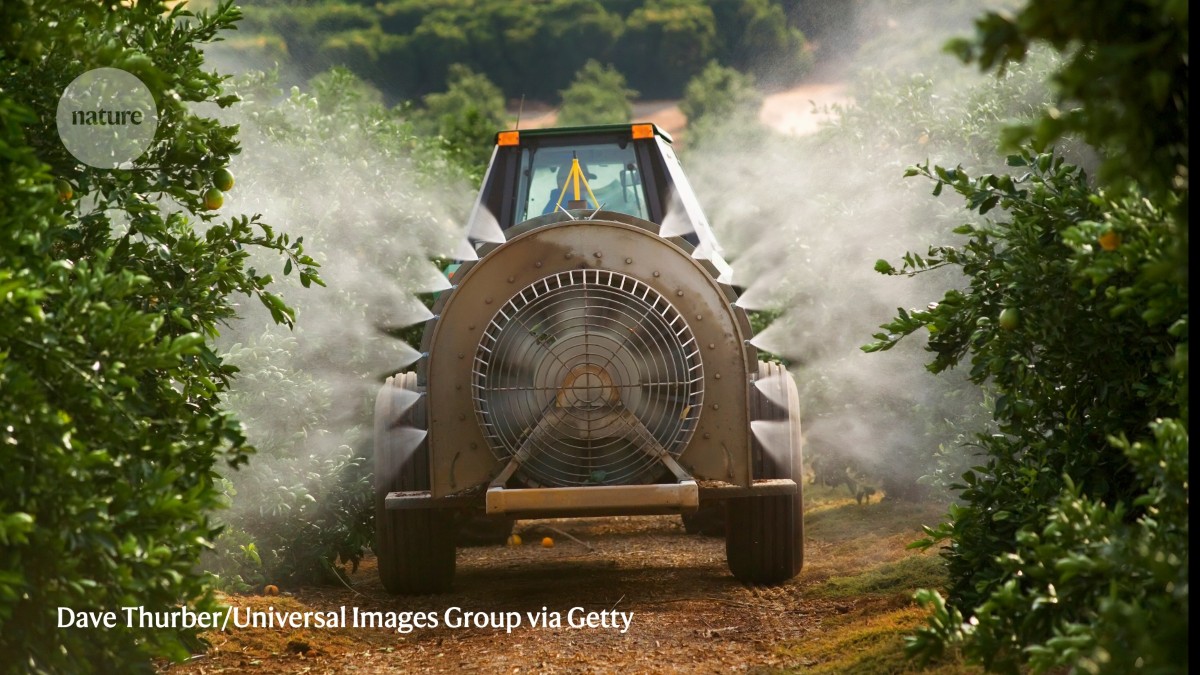

Fungicides are often sprayed onto crops in large quantities to prevent fungal diseases occurring later in the season.Credit: Dave Thurber/Design Pics Editorial/Universal Images Group via Getty
Not for nothing are fungi often described as the ‘hidden kingdom’. Many exist mainly or entirely underground, and only around 5% of the world’s fungal species are thought to have been discovered so far.
Although the problem of bacteria becoming resistant to the drugs used to defeat them has long attracted attention, its fungal parallel has flown mostly under the radar. “Very little research is done on human fungal infections compared to other types of infections,” says Matthew Fisher, a fungal epidemiologist at Imperial College London. He is one of a number of researchers who think that this urgently needs to change. “When it comes to antifungal resistance in the clinic, the situation is deteriorating alarmingly,” he says.

Nature Outlook: Antimicrobial resistance
Common fungal infections, such as thrush and athlete’s foot, are merely a source of discomfort. Most people can easily repel even the deadliest fungal pathogen, Aspergillus fumigatus, which is abundant in decaying plant matter and inhaled daily by most people without them noticing. But the same cannot be said for individuals with weakened immune defences.
For people with chronic lung diseases or HIV, or who are taking corticosteroids or other immunosuppressive drugs, a fungal infection can have serious consequences. David Denning, a medical mycologist at the University of Manchester, UK, estimates that more than 2.5 million deaths worldwide are caused by fungal infections annually, and that fungi contribute to another 1.2 million deaths ascribed to other conditions. Most deaths from fungal infections are caused by A. fumigatus — either in the lungs or, in the case of invasive aspergillosis, elsewhere in the body.
The main treatment is with drugs called azoles, resistance to which is a growing problem. In Dutch hospitals, for example, azole resistance in A. fumigatus samples obtained from patients increased from 8% in 2013 to 15% in 20181. It has also been found in 14% of A. fumigatus samples taken from soil in UK gardens2, and in around 80% of greenhouse soil samples in China3.
Expanding problem
Aspergillus fumigatus is not the only fungal pathogen that is gaining resistance. Since it was discovered in Japan in 2009, Candida auris has spread to more than 60 countries and is rapidly becoming resistant to treatment. It is “a quiet pandemic”, says Fisher.
Most cases are resistant to azoles, and some stand up to as many as four major classes of antifungal drug. This contributes to a death rate of between 30% and 60%.
“Candida auris is everywhere,” says Johanna Rhodes, a genomic epidemiologist at the University of Birmingham, UK. “It evolves drug-resistance mechanisms at a rate that we just don’t see in other pathogens.”
The fungus is intrinsically resistant to some antifungals and rapidly evolves resistance to others. A. fumigatus, by contrast, relies more on human help.
Hints of this emerged more than two decades ago, when Dutch researchers noticed that some samples of A. fumigatus taken from people who had not yet been treated for the infection were already drug resistant4. This was “strong evidence pointing towards environmental acquisition of resistance”, says Michael Bromley, a medical mycologist at the University of Manchester.
The evidence grew in 2022, when Rhodes, Fisher and their colleagues demonstrated that many azole-resistant A. fumigatus samples collected from people were almost identical genetically to those gathered from environmental sources5. “We have categorically proven that agricultural use of fungicides is driving the spread of resistance,” says Rhodes.
Others have pinpointed specific sources of azole resistance. Researchers in the Netherlands, for example, have measured particularly high levels of resistance in A. fumigatus spores from air collected in areas with greenhouse horticulture and flower-bulb production6. Another group found that soil from compost heaps in UK gardens was much more likely to include azole-resistant A. fumigatus than was soil from flower beds2.

Infection with the fungus Aspergillus fumigatus can be serious for individuals with weakened immune defences.Credit: Eye Of Science/Science Photo Library
Fisher is among those calling for tougher limits on the use of fungicides. “Our whole agricultural system is based on the use of fungicides, but this just causes fungal pathogens to evolve, so farmers use new fungicides,” he says. “The goal should be fungicide-free farming.”
Some researchers champion practices such as reduced soil disturbance and crop rotation as alternatives. But fungal diseases bring about pre-harvest crop losses of around 20%, so many farmers see fungicides as having a central role in food security. That makes it tough to cut back on their use.
High-level guidance
Other potential approaches were highlighted in a report published jointly by five European Union health and environment agencies in January 2025. Its recommendations include more-targeted approaches to azole fungicide use and improved storage of organic waste7.
And in 2022, the World Health Organization (WHO) published a fungal priority pathogens list that categorized 19 species by threat severity and called for measures to minimize resistance8. Those included improved surveillance and diagnostic capacity; global coordination on prevention and control; and research not just to optimize the use of existing antifungal therapies, but also to develop new ones.
The prospect of new drugs should be cause for optimism. The pipeline, however, is not rich. Development is lacking for all antimicrobials, and this is especially true of antifungals. In 2025, just 9 antifungal agents were in clinical development, compared with 90 antibacterial compounds. Only one class of antifungals has been approved since 2001.
This is partly because fungi are more closely related to animals than are bacteria. As a result, antifungal agents often have serious side effects. “We share a huge amount of biology, which makes it challenging to identify molecules that hit a target that is not present in humans,” says John Rex, chief medical officer at Functional Fungal Genomics (F2G) near Macclesfield, UK.
F2G has been developing an antifungal called olorofim since 2004, and a phase III trial for the treatment of invasive aspergillosis is expected to be completed later this year. Olorofim is the first of a new class of drugs that target an enzyme involved in synthesizing fungal DNA and RNA.
Fosmanogepix, another first-in-class antifungal, is in phase III trials for the treatment of fungal diseases, including those caused by C. auris. It, too, targets an enzyme — this time, one that is essential to the production of proteins in fungal cell walls. And ibrexafungerp, which was approved in the United States for vaginal Candida infections in 2021, is now in a phase III trial for various fungal diseases, including some caused by A. fumigatus.
George Thompson, a physician and fungal-disease researcher at the University of California, Davis, School of Medicine in Sacramento, has treated people with olorofim in early trials, and with fosmanogepix as part of a compassionate-use programme for individuals who don’t have any other options. “Both are complete game-changers,” he says. “Patients have been able to return to work, return to school and resume their normal lives in many cases.”
These hopes are tempered, however, by fears that the effectiveness of these freshly developed antifungals could also be undermined by agricultural fungicides. A fungicide called ipflufenoquin, which is licensed for use in the United States and several other countries, targets the same enzyme as olorofim does. Bromley’s group has shown in laboratory tests that ipflufenoquin can increase resistance to olorofim in A. fumigatus9. He is studying whether this can occur in the environment and, if so, at what levels of use. “We don’t yet know if that will emerge in the wild, but it is likely to,” he says.
Another fungicide, aminopyrifen, is as yet unlicensed, but works in the same way as fosmanogepix. “We’re in danger of repeating the mistakes of the past,” says Fisher. “Risk assessments for using chemicals in the environment don’t consider whether they cause antifungal resistance in human fungal pathogens.”
Antifungal futures
That’s why many in the field are calling for greater efforts to reserve new antifungal agents for clinical uses. “Of course we need fungicides for food security, but there are many other potential classes of fungicides that would cause side effects in humans but can be used in plants,” says medical mycologist Martin Hönigl at the Medical University of Graz in Austria. “The focus has to be on avoiding the use of fungicides that are from the same classes as the new antifungal drugs.”
Until recently, such ring-fencing seemed unlikely — the regulatory processes that govern approvals of agricultural fungicides have been mostly separate from those that control medical antifungals. But in October 2024, the US Environmental Protection Agency announced plans to recruit specialists from across government departments to provide input during the evaluation of new pesticides and consider whether they might drive resistance and reduce the effectiveness of drugs. The 2025 EU report also recommended that the approvals processes for fungicides take into account risks related to antifungal resistance.
These moves by policymakers and regulators are helpful, but tackling the antifungal resistance problem effectively will also require cooperation through bodies such as the WHO and the United Nations. “Drug-resistant pathogens aren’t confined by national borders,” says Thompson. “We need coordinated regulatory processes at a global level.”

