



You have full access to this article via your institution.
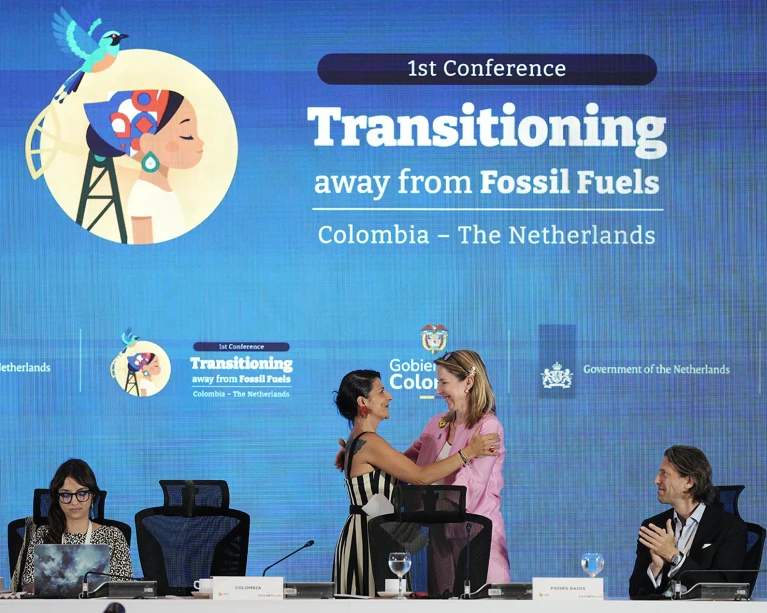
Colombia’s environment minister Irene Vélez Torres (left) with her Netherlands counterpart Stientje van Veldhoven in Santa Marta, Colombia.Credit: Ivan Valencia/AP Photo/Alamy
An important international climate-change initiative was launched last week: more than 50 countries gathered in Santa Marta, Colombia, for the First Conference on Transitioning Away from Fossil Fuels. Co-chaired by the governments of Colombia and the Netherlands, the initiative was born at least partly out of frustration with the official United Nations Conference of the Parties (COP) process, in which all UN member states attempt to work together on their climate-action policies. The Santa Marta meeting’s organizers said that their meeting was a forum to discuss practical steps to move away from fossil fuels. It is intended to complement the COP process, not replace it.
‘Beyond COP’ climate summit puts scientists at the centre of the action
The new initiative’s strong focus on having scientists lay out a path towards a fossil-free future deserves much applause. But it must not inadvertently undermine the scientific structures that inform climate policies all over the world — most notably the Intergovernmental Panel on Climate Change (IPCC).
Many climate scientists are disheartened by the COPs’ slow pace in addressing climate change. Scientific consensus leaves little doubt that, without more urgent action, a less stable, less prosperous future awaits humanity. First held in 1995, the annual COP events have failed to prioritize the creation of a road map for a just and equitable plan to phase out fossil-fuel use. This is despite overwhelming evidence that the world must do this to stay within 2 ºC of warming above pre-industrial levels and avert the most devastating effects of climate change.
As Nature’s news team reported last week, the formation of a panel of researchers representing different subdisciplines of climate science was also announced at the Santa Marta meeting (Nature https://doi.org/q5jd; 2026). Among other things, the Science Panel for the Global Energy Transition (SPGET) will help countries with their plans to phase out fossil fuels and provide benchmarks for progress.
What happened at COP30? 4 science take-homes from the climate summit
It’s heartening to see climate scientists at the centre of the initiative, providing advice to the governments that convened the meeting. At the same time, it’s important that SPGET’s leadership states explicitly that its science advice will be within the IPCC consensus.
SPGET and the IPCC have different roles. The IPCC is the UN body that assesses the latest climate research — but it does not issue climate-action recommendations to countries. SPGET, by contrast, will use scientific expertise and the best available evidence to advise countries on how to meet their goals to wind down fossil-fuel use.
It is important for SPGET’s leadership to clarify the distinction between the two and to reaffirm support for the IPCC to protect global collaboration in climate science from the swirling geopolitical winds. The United States is in the process of withdrawing from the IPCC, and there is a real risk that other countries could follow. The US withdrawal is undoubtedly a blow — not only because of the loss of funding, but also because, in the future, IPCC reviewers will not have access to climate data that the country currently contributes. If the IPCC edifice starts to crumble, it risks diminishing the quality of global climate science.
The US is quitting 66 global agencies: what does it mean for science?
There are climate scientists who would like the IPCC’s reports to be more prescriptive. However, that arises from a misunderstanding of the panel’s mandate, and the source of its credibility: its role is to enable scientists representing UN member states to agree on the facts, leaving it to the COP process and individual nations to decide how to act. Scientists from nearly every member country are in the room when the IPCC reports are written. As would be expected, plenty of arguments happen during that process — but, by the end, after the reports are signed off, every country must own the result, meaning they cannot deny its validity.
There is plenty of space for an action-focused science-advisory body such as SPGET. Scientists preparing to take up positions on the panel can have a useful, complementary role to those on the IPCC. They could issue more explicit recommendations on the basis of the available evidence, help to write road maps and agree on metrics of progress.
A climate-action refresh
How to fight climate change without the US: a guide to global action
SPGET could also help the new coalition of countries to broaden its impact. The major oil-producing states — including the United States and Saudi Arabia — were not invited to Santa Marta. Other countries that have advanced plans for decarbonization, such as China, were also not present. SPGET could include researchers from these and other countries that did not attend, and offer to advise their governments, too.
Researchers who spoke to Nature for our news report said that the atmosphere of the Santa Marta conference felt “refreshing”, because they were free to make ambitious, science-based recommendations, rather than the messy compromises driven by politics that are the characteristic outcome of the COPs. Gilberto Jannuzzi, an energy-transition specialist at the State University of Campinas in São Paulo, Brazil, said: “At the end, I think we found a smaller audience, but an audience that considers that we have something relevant to them.” That’s encouraging to hear. The real work now is to broaden that audience and coordinate efforts so as to effect the speedy, widespread change that the world needs.

