


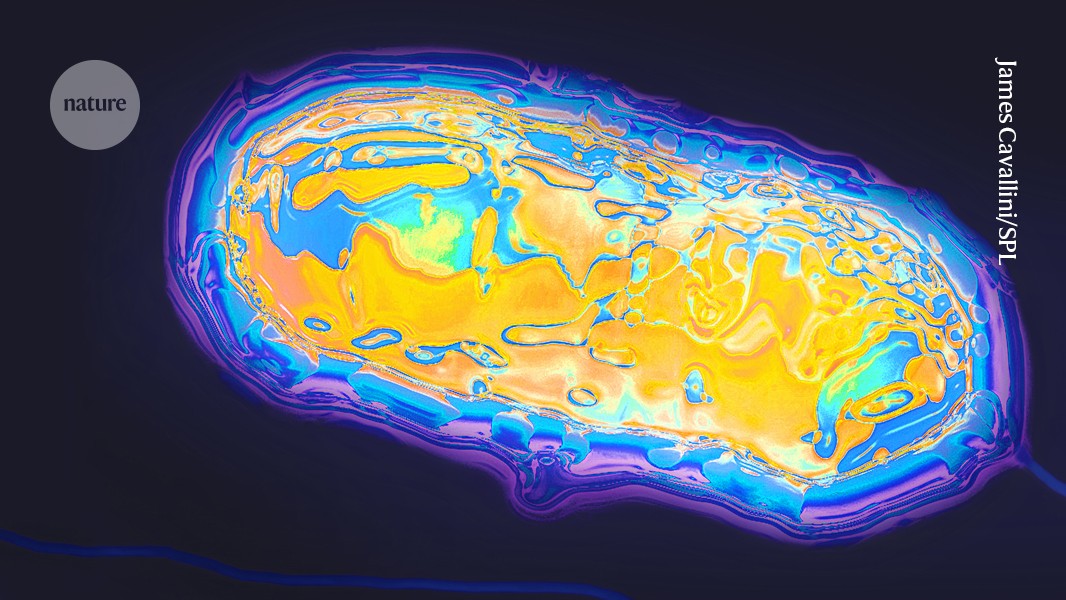

Scientists equipped Escherichia coli (example pictured) with ribosomes that lacked the amino acid isoleucine.Credit: James Cavallini/Science Photo Library
All life on Earth depends on the same molecular alphabet: 20 amino acids that cells string together to make proteins. But now, scientists have reengineered bacteria to run a core part of their cellular machinery with just 19 of those amino acids — a feat akin to rewriting one act of a Shakespearean play without a common letter like “R” while keeping the text intelligible. The work is reported today in Science1.
“It’s very exciting that it’s possible,” says Julius Fredens, a synthetic biologist at the National University of Singapore who was not involved in the research.
The work offers a blueprint for engineering cells with capabilities beyond those found in nature, the authors say, while also hinting at a simpler past when early life relied on a more limited set of building blocks.
Shrinking the script
Researchers have long sought to rewrite the genetic code of life, both to expand what cells can do and to probe the basic rules of life. For example, scientists have streamlined DNA by removing sequences that encode the same amino acid as other stretches. But most researchers have left the ‘canonical’ 20 amino acids untouched, because even small changes to a protein’s amino-acid sequence tend to disrupt its function.

AI can write genomes — how long until it creates synthetic life?
The challenge of subtracting a letter from the vocabulary of proteins intrigued Harris Wang — though his early attempts fell short. A synthetic biologist at Columbia University in New York City, Wang initially tried simply swapping one amino acid — isoleucine — with others that differ slightly in size and shape, but fewer than half of his modified proteins remaining functional.
Wang shelved the project for a few years, until a new generation of artificial-intelligence tools began to change what was possible. Systems such as AlphaFold can predict a protein’s 3D structure, and various protein language models can now suggest entirely new amino-acid sequences that fold and function. Crucially for Wang, these tools could point to non-intuitive ways that might allow replacement of isoleucine without undermining protein performance.
Still, reworking all 4,000-plus proteins in the bacterium Escherichia coli seemed too daunting a challenge. Instead, Wang chose a more focused, if still ambitious, target: the ribosome.
Proving the principle
The ribosome — a complex of more than 50 proteins and catalytic RNA — sits at the heart of the cell, translating genetic instructions into proteins. If such a critical system could operate without isoleucine, Wang reasoned, the same approach might extend to the rest of the proteome.
Engineered yeast breaks new record: a genome with over 50% synthetic DNA

