


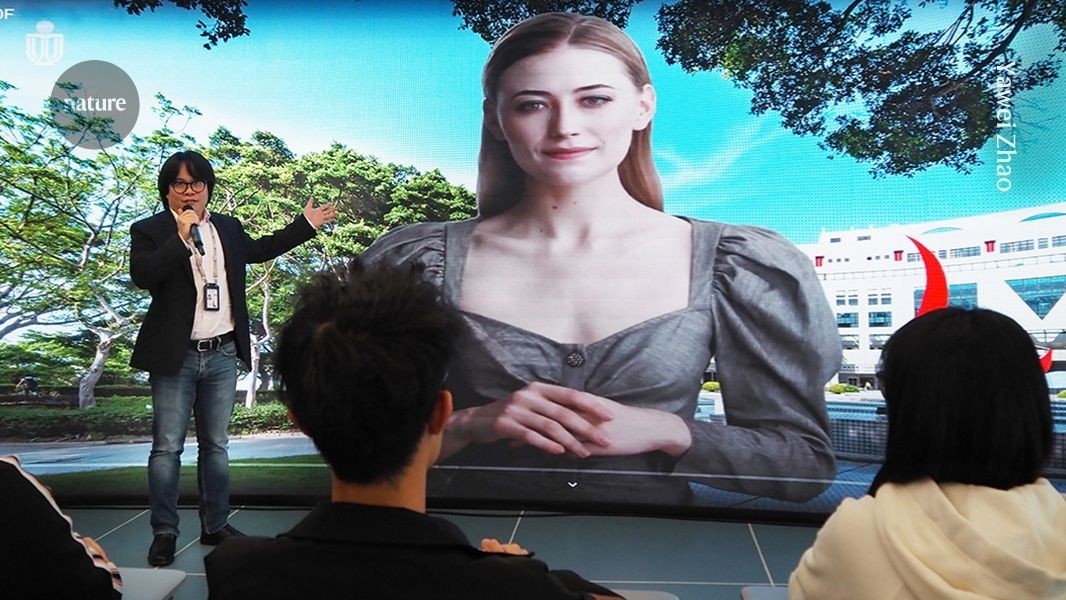

Computer scientist Pan Hui with a digital teaching avatar used at the Hong Kong University of Science and Technology in Guangzhou.Credit: Yawei Zhao
At the Hong Kong University of Science and Technology in Guangzhou, students can listen to lectures given by AI avatars that look and speak just like Albert Einstein or mathematician John Nash. The avatars can even answer students’ questions.
Universities are one of many settings in China where virtual avatars are being deployed. These computer-generated figures are built using artificial-intelligence tools, including video-generation models and large language models (LLMs), enabling them to speak and have conversations. Some of the first examples were digital salespeople on platforms such as the shopping website Taobao and Douyin, China’s version of TikTok.
More than 1.3 million companies in China offer digital avatar services, according to a 2024 Chinese government report. They’re being used in health care, in education and as social companions at home, says Mengjiao Yin, a researcher studying AI and digital humans at Wuxi Taihu University in Wuxi. Although Yin hasn’t yet heard of any scientist avatars working in laboratories, she thinks they are not far off.
AI avatars — also called digital humans — are likely to “profoundly transform” daily life and reshape every aspect of human society, says Yang Liu, a computer scientist at Tsinghua University in Beijing. “Acting as our proxies and assistants, they will take on a wide range of tasks and greatly boost productivity,” he adds. But the technology behind digital humans still needs to improve, and equal effort will have to be put into developing ethical standards and frameworks for how AI avatars operate, adds Liu.
With uptake so widespread, the government is trying to keep up. The Cyberspace Administration of China, the country’s cyberspace regulator, has released rules for how virtual digital humans should be developed and used, which come into effect today. The regulations encourage the use of AI avatars across China, and aim to boost collaborations between academia and developers of digital human technology. The widespread societal use of AI is a priority for China, and is part of the country’s latest five-year plan for social and economic development, which was published earlier this year.
Streamlining health care
Liu is part of a team at Tsinghua University in Beijing that have developed a virtual hospital simulation, called Agent Hospital, which comprises AI doctors, nurses and patients and is designed to train virtual doctors on how to tackle illnesses from diagnosis to treatment1.
Trials of Agent Hospital began in eight hospitals across China in November 2025, says Liu. Human physicians working at the hospitals have personal digital avatars to help them with tasks such as writing medical notes, recommending medical tests and proposing treatment plans. He says that, despite this, human physicians at the hospitals still make all decisions about a person’s care.
Separately, the technology provider Ant Group, based in Hangzhou, launched an AI-powered health app last June, which includes digital versions of more than 1,000 real-world physicians that can answer patients’ questions. By January, the app had 30 million active monthly users, according to company documents.
Easing education
Computer scientist Pan Hui and his team at the Hong Kong University of Science and Technology in Guangzhou started using AI avatars for teaching in 2024. He created ten digital lecturers that taught part of a social-media subject. In addition to avatars based on Einstein and Nash, the lecturers included fictional characters of different ages and nationalities, and an avatar based on Hui.
Hui says development of the AI lecturers was inspired by students asking for more guest lecturers to deliver course content. Currently, the team uses a mix of AI lecturers that are interactive or that deliver content in pre-recorded videos, both of which require a lot of computing power to generate. As the technology powering AI avatars continues to improve, Hui says he sees them being used as personal tutors that are always available.
Digital companions
Virtual human services are also being used to boost social interactions. For example, one social-media networking service, called Elys, allows users to create AI clones of themselves that socialize with other avatars through commenting and liking posts without the human user needing to be online. Some people have been using the service as a dating app to find suitable matches, says Yin.

