


Computational prediction of T3SS effectors
To determine which Buchnera proteins are most likely to be secreted by a T3SS, the complete proteome of Buchnera-Ap (UniProt: UP000001806) was run in BastionX, an online tool that predicts the likelihood of a given protein to be a substrate for bacterial secretion systems (https://bastionx.erc.monash.edu/server.jsp)16. The benchmarking parameter for v.2.0 of BastionX was selected for the run (see Supplementary Dataset 1 at Figshare17). An earlier version, Bastion3, had a false positive rate of 4.1%53, and this rate is expected to be lower in BastionX.
To determine the likelihood of SyeA orthologues from diverse Buchnera being substrates for a T3SS, a total of 103 SyeA orthologues was run in BastionX, with the common use parameter for v.2.0 selected (see Supplementary Dataset 2 at Figshare17).
syeA, syeB and flagellar genes in Buchnera
To survey the presence and absence of syeA, syeB and flagellar basal body genes in a wide range of Buchnera strains, the genomes of Buchnera strains uploaded to NCBI GenBank were selected for comparative orthology analysis (see Supplementary Dataset 2 at Figshare17). The most recently uploaded Buchnera genome from each available host aphid species (22 April 2025) was chosen. Contig- and scaffold-level assemblies were excluded. If available, the RefSeq annotation was used over the GenBank annotation. A total of 113 proteomes was collected and run on OrthoFinder v.3.0 (using the default parameters)19 to generate orthogroups. Orthogroups corresponding to the 26 flagellar basal body genes present in Buchnera-Ap (12 flg, 2 flh and 12 fli genes), along with syeA and syeB, were identified using the known accession numbers of the protein sequences from Buchnera-Ap (see Supplementary Dataset 3 at Figshare17). The percentage of total flagellar basal body genes was calculated for each species (see Supplementary Dataset 4 at Figshare17).
Genomes deemed by OrthoFinder to lack syeA were manually examined to check for the presence of divergent syeA homologues. Genomic rearrangements are rare in Buchnera45. To examine the gene neighbourhood across Buchnera strains, we selected conserved neighbouring genes (hslV, hlsU and rho) retained in all lineages and flanking syeA (Fig. 2b). We downloaded these regions as fasta files from NCBI, re-annotated them with Prokka (v.1.14.6)54 and used Clinker55 and Gene Graphics56 for calculating pairwise sequence similarity and for visualization. If present, the corresponding protein sequence was run through NCBI BLASTp to check for hits against SyeA orthologues in other Buchnera strains. In two cases (Buchnera of the related species Cavariella theobaldi and Pterocomma populeum), the syeA region contains a short hypothetical protein on the strand normally encoding syeA flanked by expanded stretches of non-coding DNA, but the hypothetical proteins showed no detectable sequence or structural similarity to SyeA, which was therefore scored as missing. Likewise, Buchnera of tribe Macrosiphini encoded SyeB with recognizable sequence homology across species, whereas Buchnera of tribe Aphidini encoded a short protein in the same position, but without sequence similarity to SyeB. For the 10 genomes missing syeA, we manually examined all unannotated open reading frames (encoding hypothetical proteins) greater than 50 amino acids for sequence homology to SyeA.
To visualize the presence and absence patterns of syeA, syeB and flagellar genes across Buchnera, a published Buchnera phylogeny57 was used to create a cladogram using a select number of Buchnera genomes from host aphid species representing all major subfamilies and collapsing less-supported nodes (Fig. 2a).
Rate of SyeA sequence evolution
To examine the rates of evolution of Buchnera proteins, coding sequences for Buchnera strains Buchnera-Ap (GCF_000009605.1), Buchnera-Ak (GCF_000225445), and Buchnera-Sg (GCF_000007365.1) were accessed from NCBI. Calculations were implemented in R (v.4.3.0) using the package Orthologr58. Only orthologous genes shared by all three strains were included. The dNdS module was used to estimate dN (number of nonsynonymous substitutions per nonsynonymous site) for each gene of Buchnera-Ap paired with its orthologue in each of the other two species.
Structural similarity searches
To examine the structural similarity across divergent Buchnera strains, AlphaFold-predicted structures were used for comparison (AlphaFold Monomer v.2.0). Previously computed .pdb files were downloaded from UniProt, and similarity was assessed using FoldMason on the FoldSeek online server59. Similarity was also scored using the DALI protein server60.
For similarity searches in genomes other than Buchnera, SyeA of Buchnera-Ap (UniProt: P57644) was used as a search query against the Protein Data Bank. Moreover, structural searches were performed against the AlphaFold-predicted protein database AFDB. To assess structural alignment quality, pairwise comparisons between SyeA of Buchnera-Ap (UniProt: P57644), EspG and VirA (UniProt: Q5WMC0 and Q7BU69) were performed using DALI and the resulting Z scores and r.m.s.d. values were obtained. We also downloaded AlphaFold-predicted structures for the conserved C-terminal region of SyeA for several distantly related Buchnera lineages (Buchnera-Cc, Buchnera-Ua and Buchnera-Bp, corresponding to UniProt Q5EU88, G2LQ59 and Q89A26) and compared these to that for Buchnera-Ap to assess extent of structural similarity across Buchnera. To visualize protein structures, we used UCSF ChimeraX (v.1.9)52.
Antibody production
Two anti-SyeA polyclonal antibodies against SyeA of Buchnera-Ap were generated by a third-party service (BioMatik) by generating reactive sera in rabbit against a conserved SyeA peptide (amino acids 272–286) and against a heterologously expressed full-length His6-tagged SyeA. The secondary antibody for both was goat anti-rabbit-Alexa Fluor 647 (Thermo Fisher Scientific, A21245). We demonstrated antibody specificity with controls consisting of E. coli containing the same plasmid but lacking syeA (Extended Data Fig. 5a–c).
The Rab7 GTPases are highly conserved, enabling us to use available antibodies for other animal species. For visualizing Rab7, we used a mouse IgG2b monoclonal antibody (Sigma-Aldrich R8779), which was previously shown to have specificity for Rab7 in A. pisum6. The secondary antibody was goat anti-mouse IgG2b-Alexa Fluor 568 (Thermo Fisher Scientific, A21144).
Heterologous expression of SyeA
We heterologously expressed His6-tagged SyeA in E. coli. Use of molecular chaperones and low induction temperatures can aid expression of unstable endosymbiont proteins61, so we used Arctic Express, a BL21 expression strain that is compatible with inducible expression plasmids and that expresses chaperone proteins from the cold-adapted bacterium Oleispira antarctica62.
The syeA gene was amplified from Buchnera genomic DNA purified from a laboratory colony of A. pisum strain LSR1 and cloned into the pET28b vector, which added a His6 tag and placed it under an inducible T7 promoter. The resulting plasmid was transformed into Arctic Express cells through electroporation. A control was made using the same plasmid but lacking the syeA region. To determine suitable expression conditions for SyeA, we used overnight Arctic Express cultures to inoculate fresh LB cultures at a starting optical density (600 nm) of 0.1 and grew them at 30 °C until they reached exponential phase (optical density of around 0.4–0.6), when they were either kept at 30 °C or transferred to 15 °C or 4 °C. Expression was induced by adding 0.1–1.0 mM IPTG. Cultures were grown for up to 24 h after induction.
To detect expressed SyeA, culture samples were pelleted and processed with bacterial lysis buffer and lysozyme to obtain soluble protein fractions. The remaining insoluble pellets were denatured and solubilized in urea and SDS. Both soluble and insoluble fractions of each temperature and IPTG concentration condition were analysed by Coomassie staining or western blotting with anti-His6-tag antibodies (see below). SyeA bands on both Coomassie staining and western blotting were seen only in cultures grown at 30 °C and induced at 0.05, 0.1 and 0.5 mM, and only in insoluble fractions, indicating misfolding or aggregation in inclusion bodies (Extended Data Fig. 5a). SyeA expression was highest with 0.05 mM IPTG at 30 °C (Extended Data Fig. 5b).
We hypothesized that the non-conserved N-terminal region might be causing aggregation and insolubility of SyeA expressed in E. coli. As only the C terminus is conserved, we reasoned that further studies of SyeA may not be affected by and may even be helped by expressing only this portion. Therefore, using a third-party service (Twist Bioscience), we generated a gene fragment for producing SyeAΔ, a construct lacking the 172 amino acids of the N terminus, with an N-terminal His6 tag and codon-optimized for E. coli. PCR was used to add overhangs to the gene fragment, allowing for cloning into the pET28b vector using Gibson Assembly Master Mix (New England Biolabs). The gene fragment was cloned into the same pET28b vector used for full syeA sequence and expressed using conditions most successful for the full-length SyeA (uninduced or induced at 0.05 mM IPTG at 30 °C, sampled 24 h post-induction). Cultures were pelleted, and pellets solubilized, followed by SDS–PAGE and Coomassie staining and western blotting. SyeAΔ showed better expression than full-length SyeA but remained in the insoluble fraction (Extended Data Fig. 5c).
Cell-free expression of SyeAΔ
As SyeAΔ was insoluble in heterologous expression experiments, we used the NEBExpress Cell-free E. coli protein synthesis system and added the pET28b-SyeAΔ construct. After incubation for 2–3 h at 37 °C, we confirmed that soluble SyeAΔ was expressed by comparing protein bands to a negative control lacking added DNA (not shown). We purified SyeAΔ from pooled cell-free expression mixtures using a nickel resin spin column, yielding 0.5 mg ml−1 in the final eluate. SyeAΔ was also expressed using the PURExpress In Vitro Protein Synthesis Kit (New England Biolabs), using 0.25 μl of the vector and incubating at 37 °C for 2 h. Purification was confirmed with SDS–PAGE and Coomassie staining (Extended Data Fig. 5d).
SyeA detection in aphid samples
To detect SyeA from aphid bacteriocytes, 100 14-day-old A. pisum str. LSR1 aphids were dissected in cold buffer A (25 mM KCl, 35 mM Tris, 10 mM MgCl2, 250 mM sucrose, 250 mM EDTA, pH 7.5) to separate and collect bacteriocytes. Bacteriocytes were then homogenized in cell lysis buffer (25 mM Tris, 0.15 M NaCl, 1 mM EDTA, 1% Triton X-100, 5% glycerol) using a pestle, then centrifuged at 12,000 rpm for 20 min at 4 °C to separate protein lysate from cell debris. For negative controls for western blots, samples containing only embryos and surrounding follicle cells from stages before Buchnera colonization were collected from five aphids.
To detect SyeA and SyeB from whole aphids using mass spectrometry, protein lysate samples from 7-day-old aphids were mixed with 6× SDS dye (0.6 M DTT, 0.35 M Tris pH 6.8, 30% (v/v) glycerol, 10% (w/v) SDS, 0.012% (w/v) bromophenol blue), boiled at 100 °C for 10 min, and run on a 12% acrylamide gel for 2 min. The gel was stained with Coomassie Brilliant Blue G-250 (3 g l−1 in 45% H2O, 45% methanol, 10% glacial acetic acid) for 10 min, then destained overnight in destain solution (85% H2O, 10% glacial acetic acid, 5% ethanol). The protein band was cut out and run in liquid chromatography coupled with tandem mass spectrometry shotgun proteomics by the University of Texas Biological Mass Spectrometry Facility. Two samples were run and analysed using Scaffold5 (https://www.proteomesoftware.com). We detected total peptide spectra counts mapping to Buchnera-Ap of 112,094 and 109,193 in the two samples. Of these SyeA was represented by 6 and 6 spectra, and SyeB by 2 and 3 spectra in the two samples. Mass spectrometry proteomics data were deposited to the ProteomeXchange Consortium via the PRIDE63 partner repository under dataset identifier PXD066113.
To detect SyeA with western blotting, protein lysate samples were mixed with 6× SDS dye, boiled at 100 °C for 10 min and run on a 12% acrylamide gel at 120 V for 1 h. Protein on the gel was subsequently transferred to a PVDF membrane using the Mini Blot Module (Thermo Fisher Scientific) at 20 V and 400 mA for 1 h. The membranes were washed in blocking milk buffer (5% skimmed milk powder in 1× TBST) for 1 h at room temperature, then incubated with 10 ml primary antibody milk (1:10,000 anti-SyeA antibody A in blocking milk buffer) overnight at 4 °C. The membranes were then washed twice for 5 min with blocking milk buffer, then incubated with 10 ml secondary antibody milk (1:1,500 goat anti-rabbit Alexa Fluor 680, Abcam) for 90 min at room temperature. Finally, the membranes were washed three times for 5 min with blocking milk buffer and once for 10 min with 1× TBST and imaged using the Odyssey CLx (LI-COR Biosciences) system using the 700 nm channel. To avoid potential loss of SyeA during the protein purification process, 50 μl of 6× SDS dye was added directly to bacteriocytes dissected from 100 LSR1 aphids and boiled at 100 °C for 10 min. Then, 15 μl was loaded onto an SDS–PAGE gel, and western blotting was performed using anti-SyeA antibodies at the same concentration as before (Extended Data Fig. 5e,f). Both anti-SyeA antibodies were used in different western blots.
Immunofluorescence microscopy
Immunofluorescence microscopy was performed based on a published protocol6. Antibodies described above were used to visualize SyeA and Rab7. Secondary antibodies were as follows: goat anti-rabbit AF-647 (Thermo Fisher Scientific, A-21245) and goat anti-mouse IgG2b AF-568 (lnvitrogen, A-21144). Actin was visualized with phalloidin-CF488 (Biotium 0042T). Aphid membranes, peptidoglycan of the Buchnera cell wall and chitin were visualized with WGA-CF488 (Biotium, 29022) (because Buchnera has lost most outer membrane components, WGA is not expected to bind to its membrane36,43). DAPI was used as a DNA stain.
For each experiment, same-aged aphids (age depending on experiment) were dissected in cold PBS to obtain embryos or bacteriocytes, and these were fixed in 3.7% formaldehyde in PBS on ice for 20–25 min. The samples were washed once in PBS and permeabilized in PAXD-Tween-20 (PBS, 5% BSA, 0.3% sodium deoxycholate, 0.3% Tween-20). The primary antibody (anti-SyeA or anti-Rab7) was diluted to 5 µg ml−1 in PAXD-Tween-20 and incubated overnight at 4 °C. The samples were washed once in PBST and blocked with PAXD-Tween-20 for 30 min. Secondary antibody incubation was performed using a 1:200 dilution to 10 µg ml−1 in PAXD-Tween-20 with DAPI, and incubated at 4 °C overnight. The samples were then washed twice with PBS and mounted in SlowFade Mounting Medium. The mounted samples were imaged using either the Nikon Eclipse epifluorescence microscope, or the Nikon AXR-NSPARC laser-scanning microscope with an NSPARC detector. Off-target binding was assessed using negative controls lacking primary antibody. Additional controls for SyeA included embryos before colonization at stage 7. Control and experimental samples were otherwise treated the same and imaged under the same settings.
For mature bacteriocytes, the fluorescence signal was visualized for both Rab7 and SyeA. The signal intensity was quantified for both channels for 122 individual symbiosomal compartments within 7 bacteriocytes, to measure the extent to which they co-occur within single compartments, by calculating Pearson’s correlation coefficient.
syeA knockdown with PNA
Although genetic manipulation of Buchnera has not yet been possible, recent studies showed the successful application of PNAs to reduce expression of targeted genes in Buchnera-Ap35,36. PNAs target the mRNA and interfere with translation or induce degradation of the transcript. A synthetic oligonucleotide complementary to the target gene is attached to a cell-penetrating peptide, which has been shown to increase uptake by cells. We applied this method to observe effects of reducing expression of syeA on the symbiosis. We designed PNAs using MASON, a package for designing targeted PNAs with no off-target hits within a genome64. For the anti-syeA PNA, we used a sequence (TGTTCAGGAATT) that targets the beginning of the coding sequence of syeA including the start codon (ATT for this gene, as the AT-rich Buchnera genome often uses this alternative start codon). The control PNA used an oligonucleotide (AAGTCTTATGGT) of the same composition and length but scrambled and designed to prevent off-target matches. The PNAs consisted of these oligonucleotides each linked to an arginine-rich cell-penetrating peptide (RXRRXRRXRRXRB-O-) to enable entry of the molecule into cells. PNAs were synthesized by PNA Bio.
Lyophilized PNAs were resuspended to 200 µM in water. Aphids were injected at the base of the hindleg with approximately 0.1 µl of 100 µM PNA in 6 mM CaCl2 using a microinjector (Narishige, IM-400) (MPa = 0.037, 0.2 s) and bevelled 5 µl calibrated pipettes (VWR). Injected aphids were placed on fresh Vicia faba leaves in Petri dishes and either sampled 24 h later (for knockdown validation and Lysoviewer assays) or placed on V. faba plants and sampled at 7 days (for embryo phenotyping).
Validation of syeA knockdown
To verify that the anti-syeA PNA reduces syeA transcripts, RNA was extracted from single, whole aphids 24 h after injection, with 12 anti-syeA and 12 control individuals. Each aphid was transferred to a 1.5 ml pestle tube to which 200 μl of Tri Reagent (MRI) was added, homogenized for 30 s with a plastic pestle (MilliporeSigma) to promote cell lysis, then kept on ice until all of the samples were ready. RNA extraction was performed using the Zymo Direct-zol kit (Zymo Research, R2052) according to the protocol provided with the kit, including a DNase treatment and eluting with 50 μl molecular-grade water. The concentration and integrity were checked using both the Nanodrop (1 μl) and Qubit BR RNA (5 μl), and by running on an agarose gel. cDNA synthesis was performed using the PrimeScript cDNA synthesis kit (Takara Bio, RR037A) according to the kit protocol and using 200 ng of total RNA (calculated based on Qubit concentrations) for each 10 μl reaction.
dPCR was performed on 2 μl of a 1:10 solution of the cDNA for each sample. Primers were as follows: SyeA_4F (GAAGCGACTATTTCTTTATCTGAAC) and SyeA_4R (AGGATGCCGTGGATTATTATTT) and were first tested with serial dilutions of aphid cDNA to verify low variability and linearity of reported concentration. Assays were run on a Qiagen QIAcuity One, 2-plex dPCR machine (Qiagen) with a 24-well 26K nanoplate (250001). The assay used the QIAcuity 3× EvaGreen PCR Master Mix (250113) according to the manufacturer’s recommended set-up and cycling conditions, with annealing temperature of 58 °C (Qiagen, HB-2791 01/2021). The plate was imaged at 200 ms with a gain of 1. All reactions had acceptable levels of partition occupancy and mean 95% confidence intervals ± 1.9%. Results from the dPCR were back-transformed to copies per ng of input RNA, and adjusted values were log10-transformed for statistical comparisons. Results were analysed for normality, homoscedasticity and tested using a nonparametric Wilcoxon rank-sum test with continuity correction. To consider possible treatment effects on Buchnera numbers, we quantified syeA transcripts relative to transcripts of a control Buchnera gene rne, encoding ribonuclease E. Methods were the same as for syeA, using primers the 5AL81_F and 5AL81_R49. Statistics were performed using base commands in R v.4.4.3 along with the packages ggplot2 in Tidyverse v.2.0.0, effectsize v.1.0.1 and Cairo v.1.6-2. Values for number of syeA transcripts divided by number of rne transcripts were normally distributed with equivalent variance, so we used a Welch two-sample t-test.
Embryo phenotypes after syeA knockdown
To determine whether syeA knockdown causes defects in colonization or development, 7-day-old (4th instar) aphids, which contain developing embryos, were injected with control PNAs or anti-syeA PNAs. To examine the phenotypes of embryos undergoing colonization at the time of exposure, we sampled 7 days later. Birth occurs 8–10 days after Buchnera colonization9,37,65, and our sampling time was chosen so that embryos exposed at colonization would be near the end of prenatal development when sampled.
We performed fluorescence in situ hybridization (FISH) to visualize Buchnera within the embryos. Aphids were dissected in 70% ethanol and fixed in Carnoy’s solution (60% ethanol, 30% chloroform, 10% acetic acid) for 1 h then dehydrated in successive washes of 100% ethanol. The samples were then bleached in 6% hydrogen peroxide in 80% ethanol at room temperature for 1 week, with the solution replaced every 2 days. Fixed bleached samples were washed in 70% ethanol before rehydration in PBST. FISH analysis was performed as previously described20 in buffer (20 mM Tris-HCl, 0.9 M NaCl, 0.01% SDS, 30% formamide) with DAPI and the Buchnera-specific probe ApisP2A-Cy5 (5′-Cy5-CCTCTTTGGGTAGATCC-3′). Samples consisting of 28 treatment and 25 control mothers were imaged under a Nikon Eclipse Epifluorescence microscope. Each was scored for presence or absence of clearly deformed embryos. Deformities included reversal of orientation, abnormal shape, smaller size or lack of eye pigment relative to the more anterior (younger) embryo.
Lysosome quantification after knockdown
To examine the effect of syeA knockdown on lysosome production in maternal bacteriocytes, 4–5-day-old (3rd instar) aphids were injected as described above. After 24 h, injected aphids were dissected in cold PBS, and bacteriocytes from individual aphids were placed into 0.2 ml tubes with 1× LysoView640 (Biotium) and DAPI. The samples were incubated for 30 min and imaged under the Nikon Eclipse Epifluorescence microscope. Using NIS-Elements BR, bacteriocytes were selected by defining a circular region of interest centred on the nucleus. The bacteriocyte area was measured as area of DAPI staining, and lysosome activity was measured as Cy5-stained area. The ratio of Cy5:DAPI was used to estimate lysosome activity per bacteriocyte.
Transmission electron microscopy to visualize flagellar basal bodies
The protocol followed that published previously15. Bacteriocytes of 7-day-old A. pisum strain LSR1 were dissected into buffer A, homogenized with a pestle, centrifuged at 4 °C for 20 min, resuspended in buffer A and kept on ice. A drop of the suspension was transferred to a carbon film-coated 400 mesh copper grid and allowed to be absorbed for 1–3 min, then dried with filter paper. Negative staining was performed as described previously15 and imaging performed immediately on a Jeol 1400Flash electron microscope.
Statistics and reproducibility
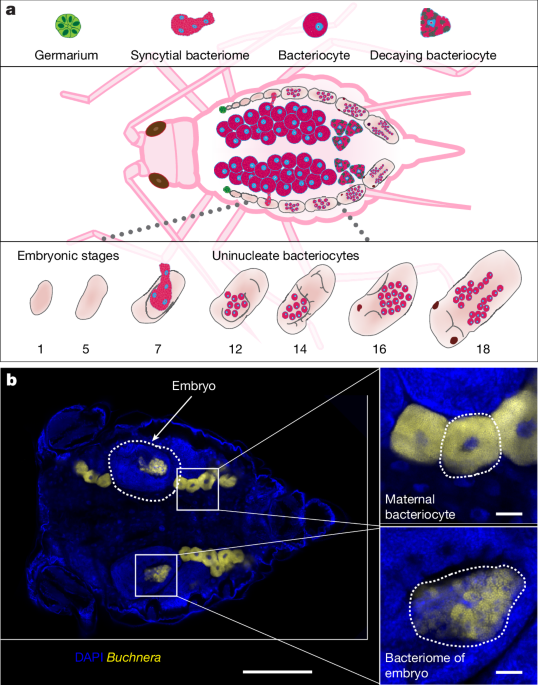
Figure 1b is representative of three independent aphid samples. Figures 4–5 and Extended Data Figs. 6 and 7 show representative images of immunofluorescence microscopy experiments carried out by three investigators. High SyeA expression in syncytia of stages 7–9 embryos (representative images in Fig. 4a,b and Extended Data Fig. 6d–f) was consistent across 6 independent aphid samples from the same and different experiments. High SyeA signal after entry to the syncytium at stage 7 (Fig. 4b) was observed in 6 independent samples across experiments. An actin mass associated with highly expressed SyeA within the extruding syncytium (Fig. 4c) was observed in five independent samples. SyeA signal forming rings at the periphery of Buchnera cells at stages 7–8 (Fig. 4d and Extended Data Fig. 6d–f) was observed in 5 independent aphid samples across experiments. The distribution of SyeA signal in bacteriocyte cytoplasm outside the actin layer after stage 9 (Fig. 4e,f and Extended Data Fig. 6g–i) was observed in 6 independent aphid samples across experiments. The pattern of SyeA signal in mature bacteriocytes of young (5–7 days old) and old (15–22 days old) aphids (Fig. 5a,c,d and Extended Data Fig. 7b–d) was observed in 8 independent samples. Negative controls for SyeA (Extended Data Figs. 6a and 7a) were included in each immunofluorescence experiment and examined for nine independent samples. The relationship between Rab7 and SyeA signal (Fig. 5c,d) was estimated for 122 symbiosomes from 7 independent samples.
The effect of PNA knockdown on syeA transcript numbers (Fig. 6b) was measured for 12 independent aphid samples each for anti-syeA treatment and controls. The effects on embryo development (Fig. 6c,d) were observed in 2 independent experiments comprising 43 control and 43 anti-syeA-treated independent maternal aphids, and both experiments revealed significantly more deformed and stunted embryos in the anti-syeA mothers relative to in the controls (two-sided Fisher’s exact test, P = 0.0058 and P = 0.0127). FISH microscopy (Fig. 6d) to observe effects on Buchnera colonization was performed on five anti-syeA samples and five controls. The effect of knockdown on lysosomal activity (Fig. 6e,f) was measured in 158 bacteriocytes from 8 treated aphids and 147 bacteriocytes from 8 control aphids. No PNA knockdown results were excluded.
Buchnera basal bodies (Extended Data Fig. 1) were observed in five negative-stain transmission electron microscopy images.
For images of gels and western blots (Extended Data Fig. 5), the numbers of independent experiments showing observed results were as follows, referring to the panels of Extended Data Fig. 5: 5 for 5a, 3 for 5b, 3 for 5c, 3 for 5d. For 5e, only one experiment included all four aphid species, but five other experiments with the same antibody show the same-sized band for independent samples of the focal species (A. pisum). For 5f, 5 experiments show the approximately 36 kDa band for bacteriocyte samples.
Reporting summary
Further information on research design is available in the Nature Portfolio Reporting Summary linked to this article.

