


Bacterial strains and plasmids
Bacterial strains and plasmids used in this study are listed in Supplementary Table 7.
Screening of WAC library for antimicrobial activity
The pre-fractionation library from the WAC6 was screened against hyperpermeable efflux-deficient E. coli BW25113 ΔtolCΔbamB in 384-well microtitre plates (Corning 3701). Each well contained 49 μl of inoculated Mueller–Hinton broth (MHB) medium (cation-adjusted MHB (BD Difco)) and 1 μl of crude methanolic extract, fractions, or conditioned medium. A Biomek FXP Integrated Liquid Handler was used to dispense the fractions, extracts, and inoculated media into the plates. Plates were incubated at 37 °C for 20 h in a static incubator. Cell growth was measured by OD at 600 nm using EnVision, SpectraMax, or Biotek Neo microtitre plate readers.
Purification of MKMs
S. rimosus WAC 7405 was routinely cultured in tryptic soy broth (TSB) medium (Difco) in 225 ml flasks for 16 h, before inoculating at 1% (v/v) into ASM medium58 in 2.8 l flasks for 4 days. Cultures were maintained at 30 °C, shaking at 220 rpm.
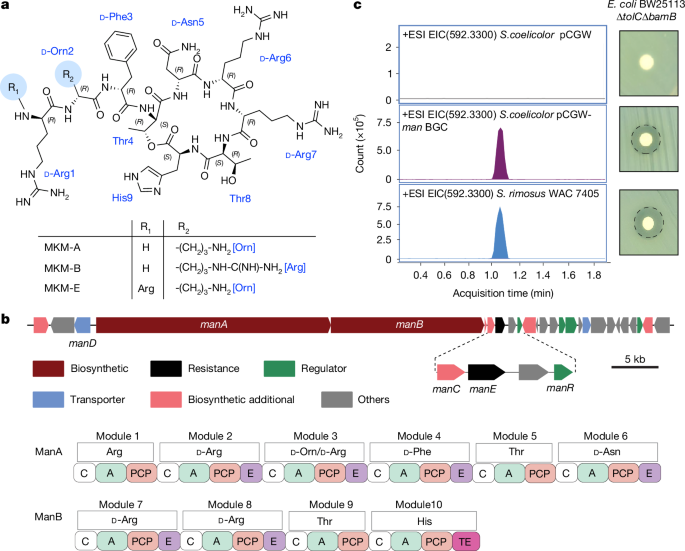
During initial discovery, the active compound, as defined by routine testing against E. coli BW25113 ΔtolCΔbamB, was isolated from conditioned medium mixed with 5% (v/v) Diaion HP-20 resin, mixed for 2.5 h. HP-20 resin was filtered using a milk filter and extracted with 300 ml of methanol for 2 h. The extract was collected and dried by rotary evaporation. After reconstitution in 10 ml water, compounds were separated by Sephadex LH-20 column (300 ml bed volume) and eluted with 50% methanol to yield 7× 50 ml fractions. Active fractions were analysed by the liquid chromatography–tandem mass spectrometry (LC–MS/MS) method; for this analysis, mass range was set to 150–2,500 m/z at a scan rate of 1 spectrum s−1. Three collision energies of 10, 30, 60 eV were selected with a medium isolation width of 4 atomic mass units. The liquid chromatography was performed using a gradient of H2O (0.1% formic acid v/v) and acetonitrile on an Eclipse SDB-C8 column (2.1 mm ID × 100 mm, 3.5 µm). The flow rate was 0.4 ml min−1, and the gradient started with 10% B for 2 min, followed by a linear gradient to 100% B over 15 min. After this, the fractions were assessed by GNPS8 to identify known compounds. Masses consistent with oxytetracycline were identified in fractions 3, 4 and 5. Fractions 1 and 2 were loaded as a liquid load on reverse-phase Combi Flash column (RediSep Rf C18 High performance Gold-50g, Teledyne) and eluted with a linear gradient of H2O (0.07% trifluoroacetic acid, solvent A) and acetonitrile (0.07% trifluoroacetic acid, solvent B). Active fractions were purified further by preparative reversed-phase high-pressure liquid chromatography (RP-HPLC- Agilent technologies) using C8 column (Eclipse XDB C8 Semi Prep 9.4 × 250 mm, 5 μm, Agilent Technologies) with a gradient of 5% to 20% of solvent B in 20 min. MKM-A and MKM-B were eluted at retention times of 17.5 and 18.5 min, respectively.
Later purifications were optimized as follows. Seed cultures in TSB were cultured for 2 days and inoculated into ASM at 10% (v/v). After HP-20 extraction, the sample was processed using SP-Sepharose cation-exchange chromatography. The column was pre-equilibrated with a 10 mM ammonium acetate buffer (buffer A; pH 5.0–5.2). The sample pH was adjusted to the same range. The column was washed with buffer A and 1 M NaCl in buffer A at pH 5.0. MKMs were eluted in 1 M NaCl in buffer A at pH 8.5–9.5. Fractions were neutralized using 0.6 N HCl during the elution. Following combiflash separation, as described above, analogues of MKM were resolved on a Chromatik Sunniest C28 RP-Aqua Semi Prep column for HPLC (10 × 250 mm, 5 µm) Purity of the compounds (>95%) was confirmed with a C28 analytical column (Sunniest RP-Aqua C28 4.6 × 100 mm, 5 µm). MKM-A (most abundant product), MKM-B, and MKM-E were purified as single peaks. Yield variations are shown in Supplementary Fig. 25.
Structural characterization of MKMs
High-resolution electrospray ionization mass spectra were acquired using an Agilent 1290 UPLC separation module and a qTOF 6550 mass detector in positive ion mode. For general liquid chromatography separation an Agilent Eclipse XDB C8 column (2.1 × 150 mm; 3.5 µm) and the following method were used: from 0 to 1 min 75% A (0.1 v/v formic acid in water), from 1 to 7 min a linear gradient to 100% B (0.1 v/v formic acid in acetonitrile) at a flow rate of 0.4 ml min−1. The NMR spectra were recorded on an AVIII 700 MHz NMR spectrometer, equipped with a cryoprobe. The compounds used in this study were dissolved in deuterated water as a solvent (Cambridge Isotope Laboratories) to a concentration of approximately 5.0 mg ml−1. Chemical shifts are reported in ppm relative to tetramethylsilane using the residual solvent signal at ppm. Chemical shifts values are expressed in ppm (δ), coupling constants (J, Hz) and peak patterns are reported as broad singlet (bs), singlet (s), doublet (d), triplet (t), quartet (q), pentet (p) and multiplet (m). MKM-A (1 mg) was treated with 6 N HCl (1 ml) in a sealed tube at 110 °C for 24 h. The reaction mixture was then extracted with ethyl acetate and the aqueous solution was dried under nitrogen. To the aqueous residue (10 µl) was added 1 M NaHCO3 (10 µl), followed by Marfey’s reagent (1-fluoro-2,4-dinitrophenyl-5-d-alanine amide) (50 µl, 1% solution in acetone). The reaction was then carried out for 1 h at 40 °C and stopped by the addition of 1 N HCl (10 µl) and methanol (420 µl)59,60.
On the basis of the predicted structure by NMR and HRMS/MS data, the following reference amino acids were selected for modification with Marfey’s reagent: l-Phe, dl-Phe, l-His, dl-His, l-Orn, dl-Orn, l-Thr, dl-Thr, l-Asn, dl-Asn, l-Arg and dl-Arg. In brief, to 10 µl of 10 mg ml−1 solution of the corresponding amino acid was added 10 µl of 1 M NaHCO3, followed by Marfey’s reagent (50 µl, 1% (w/v) solution in acetone). The reaction was carried out as described above. The standards and sample hydrolysate were analysed on a LC–MS system (qTOF 6550 coupled to UPLC 1290, Agilent Technologies) with an optimized method to best resolve between individual modified amino acids: 0–0.5 min, 10% solvent B, 0.5–20 min, linear gradient to 30% B, 20–40 min linear gradient to 65% B. Solvent A was 0.1% formic acid in water and solvent B was acetonitrile (100%) at a flow of 0.2 ml min−1 using an Agilent Eclipse XDB C8 column (2.1×150 mm; 3.5 µm). The absolute configuration of the chiral amino acids was assigned as d-Arg, d-Orn, d-Phe, d-Asn, l-Thr and l-His. Mass spectrometry analyses of MKM variants are shown in Supplementary Fig. 24 and Supplementary Table 4.
Whole-genome sequencing and BGC analysis
Genomic DNA extraction and Illumina sequencing were performed as described61. The NEB Next Ultra V1 kit was used with 500 ng of sonicated DNA from WAC 7405 and AMPure XP beads were used for size selection. Library preparation and sequencing were performed at the McMaster Genomics Facility. Skewer (v0.2.2)62 and FLASH (v1.2.11)63 were used for trimming and merging reads, and SPAdes (v3.11.1)64 for de novo assembly. Illumina assemblies are available from BioProject ID PRJNA1273197. For nanopore sequencing, 400 ng of high molecular weight genomic DNA was prepared with Oxford Nanopore’s Rapid Barcoding Kit and sequenced on a MinION R9.4.1 flow cell. Reads were assembled with Unicycler (v0.4.9b)65 and SPAdes (v3.13.0)64. MKM BGCs were identified by analysing the genome sequence using antiSMASH (v6.0.0)66 and antiSMASH (v8.0)67. The gene annotations of the MKM BGC are shown in Supplementary Table 5.
Heterologous expression of MKM
The MKM BGC was captured using transformation-associated recombination cloning10,68. DNA sequences that target MKM BGC were designed by identifying boundary sequences of the BGCs that included suitable yeast transcription start sites, as outlined in Supplementary Table 8. pCGW69 was linearized using NdeI and XhoI restriction enzymes, and the synthesized gBlocks were introduced through Gibson assembly to generate vector MKM-Gbk. The capture vector was linearized with PmeI. Genomic DNA (gDNA) from WAC 7405 was isolated using the salting-out method and treated with RNase A to remove RNA. The purified gDNA was then digested with BstZ17I/XhoI and BstZ17I/XmaJI, sites flanking the MKM BGC. Digested gDNA was further purified via sodium acetate precipitation. Linearized pCGW-gBlocks capture plasmid (~500 ng) and digested gDNA (~2 µg) were co-transformed into Saccharomyces cerevisiae VL6-48N spheroplasts. Captured clones were selected on sorbitol containing SD-Trp (synthetic defined minus Trp) medium (91 g sorbitol (1 M), 10 g glucose (2%) and 10 g agar (2%)) containing 0.1% 5-fluoroorotic acid as described70. Positive clones were obtained after 3–5 days at 30 °C. Yeast transformants were cultured in SD-Trp medium for 24 h, and plasmid DNA was extracted using the alkaline lysis method for PCR screening. Positive transformants were re-transformed into E. coli EPI300 cells by electroporation and confirmed via restriction digestion mapping.
Plasmid pCGW7405 (Supplementary Fig. 34) was reintroduced into E. coli ET12567 cells via electroporation and mobilized into the host strain S. coelicolor M1154 through E. coli–Streptomyces tri-parental mating, using E. coli ET12567/pR9406 as the helper strain71 as described previously72.
Overexpression of ManE rRNA methyltransferase
The ManE gene from the gDNA of the WAC 7405 strain was amplified using primers, METH-TRANS-FP and RP and digested with XhoI and NdeI and cloned into the corresponding sites in pGDP3, a low copy plasmid with a Plac promoter73. The corresponding sequence validated plasmid was transformed into E. coli BW25113 and BW25113 ΔtolCΔbamB strains to assess the impact on MKM susceptibility.
MIC determination
MIC against Gram-negative bacteria was assessed using the broth microdilution method in cation-adjusted MHB (MHBII, BD Difco), RPMI-1640 (Sigma Aldrich) and MOPS minimal medium with 0.4% glucose (M2106 Teknova), and MIC against S. aureus and Bacillus subtilis was determined in MHBII following standard procedures, unless specified otherwise74. Mycobacterial MICs were performed in Middlebrook 7H9 medium supplemented with 10% OADC Enrichment (oleic acid, bovine albumin, dextrose and catalase) (BD Difco) and 0.05% Tween-80. Growth (measured as colony-forming units per ml (CFU ml−1) for all mycobacterial strains was confirmed to be within the range of 1 × 10⁵ to 5 × 10⁵ cells per ml by growth on 7H10 + OADC agar. Anaerobic microbiota strains were cultured in BHI supplemented with l-cysteine (0.5 g l−1), haemin (10 mg l−1) and vitamin K (1 mg l−1) in anaerobic chambers (37 °C, 5% H2, 10% CO2, 85% N2).
Testing cytotoxicity of MKM
Mammalian culture was performed in Dulbecco Modified Eagle Medium (DMEM) supplemented with 10% fetal bovine serum (FBS), 2 mM l-glutamine, 100 units ml−1 penicillin and 100 µg ml−1 streptomycin. HEK293 cells (ATCC CRL-1573; generation 6) were seeded at 7,500 cells per well and HepG2 cells (ATCC HB8065; generation 18) were seeded at 4,000 cells per well in 384-well tissue culture-treated white plates in 50 µl DMEM and incubated for 18 h at 37 °C in the presence of 5% CO2. After 18 h of incubation, 500 nl of the compound and DMSO (1% final concentration) were added to the cells using a Labcyte Echo acoustic dispenser (Beckman Coulter). Cells were further incubated for 48 h and after that cell viability was assessed using Promega Cell Titer Glo 2.0 reagent (Fisher Scientific). Before incubating the plates at room temperature for 10 min, 50 µl of Cell Titer Glo was added directly to the medium. The plates were then shaken for 2 min. The Neo2 plate reader (Biotek) was used to read the luminescence through luminescent fibre. Cells that were either not treated or solely treated with DMSO were used as a control.
Haemolysis assay
Human blood was obtained from BioIVT (USA). Red blood cells (RBCs) were separated from blood by centrifugation at 500g for 5 min. Plasma was removed and the RBCs were washed twice with 150 mM NaCl, using a volume equivalent to the removed plasma. After washing, phosphate-buffered saline (PBS) with a pH of 7.4, in a volume equal to the removed plasma, was added to create the RBC suspension. Using a Labcyte Echo acoustic dispenser (Beckman Coulter), 1 µl of the compound was added to the wells of a 96-well V-bottom plate. The final concentration of DMSO was kept at 1% (v/v), with a DMSO-only negative control included in each replicate. For the positive control, 10 µl of Triton X-100 was added, starting at a concentration of 20% and serially diluted twofold to 0.02%. RBCs were diluted 1:50 in PBS (pH 7.4), and 99 µl of this diluted solution was added to each well. The plates were incubated at 37 °C for 1 h, then centrifuged at 500g for 5 min to pellet the intact RBCs. Sixty-five microlitres of the supernatant was transferred to a clear, flat-bottom 96-well plate, and the absorbance was measured at 540 nm.
Time-dependent killing assay
E. coli BW25113 and K. pneumoniae C1559 were grown overnight in 5 ml of cation-adjusted MHB. The cultures were then inoculated into fresh medium to achieve an optical density at 600 nm (OD600) of 0.1, corresponding to a concentration of 108 CFU ml−1. The culture was diluted 100 times, and 1 ml of the cell suspension was treated with either 5× MIC of MKM-A (160 μg ml−1 for E. coli and 80 μg ml−1 for K. pneumoniae) or tetracycline (5 μg ml−1 for E. coli and 40 μg ml−1 for K. pneumoniae) in a 1 ml culture, incubated at 37 °C with agitation at 250 rpm. Samples were taken at 0 h, 3 h, 6 h and 24 h post-incubation, plated on Mueller–Hinton agar plates, and incubated for 20–24 h at 37 °C. Colony counts were used to determine the log reduction in CFU ml−1, comparing treated strains to untreated control samples.
Propidium iodide uptake assay
E. coli BW25113 cells were grown to mid-exponential phase in MOPS minimal medium, and the OD600 was adjusted to 0.1–0.2. Cells were mixed with propidium iodide at a final concentration of 4 μM. A 190 μl aliquot of the cell suspension was added to the wells of a 96-well black-wall plate, followed by the addition of 10 μl of compounds at different concentrations up to 10× MIC (80 µg ml−1). Colistin (5 µg ml−1) was included as a positive control. Fluorescence was measured at an excitation/emission wavelength of 535/617 nm for 30 min at room temperature using a Synergy Microplate Reader (Biotek).
Assessing outer membrane permeability by NPN assay
An overnight culture of E. coli BW25113 was subcultured into fresh MOPS minimal medium and allowed to grow until reaching mid-exponential phase. The culture was then diluted to an OD 600 of 0.1–0.2 in the same medium and supplemented with 10 µM N-phenyl-1-naphthylamine (NPN) dye (prepared from a 20 mM stock solution in acetone). A volume of 190 µl of this cell suspension was combined with 10 µl of test compounds at various concentrations in a black 96-well plate. Water served as the vehicle control, as MKM-A was dissolved in water (the vehicle is adjusted accordingly on the basis of the solubility of the compound). Colistin at 5 µg ml−1 was included as a positive control. Fluorescence was measured over a 30 min period at room temperature using a microplate reader, with readings taken every 0.5–1 min at an excitation/emission wavelength of 350/420 nm.
Scanning electron microscopy
Approximately 108 cells of exponentially growing E. coli BW25113 were exposed to MKM at concentrations of 32 μg ml−1 (5× MIC) and 80 μg ml−1 (10× MIC) in MOPS minimal medium for 1 h at 37 °C. After treatment, the cells were centrifuged at 5,000g for 5 min, then resuspended in a fixative solution (4% glutaraldehyde in PBS, pH 7.4) at 0.1× the original volume. The cells were fixed at room temperature for 1 h and stored overnight at 4 °C. The following day, 50 μl of the fixed cells were transferred onto coverslips coated with poly-l-lysine, dehydrated through a series of ethanol treatments, and dried using a critical point dryer. The samples were then examined with a scanning electron microscope (TESCAN VEGA-II LSU) equipped with an X-MAX 80 mm2 EDS detector, and images were captured using INCA software.
Resistance studies
To develop resistance through sequential passaging, E. coli BW25113 cells were grown to an OD600 of 1–2 and then were diluted 200-fold in 1 ml of cation-adjusted MHB medium. The cells were incubated at 37 °C with shaking in the presence of varying concentrations of MKM-A (0.25×, 0.5× and 1× MIC) and passaged every 24 h for 15 days, with the treatment concentration increased daily as per growth to promote resistance development. The MIC of the resulting mutants was determined using broth microdilution. Genomic DNA from two resistant mutants (Ecmut1 and Ecmut2) was sequenced using Illumina and analysed with Breseq v0.37.1 to identify mutations relative to the parental strain75.
To select spontaneous mutants, approximately ~109 CFU of E. coli BW25113 and K. pneumoniae C1559 were plated on cation-adjusted Mueller–Hinton agar, and ~109 CFU of E. coli BW25113 were also plated on MOPS minimal agar containing 8× MIC of MKM-A. The plates were incubated at 37 °C for 24–48 h. The resulting colonies were tested for MKM-A susceptibility. The frequency of resistance was determined by dividing the number of colonies obtained on the treated plates by numbers of colonies plated.
To select resistance mutations in rRNA genes, ~109 CFU of E. coli SQ110ΔtolC pZ-sbmA cells20,21 overexpressing the transporter involved in MKM uptake were plated on LB agar supplemented with 32 µg ml−1 (4× MIC) of MKM-A, 100 µg ml−1 ampicillin, 50 µg ml−1 kanamycin, 50 µg ml−1 spectinomycin, and 50 uM IPTG. The plate was incubated overnight at 37 °C, the single colonies were randomly picked. The unique 23S rRNA gene (rrlE) of this strain was amplified by PCR from 11 clones using the primers 23S_rRNA_F and 23S_rRNA_R and Sanger sequenced.
In vitro transcription–translation assay
The impact of MKM-A on in vitro protein synthesis was evaluated using the E. coli S30 extract transcription–translation system (Promega) following the manufacturer’s protocol. The pBESTluc plasmid DNA was utilized as the template to produce firefly luciferase. MKM analogues were tested across a concentration range of 0.05 to 100 µM. The reactions were incubated for 1 h at 37 °C. Luminescence was then measured in opaque 96-well plates using a Synergy Microplate Reader (Biotek). The IC50 values, indicating the concentration at which MKMs inhibited protein synthesis by 50%, were determined using GraphPad Prism 10 software.
Toeprinting analysis
Toeprinting analysis was carried out in the E. coli in vitro transcription–translation system assembled from the purified components (PURExpress, NEB). Toeprinting was carried out using either 32P-radiolabelled or fluorescently labelled reverse transcription primers, following the procedures described previously21,26,27.
Reactions either contained no antibiotic or were supplemented with 50 μM retapamulin or varying concentrations of MKM. The inhibitors of aminoacyl-tRNA synthetases (mupirocin, Gly-AMS (MedChemExpress, HY-108940) or Arg-AMS (MedChemExpress, HY-112862)) were added to the final concentrations of 50 μM to stall translation at downstream catch codons (Ile, Gly or Arg, respectively). The gltX template was prepared by amplifying the gltX gene from E. coli BW25113 genomic DNA using the primers T7_gltX_F and gltX_NV1_R (Supplementary Table 8). The yrbA_wt template and its derivatives containing 3-Ser or 3-Thr codons were generated by four-primer PCRs using the primers T7_IR_AUG_F, yrbA_wt_F/yrbA_TTT_F/yrbA_SSS_F, yrbA_wt_R/yrbA_Ile_catch_R and posT-NV1_R (Supplementary Table 8).
Fluorescently labelled reactions were carried out on the ermBL toeprint mRNA template. The template was generated by PCR of two overlapping 77-nt- and 78-nt-long primers T7_ermBL_F and ermBL_UGA_R (Supplementary Table 8). Reactions were assembled in a 6 µl volume with 30 ng of the ermBL mRNA template and incubated for 15 min at 37 °C. Reverse transcription was carried out using AMV reverse transcriptase and primer NV*1-Alexa 647 (Supplementary Table 8) for 20 min at 37 °C. Reactions were terminated with 1 µl of 5 M NaOH, neutralized with 0.7 µl of 25% HCl, and nucleotide removal was performed with the QIAquick Nucleotide Removal Kit (Qiagen). The samples were dried under vacuum for 2 h at 60 °C for subsequent gel electrophoresis. The 6% acrylamide gels were scanned on a Typhoon scanner (GE Healthcare). The sequences of all toeprinting templates used in the study can be found in Supplementary Table 9.
Preparation of complexes for structural analysis
MKM–ribosome complexes were generated by in vitro translation reactions in the PURExpress In vitro Protein Synthesis Kit (NEB) as described by the manufacturer. Complex formation reactions were carried out on ermBL toeprint mRNA template (Supplementary Table 9) in a 75 µl of reaction in presence of 50 µM MKM. The reaction was incubated for 15 min at 37 °C. The reaction volume was then split: 69 µl were used for complex generation and 6 µl were further analysed by toeprinting. Ribosome complexes were isolated by centrifugation in 900 µl of sucrose gradient buffer (containing 40% sucrose, 50 mM HEPES-KOH, pH 7.4, 100 mM potassium acetate, 25 mM magnesium acetate and 6 mM 2-mercaptoethanol) for 3 h at 4 °C with 80,000g in a Optima Max-XP Tabletop Ultracentrifuge with a TLA 120.2 rotor. The pelleted complex was resuspended in Hico buffer (50 mM HEPES-KOH, pH 7.4, 100 mM potassium acetate, 25 mM magnesium acetate) supplemented with 50 µM MKM, then incubated for 10 min at 37 °C, similarly to that described previously26,27.
Preparation of cryo-EM grids
Cryo-EM grids were prepared by applying 3.5 µl of MKM–70S complexes onto freshly glow-discharged Quantifoil R3.5/1 grids (copper, 300 mesh, with an additional 3 nm carbon layer; C3-C19nCu30-01). The glow discharge was performed using a GloQube Plus system (Quorum Technologies) at 25 mA for 30 s, in a negatively charged atmosphere. Vitrification of the samples was carried out with a 1:2 ethane-to-propane mixture using a Vitrobot Mark IV (Thermo Scientific). The chamber was maintained at 100% relative humidity and 4 °C. Blotting was performed for 3.5 s at blot force 0, using Whatman 597 filter paper. After vitrification, the grids were loaded into autogrid cartridges and stored in liquid nitrogen until further use.
Data acquisition
Data acquisition was conducted on a Titan Krios G3i transmission electron microscope (Thermo Fisher Scientific/FEI) operating at the Center for Structural Systems Biology (CSSB), Hamburg. The microscope was operated in fringe-free imaging (FFI) mode, equipped with a K3 direct electron detector and a BioQuantum energy filter with a 20 eV slit width. Prior to data collection, gain reference and GIF fine-centring were completed. Automated data acquisition was carried out using EPU software (v3.2.0.4775REL).
Movies were captured at a nominal magnification of 105,000×, corresponding to a calibrated pixel size of 0.832 Å (0.416 Å in super-resolution mode, binned 2× via EPU). The dataset was collected using defocus values ranging from −0.3 µm to −1.0 µm in 0.1 µm increments between holes. Each exposure lasted 1.95 s in nanoprobe mode, during which 35 frames were recorded at a dose rate of ~1.14 electrons per frame per Å2, resulting in a total accumulated dose of approximately 40 electrons per Å2 (~15 e− px−1 s−1 over vacuum). A 70 µm C2 aperture and beam spot size 7 were used. Objective lens astigmatism was corrected to below 1 nm, and coma-free alignment was refined to under 50 nm using Sherpa’s AutoCTF module (v2.11.1). In total, 5,455 gain-corrected TIFF micrographs of the MKM–70S complex were acquired.
Cryo-EM data processing
RELION (v5.0.0)76,77 was used for image processing, unless specified otherwise. For motion correction, RELION’s implementation of MotionCor2 with 7 × 5 patches78, and, for initial contrast transfer function (CTF) estimation, CTFFIND (v4.1.14)79, were used. After motion correction and CTF estimation, 691,679 particles were picked using crYOLO80 (Supplementary Fig. 26a), and the particle coordinates were then imported into RELION. 2D classification with 100 classes was performed and 483,608 ribosome-like particles were selected for further processing (Supplementary Fig. 26b,c). After 2D classification, all ribosome-like particles were selected, extracted with pixel size of 2.49 Å, and 60 Å low pass filtered 70S ribosome (PDB ID 7K00)28 was used as reference to perform 3D consensus refinement of these particles. With this 3D refined map, 3D classification was performed without angular sampling. All classes that contained 70S ribosomes at high resolution were used for further processing. Particles with homogenous 3D class distribution were re-extracted using smaller pixel size and subjected to 3D refinements. Subsequently, CTF refinements were performed to correct for anisotropic magnification, defocus and astigmatism, beam tilt, trefoil and higher order aberration followed by Bayesian polishing81. After several rounds of 3D classifications and focused classification on the tRNA binding pockets (Supplementary Fig. 26d–f), focus refinement on the 50S (70S, P-tRNA, A-tRNA, 261,301 particles) led to a final average resolution (gold-standard Fourier shell correlation (FSC) = 0.143) of 2.40 Å (Supplementary Fig. 26g). The 70S containing classes were combined (70S complex, P-tRNA, A-tRNA, 340,201 particles) and refined to a final average resolution (gold-standard FSC = 0.143) of 2.45 Å (Supplementary Fig. 26h). Local resolution was calculated with RELION (v5.0.0)76,77.
Generation of molecular models
The molecular models were based on the E. coli 70S ribosome (PDB ID 7K00)28. Starting models with individual chains of ribosomal proteins and rRNA were rigid body fitted using ChimeraX82 and modelled using Coot (0.9.8.92)83,84 from the CCP4 software suite (v8.0)85. Model refinement was done using Servalcat86. For the antibiotic MKM, without available 3D structure, models were generated using ChemDraw (PerkinElmer Informatics) with structural restrains generated using aceDRG87. Manual adjustments using real space refinement function was done using Coot83,84. The final molecular models were validated using Phenix comprehensive cryo-EM validation tool in Phenix 1.20–4487 (ref. 88) (Extended Data Table 2).
Figure preparation for cryo-EM data
Particle orientations and their distribution was determined and plotted using Relion (v5.0.0)76,77. The Molprobity server89 was used to calculate map versus model cross–correlation at FSC = 0.5 for all maps (Supplementary Fig. 27). UCSF ChimeraX (v1.8)82 was used to isolate densities, colour zone maps and visualize density images. Models were aligned using PyMol (v3.0) (Schrödinger). Figures were assembled using Inkscape v1.3.
Translocation assay
In vitro translocation assay was carried out using the model mRNA MFK (Supplementary Table 9) as described58. The mRNA was prepared by in vitro transcription of a PCR product amplified using the primers MF_F1, MF_F2, and MF_R (Supplementary Table 8). A 4.5 μl reaction containing 1 μM E. coli ribosomes, 0.5 μM mRNA, 1 μM tRNAiMet, 0.5 μM radiolabelled NV1 primer (Supplementary Table 8), 2 U μl−1 RiboLock RNase Inhibitor (Thermo), and antibiotic tested (50 μM MKM or 250 μM negamycin) in pure system buffer (PSB; 9 mM Mg(CH3COO)2, 5 mM K3PO4, 95 mM potassium glutamate, 5 mM NH4Cl, 0.5 mM CaCl2, 1 mM spermidine, 8 mM putrescine, 1 mM dithiothreitol, pH 7.3)90 was incubated for 20 min at 37 °C. Then N-acetyl-Phe-N-tRNAPhe (ref. 91), in which amino acid is attached to the A3′ hydroxyl of the tRNA via an amide bond, was added to the final concentration of 2 μM followed by 10 min incubation at 37 °C. After addition of the E. coli EF-G and GTP to the final concentrations of 0.2 μM and 533 μM, respectively and incubation for 5 min at 30 °C, 1 µl of the mixture of AMV reverse transcriptase (Roche) and dNTPs (2.1 U/µl AMV reverse transcriptase and 2 mM dNTPs in PSB) was added, and the reactions were incubated for another 5 min at 30 °C. The reaction was stopped by addition of 200 μl of the resuspension buffer (300 mM NaCH3COO, 5 mM EDTA, 0.5% SDS), DNA was then isolated by phenol-chloroform extraction, precipitation by addition of 3 volumes of ice-cold ethanol, incubating at −70 °C for 15 min, and centrifugation for 30 min (4 °C, 20,000g). The reaction products were resolved in 6% sequencing polyacrylamide gel and imaged on the Typhoon phosphorimager.
Semiquantitative analysis of methylated 23S ribonucleoside abundance
To identify the posttranscriptional modification installed by ManE 50S ribosomal subunits were isolated from E. coli BW25113 transformed with either empty vector pGDP373 or pGDP3-manE, constitutively expressing ManE methyltransferase under the control of the Pbla promoter. Overnight cultures of the two strains were diluted 1:50 in 75 ml of LB medium supplemented with 100 μg ml−1 ampicillin and incubated with shaking for 5 h (37 °C, 240 rpm). The cultures were chilled on ice for 10 min, and the cells were collected by centrifugation at 4,400g for 10 min at 4 °C. Cell pellets were washed once with 20 ml of wash buffer (50 mM HEPES pH 7.6, 10 mM MgCl2, 50 mM NH4Cl), frozen in liquid nitrogen, and stored at −80 °C.
For isolation of the ribosomes, 0.5 g of frozen cell paste for each strain was resuspended in 0.7 ml of lysis buffer (20 mM Tris/HCl pH 8.0, 10 mM MgCl2, 100 mM NH4Cl, 5 mM CaCl2, 0.4% Triton X-100, 0.1% NP-40, 1 mg ml−1 lysozyme, 100 U ml−1 DNAse I (Roche), 320 U ml−1 SUPERase·In RNase Inhibitor (Invitrogen)) and incubated on ice for 30 min. Cell suspension was transferred into 3× 2-ml tubes containing 400 mg of Lysing Matrix B beads (MP Biomedicals) each. Cells were lysed in FastPrep-24 bead beater (MP Biomedicals) (3 min, 6.5 beats s−1). The tubes were centrifuged 12 min at 20,000g (4 °C) and 600 μl of clarified lysates were layered on top of 1.7 ml of sucrose cushion (20% sucrose, 20 mM Tris/HCl pH 8.0, 10 mM MgCl2, 100 mM NH4Cl) in the tubes for the S110AT rotor of Sorvall MX 120 Plus Micro-Ultracentrifuge (Thermo). Ribosomes were pelleted by centrifugation at 422,000g for 1 h (4 °C). The ribosome pellets were rinsed with 300 µl of resuspension buffer (20 mM Tris/HCl pH 8.0, 1.5 mM MgCl2, 100 mM NH4Cl) and then resuspended in 300 µl of the same buffer. The samples were centrifuged at 20,000g for 10 min (4 °C) and 70 A260 units from each sample were loaded on top of two tubes (12 ml each) with 5–20% sucrose gradients prepared in the following buffer: 20 mM Tris/HCl pH 8.0, 1 mM MgCl2, 100 mM NH4Cl. Tubes were centrifuged for 2.5 h at 273,000g (39,000 rpm) in SW 41 Ti rotor (Beckman). The contents of the tubes were fractionated using piston gradient fractionator (Biocomp Instruments) and the fractions containing 30S ribosomal subunits were collected.
Total RNA was isolated from the fractions by hot phenol/chloroform extraction procedure as follows: acid-phenol:chloroform:isoamyl alcohol pH 4.5 (125:24:1; Ambion) prewarmed to 65 °C was added to sucrose gradient fractions in 1:1 ration (v/v) and the mixture was incubated for 5 min at 65 °C with shaking (1,400 rpm) followed by centrifugation at 15,000g for 2 min. The aqueous phase was transferred to a new tube and phenol extraction was repeated with 1 vol of room temperature acid-phenol: chloroform: isoamyl alcohol mixture. After that 0.9 vol of chloroform was mixed with aqueous phase followed by immediate centrifugation. The RNA from aqueous phase was then precipitated by addition of sodium acetate, pH 5.5, to the final concentration of 300 mM and 1.1 vol of ice-cold isopropanol followed by 30 min incubation at −80 °C. RNA was pelleted by centrifugation at 20,000g 30 min (4 °C) and supernatant was discarded. The RNA pellet was rinsed with 0.8 ml of ice-cold 80% ethanol and then resuspended in 60 µl of 10 mM Tris/HCl pH 7.0. The quality of the 23S rRNA was analysed by agarose gel electrophoresis and the presence of C2395 modification was confirmed by primer extension (see ‘Primer extension’).
Twenty-five micrograms of RNA from each sample were digested overnight by 1 U of Nuclease P1 (NEB) at 37 °C in 50 µl reactions containing 1× P1 Reaction Buffer (NEB) supplemented with 0.8 mM ZnSO4. In order to convert the resulting ribonucleotides to ribonucleosides, 0.25 U of Shrimp Alkaline Phosphatase (rSAP, NEB) and 5.5 µl of 10× rSAP Buffer (NEB) were added and the reactions were incubated at 37 °C for 3 h.
Samples containing ribonucleosides were further purified by extraction with 90% acetonitrile:water to remove insoluble material and concentrated by vacuum centrifugation. Samples were dissolve in 90% acetonitrile:water and analysed by high-resolution LC–MS on an Agilent 6546 LC-Q-TOF by hydrophilic interaction chromatography according to published methods92. Samples were separated on an Agilent Poroshell 120 HILIC-Z column (2.7 μm, 2.1 × 150 mm) at 0.1 ml min−1 in a 10 mM ammonium acetate (pH 5.2)–acetonitrile gradient starting with 10% of acetonitrile to 60% in 32 min, followed by 4 min isocratic and returning to 10% in 1 min with isocratic again at 6 min and further 6 min post-run. The flow rate was set to 0.1 ml min−1. Retention times of methylated cytidine and guanosine nucleoside standards were defined using compounds obtained from Cedarlane (Cm, 5mC, Gm, 1mG, 7mG) and TargetMol (m2G).
Integrated ion intensities were determined for hydrogen, sodium, and potassium adducts of expected nucleosides, methylated nucleosides, and nucleobases produced through in-source fragmentation. Mass error for all analysed nucleoside ions was less than 5 ppm. Signals for all ions were normalized by the median intensity and compared between control or methyltransferase containing E. coli cells to identify ions with 1.5-fold or greater change in intensity.
Primer extension
Total RNA was extracted from the corresponding strains of E. coli using the RNeasy total RNA extraction kit (Qiagen). Primer extension analysis of rRNA modifications was performed using one microgram of total RNA essentially as described93. Primer L2507 (Supplementary Table 8) was used for the analysis of C2395 modification.
Ribosome profiling
Ribo-seq experiments were performed as described93. In brief, the overnight culture of E. coli BL21ΔtolC was diluted 1:100 in 4 flasks (2 MKM-treated and 2 control samples) containing 100 ml of MOPS minimal medium (M2106 Teknova) each. The cultures were grown at 37 °C until reaching the OD600 of ~ 0.55. For MKM-treated samples, MKM-A dissolved in DMSO was added to the cultures to a final concentration of 50 µg ml−1 (25× MIC), and incubation continued for 2 min. Equivalent amount of DMSO was added to control samples for 2 min. Cells were collected by rapid filtration and flash frozen in liquid nitrogen. Cell pellets were resuspended in 300 µl of cold lysis buffer (20 mM Tris, pH 8.0, 10 mM MgCl2, 100 mM NH4CL, 5 mM CaCl2, 0.4% Triton X-100, and 0.1% NP-40) supplemented with 3 mM GMPPNP, 30 U RNase-free DNase I (Roche) and 96 U Superase•In RNase inhibitor (Invitrogen) and lysed by bead-beating with 300 mg of zirconium beads in the FastPrep-24 bead-beater (MP Biomedicals) for 1 min at 6.5 beats s−1. Cell lysates were clarified by centrifugation at 20,000g for 10 min at 4 °C. 22 A260 units of the clarified lysates were treated with 880 U of S. aureus Micrococcal Nuclease (MNase, Roche) for 60 min at 25 °C. The MNase reaction was quenched by addition of EGTA to final concentration of 6 mM. The lysates were layered over 2 ml of sucrose cushion (20% sucrose, 20 mM Tris/HCl pH 8.0, 10 mM MgCl2, 100 mM NH4Cl) in 4 ml tubes for S110AT rotor of Sorvall MX 120 Plus Micro-Ultracentrifuge (Thermo Fisher). Ribosomes were pelleted by centrifugation for 1 h at 422,000g (100,000 rpm). The pellets were resuspended in 500 µl of resuspension buffer (20 mM Tris/HCl pH 8.0, 10 mM MgCl2, 100 mM NH4Cl, 1% SDS) and frozen in liquid nitrogen. Subsequent isolation of ribosomal footprints and library preparation were performed as described94.
A script was used to demultiplex the samples, remove the linker barcode and then remove 5 nt from the 3′ end and 2 nt from the 5′ end, which were added as part of the library design94. Bowtie2 (v2.2.9)95 within the Galaxy pipeline96 first aligned the trimmed reads to the non-coding RNA sequences. The remaining unmapped reads were aligned to the reference genome of the E. coli strain BL21 (GenBank ID CP053601.1). The 24 nt- to 46 nt-long reads were used in the subsequent analyses. The first position of the P-site codon was assigned 15 nt from the 3′ end of the read37.
The metagene analyses at the annotated start and stop regions followed the described protocol97. Included in the analysis were the open reading frames (ORFs) that were: (1) separated by at least 50 nt; (2) with the length of 300 nt or more; (3) with at least 20% of the positions had assigned reads values above zero; and (4) with average number of reads per million mapped reads (RPM) per nt greater than 0.005. For the metagene plots, ribosome footprint density was normalized to the average coverage of the ORF, including 50 flanking nucleotides. The mean of the normalized values was computed and plotted for the ORF segments around the start and stop codons.
To analyse sequence specificity of MKM-induced ribosome stalling we first selected the codons in the bodies of the genes (excluding the first ten and last three codons of the genes), for which the ribosome occupancy was at least five times higher in the MKM-treated sample compared to the control (data from duplicates were merged for this analysis). For each site, the corresponding sequence of the amino acids was determined, and the over- or underrepresentation of amino acids for each position around the stall was analysed using the online pLogo tool57 (https://plogo.uconn.edu/) with selected (n = 5,248) and total (n = 194,045) samples of stalling sequences.
To evaluate the dependence of MKM-induced stalling efficiency on the identity of the codons in the ribosomes’ A, P and E-sites, we calculated the MKM stall score on a codon-by-codon basis throughout the genome and determined average stall scores for each of 61 sense codons (Extended Data Fig. 4b). For each codon MKM stall score was calculated as:
$${\rm{MKM}}\,{\rm{stall}}\,{\rm{score}}=\log 2\frac{({\rm{normalized\; codon\; RPM\; in\; the\; MKM\; sample}})}{({\rm{normalized\; codon\; RPM\; in\; the\; control\; sample}})}$$
Each codon RPM value was normalized to the total gene RPM. Only the codons having more than 5 aligned reads in both the MKM-treated and control samples were taken into the analysis. Genes showing fewer than 100 aligned reads were excluded from the analysis. Data from the duplicates were merged for this analysis.
Ex vivo efficacy
Human blood was procured from BioIVT. K. pneumoniae C1559 cells were cultivated in cation-adjusted Mueller–Hinton medium until the OD600 reached 1.0. Then, 10 µl of these cells were inoculated into 990 µl of blood containing either 5× MIC of MKM-A or an equal amount of sterile water, followed by incubation at 37 ºC. Samples were obtained at 0 h, 3 h, and 6 h, and CFU values were determined by serial dilution and plating on Mueller–Hinton agar plates.
C. elegans–K. pneumoniae in vivo antibiotic activity assay
A C. elegans double mutant strain, AU37 (glp-4(bn2);sek-1(km4)), was used for this assay due to its enhanced pathogen infection sensitivity and temperature-sensitive sterility. The infection protocol was carried out as previously described98, with slight modifications to accommodate our experimental conditions. Standard C. elegans media and protocols were used for the maintenance and growth of worms99. In summary, eggs were collected from gravid adult worms by bleaching and incubated on solid agar plates at 25 °C for 48 h, until early adulthood. Worms were thoroughly washed with M9 buffer and transferred onto LB agar plates containing lawns of infective K. pneumoniae C1559 and ATCC 33495 and were incubated for another 24 h. Worms were then washed from plates and resuspended in M9 to an approximate 2 worm per microlitre concentration. A survival assay was conducted in a 96-well plate with experimental wells containing 15 µl of worms, 80 µl S-basal (5.85 g NaCl, 1 g K2HPO4, 6 g KH2PO4, 1 ml cholesterol (5 mg ml−1 in ethanol), H2O to 1 l. Sterilize by autoclaving), and 5 µl of test compound. Plates were sealed with a porous film and incubated at 25 °C for a total of 7 days. The number of dead worms were counted every 24 h to generate a Kaplan–Meier survival curve.
Identification of ManE-containing BGCs and phylogenetic tree construction
The protein sequence of ManE was used as a query in NCBI BLASTp. The results were manually curated to obtain non-redundant protein sequences. To analyse the corresponding genomes that showed the presence of manE homologues, antiSMASH (v.7.0) was used. The BGCs from each strain were extracted and compared using Clinker100. The manE-like methyl transferases from these BGCs were extracted and aligned with the in-built MUSCLE algorithm in MEGA11 (ref. 101) using default settings. This alignment was used to build a maximum-likelihood phylogenetic tree with MEGA11, utilizing the WAG substitution model, a bootstrap value of 100, and default parameters. An unrelated RlmE methyltransferase from E. coli K12 was used as an outgroup for tree rooting.
In vitro plasma stability assay
Human and mouse blood (10 ml each) were collected into EDTA-coated tubes and centrifuged at 2,000g for 15 min at 4 °C to obtain plasma. Plasma samples were aliquoted and stored at −20 °C until use. For each assay, 500 µl of plasma was mixed with 500 µl of PBS (pH 7.4). The resulting 1 ml mixture was divided equally into two tubes (500 µl each). MKM-A was added from a 5 mM stock solution to a final concentration of 10 µM. Samples were incubated at 37 °C with shaking, and aliquots (50 µl) were collected at 0, 15, 30, 60 and 120 min. Each aliquot was immediately mixed with 50 µl of ice-cold acetonitrile, followed by centrifugation at 17,000 rpm for 5 min. Supernatant (10 µl) was removed, and 5 µl was injected onto an Agilent Eclipse Plus C18 column (1.8 µm, 2.1 × 100 mm) for LC–MS analysis with acetonitrile and water gradient in presence of 0.1% formic acid. Extracted ion chromatograms corresponding to the (M + 2H)2+ species of MKM-A were integrated, and peak areas were normalized to the PBS control containing 10 µM MKM-A, which was set to 100% for calculation of the percentage of compound remaining. Benfluorex (1 µM) served as the positive control, and its (M + H)+ ion (m/z 352.15) was quantified using the same workflow. Data analysis and curve fitting were performed in GraphPad Prism. All experiments were conducted in duplicate with two independent biological replicates.
Pharmacokinetic studies in mice
All mouse experiments were performed in the Central Animal Facility at McMaster University under Animal Use Protocol 24-37 as approved by the Animal Research Ethics Board according to guidelines set by the Canadian Council on Animal Care. Animals were housed in a specific pathogen-free barrier facility under containment level 2 conditions and maintained on a 12 h:12 h light:dark cycle, which was maintained at a temperature of 21 °C and 30–50% humidity. Animals were randomly allocated to different groups and blinding was not deemed necessary. Pharmacokinetic evaluation of MKM-A was performed in immunocompetent, uninfected female ICR CD-1 mice (7–10 weeks of age; Envigo). Mice received a single subcutaneous dose of MKM-A (50 mg kg−1 in normal saline). The blood samples (0.3–0.4 ml) were collected by cardiac puncture under isoflurane anaesthesia at 0.25, 0.5, 1, 2, 4, 8 and 24 h post-dose (three animals per time point). Blood was drawn into K2EDTA tubes, kept on ice, centrifuged at 2,500g for 15 min at 4 °C, and plasma was stored at −70 °C for no longer than 1 week.
For LC–MS analysis, 100 µl plasma aliquots were mixed with 50 µl of 0.1% formic acid in acetonitrile to precipitate the proteins, and then 100 µl of 0.1% formic acid in water containing vancomycin (16 µg ml−1), as the internal standard, was added. Samples were vortexed for 5 min, centrifuged at 4,000 rpm for 5 min, and 1 µl of the supernatant was analysed on an Agilent 6550 qTOF coupled to a 1290 UPLC system. MKM-A and vancomycin were quantified using the ions [M + 4H]4+ (m/z 296.6723, retention time 6.007 min) and [M + 2H]2+ (m/z 724.7233, retention time 6.321 min), respectively. Chromatographic separation was achieved on a Luna Omega Polar C18 column (3 µm, 100 Å, 100 × 4.6 mm) at a flow rate of 0.5 ml min−1 and using the following gradient: 100% aqueous (0.1% formic acid) for 2 min, and then 100% aqueous to 95% acetonitrile over 9 min. Calibration standards (0.8–100 µg ml−1) were prepared in plasma and processed identically; the quantifiable linear range was 1.6–50 µg ml−1. Samples without detectable peaks or <75% of the lower limit of quantification were classified as being below the limit of quantification.
Peak areas were integrated using MassHunter Quantitation (v10.1). Plasma concentrations were plotted over time and pharmacokinetic parameters were calculated using Phoenix WinNonlin (Build 8.4.). Non-compartmental analysis used linear-scale data between 1–4 h, as values at 8 h and 24 h were below the limit of quantification. Parameters obtained included, elimination rate constant (λz), terminal half-life t1/2, Cmax and AUC(0–24 h).
Statistics and reproducibility
Survival curves were analysed using a log-rank (Mantel–Cox) test. Statistical significance was defined as ****P < 0.0001, as indicated in the figure legends. Data were compiled in Microsoft Excel, and statistical analyses were performed using GraphPad Prism (v.10.2.3 and v.10.5.0). All toeprinting assays were performed at least twice; shown gels are representative of at least two independent experiments that produced similar outcomes.
Reporting summary
Further information on research design is available in the Nature Portfolio Reporting Summary linked to this article.

