


Animal culture
A closed life cycle of M. leidyi based on cydippid reproduction has been established in the laboratory. The animals used to establish the culture were originally collected at the Kristineberg Marine Research Station.
Twenty to 40 individuals were maintained in 3-l Kreisel tanks at 17–19 °C in 27.5 ppt artificial seawater (ASW) (Red Sea Salt, Red Sea Fish Pharm), under a 19–5 light–dark cycle and fed once daily with Brachionus plicatilis (Rotifera). Feeding was performed manually using a Pasteur pipette by adding 3 drops of a concentrated rotifer suspension (100,000–150,000 rotifers per ml) per 3-l tank. Water in the Kreisel tanks was completely changed manually once every 2 weeks. Rotifers were fed with a commercial concentrated microalgae solution (RGcomplete, Reef Nutrition) and cultured according to a previously described protocol15.
For embryo collection, 10–20 cydippids (0.5–0.8 cm in size) were transferred into 200–250 ml beakers before the dark period of the light–dark cycle. Spawning occurred synchronously about 2–2.25 h after the start of the next light cycle. More than 90% of embryos (up to about 99%) developed synchronously. A small fraction of embryos lagged behind by one cleavage division at early stages; however, this difference was no longer detectable by the gastrula stage. After spawning, animals were returned to 3-l Kreisel tanks. Under these conditions, animals spawned daily.
Nematostella vectensis polyps were maintained in 16% ASW at 18 °C in the dark and fed daily Artemia salina nauplii. To induce spawning, the polyps were transferred to a 25 °C illuminated incubator for 10 h. Eggs were fertilized for 30 min, dejellied in 3% l-cysteine–ASW solution and then washed six times in ASW53.
No ethical approval was required for work with invertebrate species (M. leidyi and N. vectensis).
Transplantation experiments
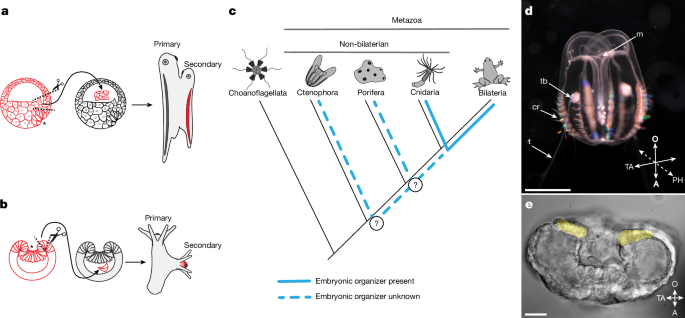
Specific parts of the donor gastrula (around 4 h after fertilization, at 17–19 °C, mid-gastrulation) were excised with a fine scalpel (Feather Sterile MicroScalpel 15 Deg, 72045-15, Feather Safety Razor) and transplanted into a host embryo at the same stage of development. The tissues were transplanted to the lateral side of the host embryo at the tentacular axis. A single incision (around 30 μm deep and 40 μm long) was made in the host embryo, and a donor explant was gently inserted into this slit so that its internal surface lay against the wound of the host embryo. The graft adhered immediately and became firmly attached to the host tissues within the next 5–7 min (Extended Data Fig. 1). Following grafting, embryos were incubated in plastic Petri dishes coated with 2% agarose. The agarose-coated bottom prevented embryo adhesion to the plastic surface and further mechanical damage of the embryos. The results of transplantation were analysed in cydippids at day 2 after fertilization.
To follow the distribution of the grafted tissues in the host animals, we labelled the embryos with the vital membrane dye FM4-64FX (F34653, Invitrogen) or FM1-43FX (F35355, Invitrogen). Before transplantation, the vitelline membrane was manually removed from embryos at the 2–2.5 h after fertilization stage. Embryos were then transferred to a staining solution for 1 h (ASW containing FM4-64FX (or FM1-43FX) at 10 μg ml–1) and incubated in the dark. After staining, embryos were rinsed three times in seawater to remove excess dye and maintained in seawater until the desired developmental stage. Tissue from stained with FM4-64FX embryos was then transplanted into unstained (or stained with FM1-43FX) embryos.
The same grafting methodology was used for xenotransplantation experiments. Specific parts of the donor M. leidyi gastrula were transplanted into the blastocoel of gastrulating N. vectensis embryos. These manipulations were performed in ASW with a salinity of 22–23%. For N. vectensis transplantations, all the manipulations were the same except that they were performed in 16% ASW. After grafting, N. vectensis embryos were incubated in plastic Petri dishes. The embryos were fixed at 58 h after fertilization.
Pharmacological treatments
To inhibit TGFβ–SMAD2/3 signalling, embryos were treated with the ALK4/5/7 (TGFβ type I receptors) inhibitors A83-01 (HY-10432A, MedChemExpress) or SB431542 (S4317, Sigma-Aldrich). A83-01 was prepared by diluting a 10 mM stock solution (in DMSO) in ASW. SB431542 was prepared from a 50 mM stock solution (in DMSO) and diluted in ASW immediately before use. Final working concentrations were 2 µM A83-01 for M. leidyi and 15 µM for N. vectensis; SB431542 was used at 30 µM for M. leidyi and at 30 or 40 µM for N. vectensis, depending on the experiment. Control embryos were treated with an equal volume of DMSO. Treatments were initiated at the 2–4-cell stage in both species.
For inhibition of β-catenin signalling in M. leidyi, embryos were treated with 10 µM of the β-catenin inhibitor iCRT14 (SML0203, Sigma-Aldrich) from the 2–4-cell stage until the end of gastrulation (8 h after the first division). For β-catenin activation, embryos were treated with 2.5 µM CHIR99021 (SML1046, Sigma-Aldrich) either from the 2-cell stage to 8 h after the first division (early treatment) or, where indicated, extended to 24 h after fertilization (prolonged treatment).
For transplantation-based induction assays, embryos with grafted tissues were incubated for 12 h in inhibitor-containing ASW (SB431542 for TGFβ–SMAD2/3 inhibition or iCRT14 for β-catenin inhibition) with DMSO controls in parallel. Inhibitors were then washed out, and embryos were scored at 2 days after fertilization (M. leidyi) or fixed at the indicated time points (N. vectensis).
In situ hybridization
The in situ hybridization protocol for M. leidyi was developed based on a published protocol for the sea anemone N. vectensis54. Tissues were first fixed in ice-cold 3.7% formaldehyde and 0.2% glutaraldehyde in PBS for 15 min on ice, followed by an additional 1 h in 3.7% formaldehyde in PBS at room temperature on a shaker. The fixative solution was replaced with PTw buffer (1× PBS (P4417, Sigma) and 0.1% Tween-20, pH 7.4), and the embryos were washed 3 times in PTw for 15 min at room temperature, followed by gradual transfer to 100% methanol and stored at −20 °C until use.
Digoxigenin-labelled RNA probes were synthesized using a MEGAscript SP6 Transcription kit (AM1330, Invitrogen). Fixed M. leidyi embryos were rehydrated through 60% and 30% methanol in PTw, digested with 80 μg ml–1 Proteinase K (AM2546, Thermo Fisher Scientific) in PTw for 40 s and then washed in 2 mg ml–1 glycine in PTw.
The DIG-labelled RNA probes, diluted to 0.5 ng ml–1 in hybridization solution, were incubated with the embryos overnight at 58 °C. Probe detection was performed using anti-Digoxigenin-AP Fab fragments (11093274910, Roche Diagnostics), diluted 1:2,000 in 0.5% blocking reagent (11096176001, Roche Diagnostics) in 1× MAB. This was followed by a substrate reaction using a mixture of NBT and BCIP (NBT, 11383213001; BCIP, 11383221001, Roche Diagnostics), as previously described3.
In situ hybridization with N. vectensis embryos was carried out following previously published protocols3,54.
Clones of NvFoxA (GenBank: AY457634), NvBrachyury (GenBank: AF540387), NvSix3/6 (GenBank: KC137590), NvWnt2 (GenBank: AY725201), NvSnail (GenBank: AY651960), NvLhx1 (GenBank: BAH58087), NvErg (GenBank: EF427936), MlBrachyury (GenBank: DQ988137.1), MlLhx1/5 (GenBank: JF912807) and MlLhx3/4 (GenBank: JF912808) were used to generate DIG-labelled RNA probes.
mRNA microinjections
For overexpression experiments of M. leidyi TGFβ-family ligands in N. vectensis, full-length coding sequences of M. leidyi TGFβ-ML368915 (GenBank: JN380186), TGFβ-ML102235 (GenBank: JN380181.1), TGFβ-ML218835 (GenBank: JN380180) and control eGFP mRNA were cloned into pCRII vectors, flanked by the SP6 promoter and the SV40 polyA sequence. The full-length coding sequences of M. leidyi TGFβ ligands were amplified from M. leidyi cDNA using the following gene-specific primers: TGFβ-ML368915_dir GGCGCGCCAAAAAAATGCTTCACCTAGTTCTCGTTTTGTC; TGFβ-ML368915_rev CCTGCAGGTTATCGGCAGCTGCAGGAGTCGACAAC; TGFβ-ML102235_dir GGCGCGCCAAAAAAATGAGGACACTGAATTTGTTCCTAC; TGFβ-ML102235_rev CCTGCAGGTCACTTACAGCCACACTCTGTAAC; TGFβ-ML218835_dir GGCGCGCCAAAAAAATGGTTTGGCTGCTACTACTTTTATAC; and TGFβ-ML218835_rev CCTGCAGGTCACTCACAACCACACTGTTCGACC. The pCRII vectors containing the respective cDNAs were linearized with NotI, and mRNA was transcribed using a SP6 mMessage mMachine kit (AM1340, Invitrogen). Each mRNA were diluted to a final concentration of 0.35 µg µl–1. Fluorescent dextran-Alexa594 (D22913, Invitrogen) was co-injected as a tracer.
Microinjections into M. leidyi eggs were performed using a Pneumatic PicoPump microinjector (SYS-PV830, World Precision Instruments) equipped with a negative pressure function. Negative pressure (or suction pressure) was used to break the plasma membrane and allow the injection needle to enter the egg55. A Laboport N86 KT.18 pump was connected to the microinjector to generate negative pressure.
Microneedles (TW100F-4, World Precision Instruments) were pulled using a P-2000 puller (Sutter Instrument) with the following settings: heat, 260; filament, 4; velocity, 50; delay, 150; and pull, 150. The injection needle was loaded with mRNA solution from the end. The holding pipette was made from a Pasteur pipette with the tip rounded by heating and scraping with sandpaper56. For injection, a lid from a 4-well plate (176740, Nunc, Thermo Fisher Scientific) was placed under an inverted microscope (Axiovert 100, Carl Zeiss) and filled with ASW. Fertilized eggs were immobilized using a holding pipette by gentle suction. The injection needle was positioned horizontally and first passed through the outer vitelline membrane. After passing through the outer vitelline membrane, the needle tip was positioned at the plasma membrane. Negative pressure was then applied while the needle was gently moved into the egg. The injector was subsequently switched back to positive pressure, and a single injection pulse was applied (around 3–5 pl of the injection solution per egg) (Supplementary Video 1). Injected eggs were transferred to 35 mm Petri dishes containing ASW for further development.
WNT ligand expression in N. vectensis embryos
For mosaic overexpression assays, the full-length coding sequences of M. leidyi WntA (GenBank: HM448813), Wnt6 (GenBank: HM448814), Wnt9 (GenBank: HM448815) and WntX (GenBank: HM448816) were cloned into pCRII-EF1α vectors (derived from pCRII-TOPO) under the control of the ubiquitous N. vectensis Ef1a promoter. The full-length coding sequences of M. leidyi WNT ligands were amplified from M. leidyi cDNA using the following gene-specific primers: MlAscWnt6F GGCGCGCCATGTCTGTCAGGGGAATCCTGTGC; MlSbfWnt6R CCTGCAGGCGCTGTCACGTACACCGAGTT; MlAscWntAF GGCGCGCCGCATATGCCTCCGCTGTTATTA; MlSbfWntAR CCTGCAGGGGTTAGCTATTGCAGGTGTAGGTG; MlAscWnt9F GGCGCGCCTGTAGATGGAGTTTCAGTCCCG; MlSbfWnt9R CCTGCAGGCGAGGCCTAATTGCAGTAATGA; MlAscWntXF GGCGCGCCCGCTCGCCTGAAATATATGG; and MlSbfWntXR CCTGCAGGCGCCTATAAAGTCCGGGAAT. Single blastomeres at the 8–16-cell stage were injected with a mixture containing 50 ng μl–1 plasmid DNA, 1× I-SceI buffer, 0.1 µg µl–1 fluorescent dextran-Alexa594 (D22913, Invitrogen) and 0.2 U μl–1 I-SceI meganuclease (New England Biolabs, R0694S). The mix was incubated for 30 min at 37 °C before injection57. As a control, we used the same pCRII-EF1α plasmid driving expression of the fluorescent reporter mCherry. After injection, embryos were cultured at 20 °C and raised to the primary polyp stage (7–9 days and fertilization), when phenotypes were scored.
Phalloidin staining
For phalloidin staining, N. vectensis embryos were first fixed in a solution containing 4% paraformaldehyde and PTw (1× PBS, 0.1% Tween 20 and 0.2% Triton X-100) for 1 h at room temperature. Following fixation, they were washed five times with PTw. A staining solution was prepared by adding 2 µl of phalloidin-AlexaFluor488 1 µl ml–1 (A12379, Invitrogen) per 100 µl PTw, and the embryos were stained overnight at 4 °C. After three 15-min washes with PBS, the embryos were embedded in Vectashield (H-1000, Vector Laboratories).
Microscopy
Embryos and cydippids were imaged using a fluorescence microscope (Carl Zeiss AxioImager.M2, Carl Zeiss Microscopy) equipped with a digital camera (pco.panda 4.2, Excelitas PCO). Images were acquired using a Plan-Apochromat ×20/0.8 objective with DIC and/or fluorescence microscopy. Samples were mounted under a coverslip supported by small modelling clay spacers at its four corners to prevent compression and allow immobilization. Live specimens were imaged in seawater. Nomarski and fluorescence images were overlaid in Fiji (v.2.14.0) software58.
Samples after in situ hybridization were imaged using either a Nikon Eclipse 80i microscope (Nikon) equipped with a Nikon DS-Fi1 camera (Nikon) and a Plan-Apochromat ×20/0.75 objective or an Axioscope 5 microscope (Carl Zeiss Microscopy) equipped with an Axiocam 503 colour camera and an EC Plan-Neofluar ×20/0.5 objective. Samples were mounted in 80% glycerol under a coverslip supported by small modelling clay spacers at its four corners to prevent compression. Slight movement of the coverslip allowed the embryo to be rotated under it, which enabled imaging from different angles.
Confocal imaging was performed using a Carl Zeiss LSM 980 microscope (Carl Zeiss Microscopy). For analysis of overall morphology, M. leidyi cydippids were fixed in 4% paraformaldehyde in PBS, stained with DAPI (1 µg ml–1) in PBS for 30 min at room temperature, gradually transferred to 80% glycerol and mounted under a coverslip supported by small modelling clay spacers at its four corners to prevent compression. Nematostella vectensis embryos stained with phalloidin were mounted and imaged in the same way. Live embryos and cydippids were mounted under a coverslip supported by modelling clay spacers in ASW. In some cases, cydippids were gently compressed to reduce movement during imaging. A C-Apochromat ×40/1.20 W objective was used for imaging M. leidyi embryos, whereas a Plan-Apochromat ×20/0.8 objective was used in all other cases.
Statistical analysis
All statistical analyses were performed in R (v.4.6.0; R Foundation for Statistical Computing). Analyses were conducted on replicate-level embryo counts rather than percentages. Each biological replicate represents an independent cohort of embryos obtained from a separate spawn or collection, and embryos were scored once (no repeated measures). For organizer transplantation assays, embryos were classified according to phenotypic outcomes. Complete secondary pharynx formation (two pharynxes) was used as the primary end point for organizer induction success in M. leidyi, whereas ectopic secondary NvFoxA expression was used as the primary end point in N. vectensis. For each biological replicate and treatment condition, the number of embryos meeting the defined end point (successes) and the total number of embryos scored were recorded, which produced binomial count data with replicate-specific denominators. Treatment effects were evaluated using a binomial generalized linear mixed model with a logit link, fitted to replicate-level counts, with treatment as a fixed-effect variable and biological replicate included as a random intercept to account for between-replicate variability (cbind(successes, failures) ~ treatment + (1 | replicate)). We validated that the model explained the data significantly better than the null model (cbind(successes, failures) ~ 1 + (1 | replicate)) with a two-way analysis of variance (α = 0.001). Effect sizes are reported as odds ratios (OR) relative to DMSO controls with 95% confidence intervals (CI) obtained from the model. Two-sided P values were derived from Wald z-tests for fixed effects, and significance was assessed at α = 0.05. Data processing and statistical modelling were performed using the packages readxl (v.1.4.5), dplyr (v.1.2.1), lme4 (v.2.0-1), broom.mixed (v.0.2.9.6) and emmeans (v.2.0.1). Microsoft Excel (Microsoft 365) was used for data handling and preliminary data organization.
No statistical methods were used to predetermine sample sizes. Experiments were not randomized because embryos were obtained from synchronous spawns and showed minimal variability before manipulation. Investigators were not blinded during data collection or outcome assessment because the analysed phenotypes were morphologically distinct.
Experimental criteria and viability
Under our standard culture conditions, >90% (up to about 99%) of fertilized M. leidyi eggs developed into morphologically normal cydippids at 2 days after fertilization, and fertilized eggs reaching this stage were considered viable. Datasets were excluded if viability in the untreated or DMSO control group at 2 days after fertilization dropped below 90%. In transplantation experiments, survival of manipulated embryos was 90–100%. In pharmacological inhibition experiments, survival in inhibitor-treated embryos was slightly reduced relative to DMSO controls, but the difference never exceeded 5%.
Figures and illustrations
Figures were prepared using Adobe Photoshop 2026 (v.27.0) and Adobe Illustrator 2026 (v.30.3).
Reporting summary
Further information on research design is available in the Nature Portfolio Reporting Summary linked to this article.

