


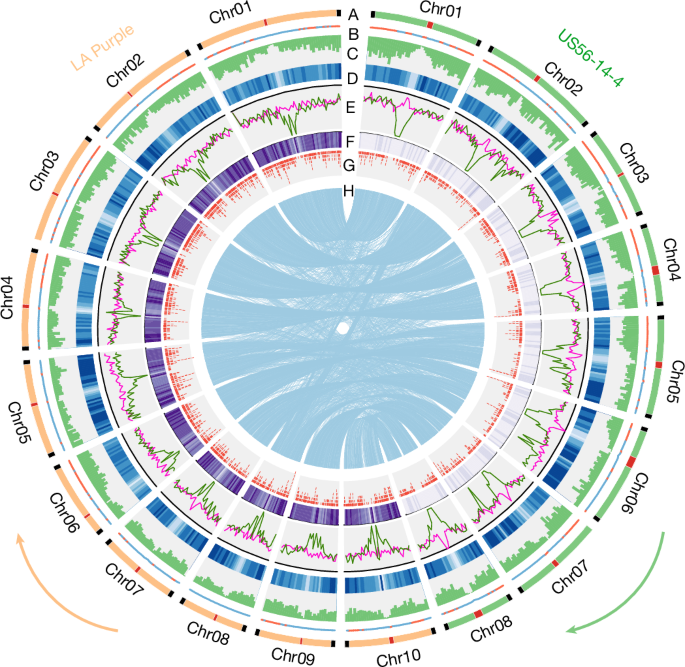
Bremer, G. A cytological investigation of some species and species-hybrids of the genus Saccharum. Genetica 5, 273–326 (1923).
Bremer, G. Problems in breeding and cytology of sugar cane. IV. The origin of the increase of chromosome number in species hybrids of Saccharum. Euphytica 10, 325–342 (1961b).
OECD/FAO. OECD-FAO Agricultural Outlook 2025–2034 (OECD Publishing, 2025).
Burr, G. O. et al. The sugarcane plant. Annu. Rev. Plant Physiol. 8, 275–308 (1957).
D’Hont, A. et al. Characterisation of the double genome structure of modern sugarcane cultivars (Saccharum spp.) by molecular cytogenetics. Mol. Gen. Genet. 250, 405–413 (1996).
Piperidis, G., Piperidis, N. & D’Hont, A. Molecular cytogenetic investigation of chromosome composition and transmission in sugarcane. Mol. Genet. Genomics 284, 65–73 (2010).
D’Hont, A. Unraveling the genome structure of polyploids using FISH and GISH; examples of sugarcane and banana. Cytogenet. Genome Res. 109, 27–33 (2005).
Price, S. Cytological studies in Saccharum and allied genera VII. Maternal chromosome transmission by S. officinarum in intra- and interspecific crosses. Bot. Gaz. 122, 298–305 (1961).
Bielig, L. M., Mariani, A. & Berding, N. Cytological studies of 2n male gamete formation in sugarcane, Saccharum L. Euphytica 133, 117–124 (2003).
Narayanaswami, S. Megasporogenesis and origin of triploids in Saccharum. Indian J. Agric. Sci. 10, 534–551 (1940).
Zhang, J. et al. Allele-defined genome of the autopolyploid sugarcane Saccharum spontaneum L. Nat. Genet. 50, 1565–1573 (2018).
Zhang, Q. et al. Genomic insights into the recent chromosome reduction of autopolyploid sugarcane Saccharum spontaneum. Nat. Genet. 54, 885–896 (2022).
Healey, A. L. et al. The complex polyploid genome architecture of sugarcane. Nature 628, 804–810 (2024).
Bao, Y. et al. A chromosomal-scale genome assembly of modern cultivated hybrid sugarcane provides insights into origination and evolution. Nat. Commun. 15, 3041 (2024).
Zhang, J. et al. The highly allo-autopolyploid modern sugarcane genome and very recent allopolyploidization in Saccharum. Nat. Genet. 57, 242–253 (2025).
Wang, J. et al. Genetic architecture of sugarcane traits in a polyploid genomics framework. Nature 654, 994–1003 (2026).
Rhie, A., Walenz, B., Koren, S. & Phillippy, A. Merqury: reference-free quality, completeness, and phasing assessment for genome assemblies. Genome Biol. 21, 245 (2020).
Bretagnolle, F. & Thompson, J. D. Gametes with the somatic chromosome number: mechanisms of their formation and role in the evolution of autopolyploid plants. New Phytol. 129, 1–22 (1995).
Bremer, G. Problems in breeding and cytology of sugar cane. II, the sugar cane breeding from a cytological view-point. Euphytica 10, 121–258 (1961).
Bremer, G. Increase of chromosome number in species-hybrids of Saccharum in relation to the embryosac development. Bibliogr. Genet. 18, 99 (1959).
Ramanna, M. S. & Jacobsen, E. Relevance of sexual polyploidization for crop improvement. Euphytica 133, 3–8 (2003).
Wijnker, E. et al. The genomic landscape of meiotic crossovers and gene conversions in Arabidopsis thaliana. eLife 2, e01426 (2013).
Choi, K. et al. Arabidopsis meiotic crossover hotspots overlap with H2A.Z nucleosomes at gene promoters. Nat. Genet. 45, 1327–1336 (2013).
Kreiner, J. M., Kron, P. & Husband, B. C. Frequency and maintenance of unreduced gametes in natural plant populations: associations with reproductive mode, life history and genome size. New Phytol. 214, 879–889 (2017).
Vieira, M. L. C. et al. Revisiting meiosis in sugarcane: chromosomal irregularities and the prevalence of bivalent configurations. Front. Genet. https://doi.org/10.3389/fgene.2018.00213 (2018).
Oliveira, B. et al. New trends in sugarcane fertilization: Implications for NH3 volatilization, N2O emissions and crop yields. J. Environ. Manage. 342, 118233 (2023).
Price, S. Chromosome numbers in interspecific hybrids. Bot. Gaz. 118, 146–159 (1957).
Chai, J. et al. All nonhomologous chromosomes and rearrangements in Saccharum officinarum × Saccharum spontaneum allopolyploids identified by oligo-based painting. Front. Plant Sci. https://doi.org/10.3389/fpls.2023.1176914 (2023).
Higgins, J. et al. Unravelling mechanisms that govern meiotic crossover formation in wheat. Biochem. Soc. Trans. 50, 1179–1186 (2022).
Wenger, A. M. et al. Accurate circular consensus long-read sequencing improves variant detection and assembly of a human genome. Nat. Biotechnol. 37, 1155–1162 (2019).
Burton, J. N. et al. Chromosome-scale scaffolding of de novo genome assemblies based on chromatin interactions. Nat. Biotechnol. 31, 1119–1125 (2013).
Chen, S., Zhou, Y., Chen, Y. & Gu, J. fastp: an ultra-fast all-in-one FASTQ preprocessor. Bioinformatics 34, i884–i890 (2018).
Cheng, H. et al. Efficient near-telomere-to-telomere assembly of nanopore simplex reads. Nature 655, 166–173 (2026).
Cheng, H., Concepcion, G. T., Feng, X., Zhang, H. & Li, H. Haplotype-resolved de novo assembly using phased assembly graphs with hifiasm. Nat. Methods 18, 170–175 (2021).
Zeng, X. et al. Chromosome-level scaffolding of haplotype-resolved assemblies using Hi-C data without reference genomes. Nat. Plants 10, 1184–1200 (2024).
Durand, N. et al. Juicebox provides a visualization system for Hi-C contact maps with unlimited zoom. Cell Syst. 3, 99–101 (2016).
Li, H. Minimap2: pairwise alignment for nucleotide sequences. Bioinformatics 34, 3094–3100 (2018).
Chen, Y., Zhang, Y., Wang, A., Gao, M. & Chong, Z. Accurate long-read de novo assembly evaluation with Inspector. Genome Biol. 22, 312 (2021).
Simão, F. A., Waterhouse, R. M., Ioannidis, P., Kriventseva, E. V. & Zdobnov, E. M. BUSCO: assessing genome assembly and annotation completeness with single-copy orthologs. Bioinformatics 31, 3210–3212 (2015).
Li, H. & Durbin, R. Fast and accurate short read alignment with Burrows–Wheeler transform. Bioinformatics 25, 1754–1760 (2009).
Ou, S., Chen, J. & Jiang, N. Assessing genome assembly quality using the LTR Assembly Index (LAI). Nucleic Acids Res. 46, e126 (2018).
Pedersen, B. S. & Quinlan, A. R. Mosdepth: quick coverage calculation for genomes and exomes. Bioinformatics 34, 867–868 (2018).
Krzywinski, M. et al. CIRCOS: an information aesthetic for comparative genomics. Genome Res. 19, 1639–1645 (2009).
Tang, H. et al. JCVI: A versatile toolkit for comparative genomics analysis. iMeta 3, e211 (2024).
Marcais, G. et al. MUMmer4: a fast and versatile genome alignment system. PLoS Comput. Biol. 14, e1005944 (2018).
Flynn, J. M. et al. RepeatModeler2 for automated genomic discovery of transposable element families. Proc. Natl Acad. Sci. USA 117, 9451–9457 (2020).
Li, Y., Jiang, N. & Sun, Y. AnnoSINE: a short interspersed nuclear elements annotation tool for plant genomes. Plant Physiol. 188, 955–970 (2022).
Rho, M. & Tang, H. MGEScan-non-LTR: computational identification and classification of autonomous non-LTR retrotransposons in eukaryotic genomes. Nucleic Acids Res. 37, e143–e143 (2009).
Ou, S. et al. Benchmarking transposable element annotation methods for creation of a streamlined, comprehensive pipeline. Genome Biol. 20, 275 (2019).
Zhang, R.-G. et al. TEsorter: an accurate and fast method to classify LTR-retrotransposons in plant genomes. Hortic. Res. 9, uhac017 (2022).
Yan, H., Bombarely, A. & Li, S. DeepTE: a computational method for de novo classification of transposons with convolutional neural network. Bioinformatics 36, 4269–4275 (2020).
Edgar, R. C. Search and clustering orders of magnitude faster than BLAST. Bioinformatics 26, 2460–2461 (2010).
Tarailo-Graovac, M. & Chen, N. Using RepeatMasker to identify repetitive elements in genomic sequences. Curr. Protoc. Bioinformatics 4, 4.10.11–14.10.14 (2009).
Benson, G. Tandem repeats finder: a program to analyze DNA sequences. Nucleic Acids Res. 27, 573–580 (1999).
Lin, Y. et al. quarTeT: a telomere-to-telomere toolkit for gap-free genome assembly and centromeric repeat identification. Hortic. Res. 10, uhad127 (2023).
Haas, B. J. et al. De novo transcript sequence reconstruction from RNA-seq using the Trinity platform for reference generation and analysis. Nat. Protoc. 8, 1494–1512 (2013).
Kim, D., Paggi, J. M., Park, C., Bennett, C. & Salzberg, S. L. Graph-based genome alignment and genotyping with HISAT2 and HISAT-genotype. Nat. Biotechnol. 37, 907–915 (2019).
Gabriel, L. et al. BRAKER3: Fully automated genome annotation using RNA-seq and protein evidence with GeneMark-ETP, AUGUSTUS, and TSEBRA. Genome Res. 34, 769–777 (2024).
Gabriel, L., Hoff, K., Bruna, T., Borodovsky, M. & Stanke, M. TSEBRA: transcript selector for BRAKER. BMC Bioinformatics 22, 566 (2021).
Holst, F. et al. ab initio prediction of primary eukaryotic gene models combining deep learning and a hidden Markov model. Nat. Methods 23, 732–739 (2026).
Haas, B. et al. Automated eukaryotic gene structure annotation using EVidenceModeler and the program to assemble spliced alignments. Genome Biol. 9, R7 (2008).
Blum, M. et al. The InterPro protein families and domains database: 20 years on. Nucleic Acids Res. 49, D344–D354 (2021).
Cantalapiedra, C. P., Hernández-Plaza, A., Letunic, I., Bork, P. & Huerta-Cepas, J. eggNOG-mapper v2: functional annotation, orthology assignments, and domain prediction at the metagenomic scale. Mol. Biol. Evol. 38, 5825–5829 (2021).
Wang, Y. et al. MCScanX: a toolkit for detection and evolutionary analysis of gene synteny and collinearity. Nucleic Acids Res. 40, e49 (2012).
Wu, T. D. & Watanabe, C. K. GMAP: a genomic mapping and alignment program for mRNA and EST sequences. Bioinformatics 21, 1859–1875 (2005).
Edgar, R. MUSCLE: a multiple sequence alignment method with reduced time and space complexity. BMC Bioinformatics 5, 113 (2004).
Bailey, T. L. STREME: accurate and versatile sequence motif discovery. Bioinformatics 37, 2834–2840 (2021).
Jiao, W.-B. & Schneeberger, K. Chromosome-level assemblies of multiple Arabidopsis genomes reveal hotspots of rearrangements with altered evolutionary dynamics. Nat. Commun. 11, 989 (2020).
Ono, Y., Hamada, M. & Asai, K. PBSIM3: a simulator for all types of PacBio and ONT long reads. NAR Genom. Bioinform. 4, lqac092 (2022).
Baid, G. et al. DeepConsensus improves the accuracy of sequences with a gap-aware sequence transformer. Nat. Biotechnol. 41, 232–238 (2023).
CNCB–NGDC Members and Partners. Database resources of the National Genomics Data Center, China National Center for Bioinformation in 2026. Nucleic Acids Res. 54, D28–D47 (2026).
Tang, H. KLASSIFY: classify chimeric reads based on unique k-mer contents (Version 0.1.6) [Computer software]. Zenodo https://doi.org/10.5281/zenodo.20838810 (2026).

