


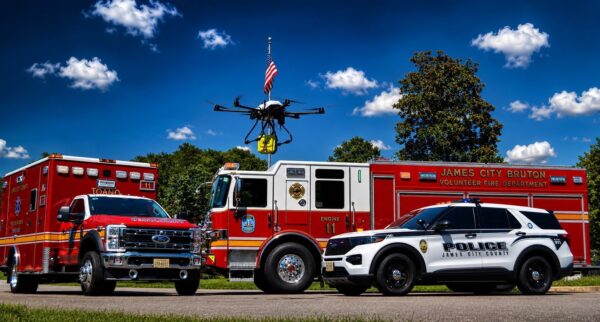
A middle-aged man unexpectedly collapses at his home in James City County, Virginia. His family members call the 911 emergency dispatch, reporting the situation and describing his symptom. The dispatcher recognizes that the emergency could involve a sudden cardiac arrest and not only sends first responders to the scene, but also a drone carrying an automated external defibrillator (AED).
The drone arrives at the home precious minutes ahead of the ground-based first responders, and lowers the AED to the waiting family members who then following the dispatcher’s instructions in how to use the equipment to save the patient’s life, before the paramedics arrive to take over.
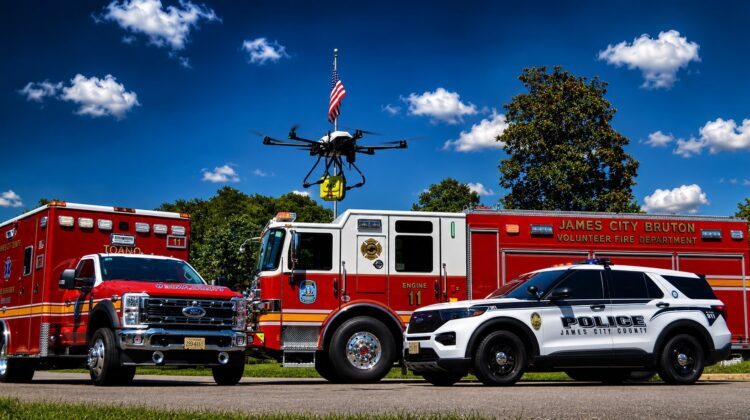
That scenario could soon become commonplace under a program operated under the James City County police and fire departments. The county, located on the historic Virginia Peninsula, is only the second site in the country to launch a defibrillator delivery project under a collaborative research program funded by the American Heart Association (AHA), with Duke University and Virginia Commonwealth University (VCU) serving as the study’s lead institutions.
The site of the first such program is in Forsyth County North Carolina.
Drones Cut AED Delivery Time by More Than Five Minutes
“The point of this research project is to cut down on how much time it takes to get the defibrillator to a person and start delivering shocks,” Sgt. Tiara Suggs, of the James City County PD, said in an interview. “Because drones don’t have to follow roads or stop at stoplights or avoid other traffic, going from point A directly to point B, the drone is getting this AED significantly faster to where it needs to be.”
According to the AHA, the early application of CPR and defibrillation are critical steps in improving the chances of survival for victims of sudden cardiac arrest. Research shows that for every minute defibrillation is delayed the chances for survival decrease by 7% to 10%.
The county is set to enter the pilot phase for its AED delivery program on August 1, following three phases of testing. Early test flights demonstrated the program’s potential to save lives by cutting down the time it takes to deliver an AED to a patient.
In one test flight, an AED delivered by the police department’s Air10 hexacopter drone reached a residence in two minutes and 30 seconds. This compares with the fire department’s average response time to the same area of eight minutes and six seconds, meaning the AED arrived at the scene more than five and a half minutes faster than it would have if carried aboard a ground-based vehicle.
Two-and-a-Half Years in the Making
Suggs said the genesis of the AED delivery program occurred in 2023 when the county’s fire department approached the police department with the idea of joining the study. At the time, the police department had a small tactical drone operation, but had not yet developed a full-blown Drones as First Responder (DFR) system, a prerequisite for taking part in the AED delivery study.
“So, we have spent the last two-and-a-half years developing the regulations and the rules for ourselves and trying to put together a DFR program for our agency.”
As the county enters into the pilot test phase of the study, the PD will have continued to maintain its DFR flight schedule, flying a DJI M30T, “but the AED delivery drone will also be set up and ready to fly to live potential cardiac arrest calls.”
While its DFR program is based at the county’s Law Enforcement Center in Williamsburg, its AED-delivery project will be based at Fire Station 1 in the town of Toano, in a more rural area of the county. That location was chosen by design, as one of the goals of the study is to improve survivability rates in rural areas.
“That area is significantly more spread out than any other part of the county, so sometimes it takes first responders longer to get to those places,” Suggs said.
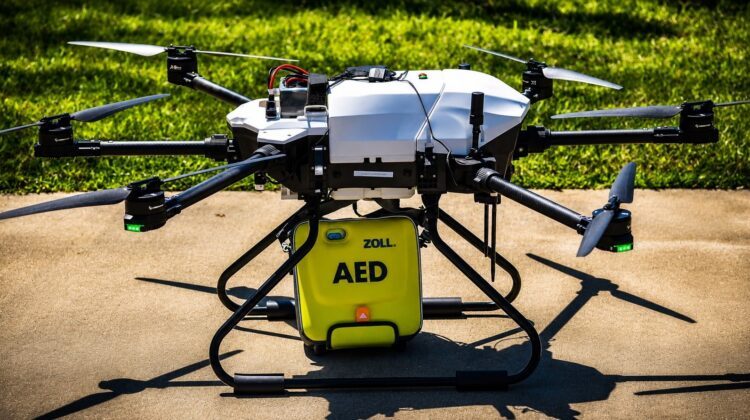
The UAV used to deliver the AEDs has a flight range of about five miles, and has a 20-pound payload capacity, more than adequate to carry the AED, which only weighs about six pounds. The vehicle, produced by Arc Aero, a Palo Alto, California-based start-up, can fly at speeds of 40 mph and has a battery life of about 45 minutes.
Study’s Goal to Show That Drone Use Can Save Lives
The proliferation of easy-to-use AEDs has become commonplace over the last several years, with units being prominently positioned in hotels, airports and other public spaces, said Basil Yap, a consultant to the Duke-led study.
Yap, the vice president of Winston-Salem North Carolina-based Hovecon Consulting, said the study is designed to determine whether drone deliveries of AEDs can improve survivability rates for patients who suffer sudden cardiac arrest in their homes or other locations in less-populated areas.
“Essentially the likelihood of surviving an out-of-hospital cardiac arrest is low,” he said. “The survival rate has been pretty stagnant since the ’80s. And, survival is anywhere between 8% to 11%. And in rural areas, it goes anywhere between 6% to 8%.”
He said the study is expected to compare the results achieved by the two participating jurisdictions, based in part on the longevity of their respective DFR programs. The Forsyth County Sheriff’s Office in North Carolina was one of the first DFR programs in the nation, he said, while James City County had just recently introduced its own DFR program.
Setting the Standard for DFR Programs Nationwide
The study also is expected to provide a roadmap for other cities and counties looking to launch AED drone-delivery programs in their own localities, he said.
“Hopefully they’ll see the value in it. Again, we have to look at the data, and they can expand those elsewhere in the country,” he said. “We’re setting the standard right now for DFR programs in the future to integrate AEDs into their operations.”
Read More

Jim Magill is a Houston-based writer with almost a quarter-century of experience covering technical and economic developments in the oil and gas industry. After retiring in December 2019 as a senior editor with S&P Global Platts, Jim began writing about emerging technologies, such as artificial intelligence, robots and drones, and the ways in which they’re contributing to our society. In addition to DroneLife, Jim is a contributor to Forbes.com and his work has appeared in the Houston Chronicle, U.S. News & World Report, and Unmanned Systems, a publication of the Association for Unmanned Vehicle Systems International

