


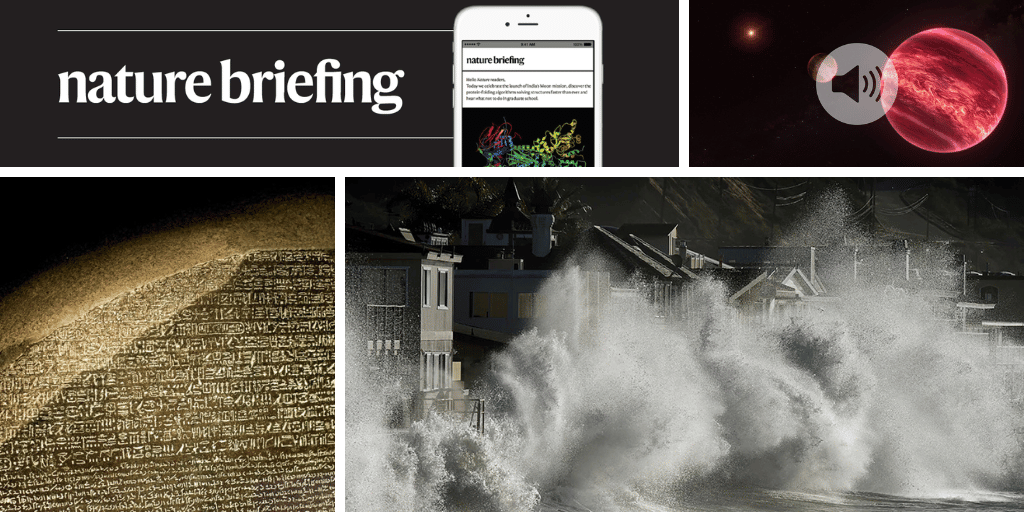
Hello Nature readers, would you like to get this Briefing in your inbox free every day? Sign up here.

California (Mondos Beach shown here in 2016) often experiences increased storms — and storm waves — during El Niños that can lead to flooding.Credit: Mark Ralston/AFP via Getty
The El Niño climate pattern that’s strengthening in the Pacific Ocean is on track to be the largest one in at least 150 years, researchers say. If current forecasts pan out, the El Niño will unleash a surge of heat from the ocean that, combined with human-induced global warming, will probably make next year the hottest on record. That an El Niño is occurring now isn’t surprising in itself, but the peak of this event is set to surpass the previous record-holder by “truly, a mind-blowing margin”, says climate scientist Zeke Hausfather.
Humanity might have spoken tens of thousands of languages between 3,000 and 1,000 years ago, which have dwindled down to the around 7,500 unique languages used today. Researchers estimate that the number of spoken languages ballooned starting at the end of the last glacial period, as humans moved from hunter-gatherer groups into agricultural communities. After peaking around 2,000 years ago, the number began to fall again, possibly because of the spread of powerful, monolingual cultural groups through conquest and trade.
From mid-September, the US government will limit international students to no more than four years in the United States unless they can secure an extension. The move overturns a decades-old policy that allows students to stay for the duration of their academic programme. The government says that the new rule will “combat rampant visa abuse”, but some researchers worry that it will curtail the flow of international students into the US, since it takes more than 5 years on average to complete a PhD in science or engineering.
A handheld breathalyser can measure when the body is burning fat in real time. The device measures the level of acetone, a compound produced by the breakdown of fatty acids in the liver, in a person’s breath. The user’s exhalation is guided by a smartphone app, which improves the device’s accuracy, says the team who developed it. The device could be used by people trying to manage weight loss, although researchers say that it should be tested in more people to confirm that its results are accurate.
Reference: Device paper
Features & opinion
Homer’s epic The Odyssey has roots as far back as 1600 bc — and gives glimpses into the science, medicine and technology of the Homeric world. For example, a spear plunged into the Cyclops’s eye sizzles like a quenched blade — a sound that would be known to someone familiar with forging steel, not pure iron or bronze. This suggests the detail was added when the story was first committed to text after centuries of being told orally. There are even nuggets of astronomical knowledge: the poem’s mentions of the Pleiades, Hyades and Orion show that “these names go back to the very beginning of Greek astronomy”, says historian James Evans.
An off-world settler is reminded why she left Earth in the latest short story for Nature’s Futures series.
In a rare dispatch from Afghanistan, where the Internet and access to communication are often restricted, a female physician describes her attempts to provide health care in remote rural areas. She is one of the few such professionals still working in a country where the Taliban has banned higher education and most forms of paid employment for women. Taliban rules say she can’t work without a male ‘guardian’, and many of the women she treats are similarly trapped in their homes. Nevertheless, she examines up to 20 patients a day, sometimes knocking on doors to find those who need her. “They need even the little that I can do for them,” she says.
Read more: How the world should oppose the Taliban’s war on women and girls (Nature editorial | 7 min read, from 2022)
Researchers have spotted an ‘exosatellite’ about the mass of Jupiter orbiting a brown dwarf, a kind of ‘failed’ star. This orbiter might sound a lot like a moon, but it’s “very planet-like, and so it’s hard for us to call that a moon”, astrophysicist and study co-author Kevin Hoy tells the Nature Podcast. Part of the problem is that exomoons — those beyond our Solar System — are notoriously hard to spot, and astronomers disagree on how to know if one has been detected.
Nature Podcast | 24 min listen
Subscribe to the Nature Podcast on Apple Podcasts, Spotify or YouTube Music, or use the RSS feed
Today, Leif Penguinson is roaming around the spectacular Skyline Arch in Arches National Park, Utah. Can you find the penguin?
The answer will be in Monday’s e-mail, all thanks to Briefing photo editor and penguin wrangler Tom Houghton.
This newsletter is always evolving — tell us what you think! Please send your feedback to [email protected].
Thanks for reading,
Flora Graham, chief editor, Nature Briefing
With contributions by Jacob Smith
• Nature Briefing: Careers — insights, advice and award-winning journalism to help you optimize your working life
• Nature Briefing: Microbiology — the most abundant living entities on our planet — microorganisms — and the role they play in health, the environment and food systems
• Nature Briefing: Anthropocene — climate change, biodiversity, sustainability and geoengineering
• Nature Briefing: AI & Robotics — 100% written by humans, of course
• Nature Briefing: Cancer — a weekly newsletter written with cancer researchers in mind
• Nature Briefing: Translational Research — covers biotechnology, drug discovery and pharma


