


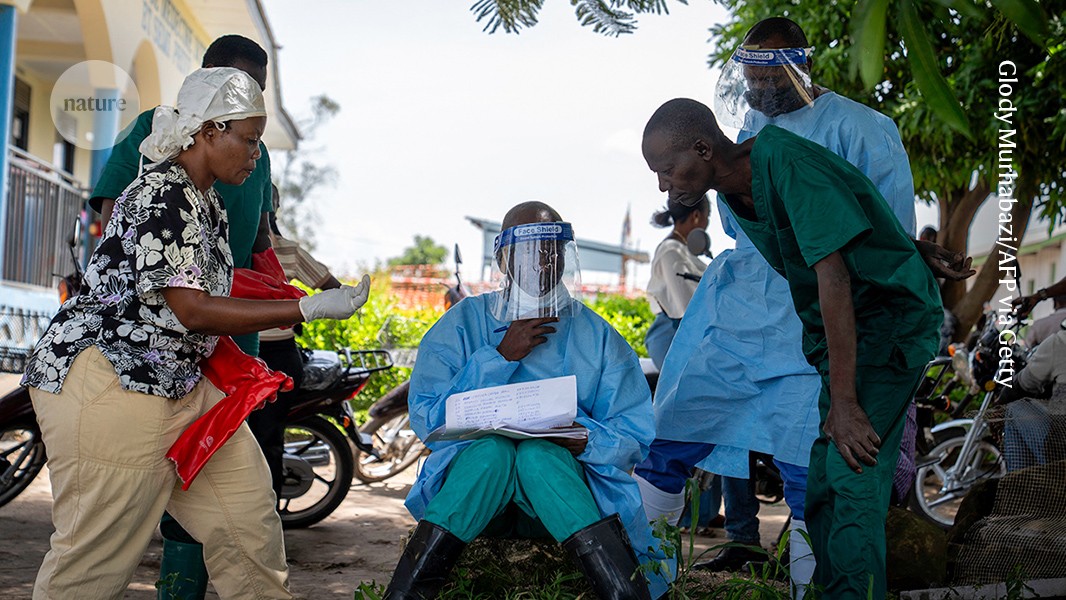

Researchers are aiming to test the vaccine in outbreak scenarios in Uganda later in 2026.Credit: Glody Murhabazi/AFP via Getty
Four days ago, the first volunteer was vaccinated against Bundibugyo ebolavirus. That is just 68 days after the World Health Organization declared the current Ebola outbreak in the Democratic Republic of the Congo (DRC) and Uganda a public-health emergency of international concern. By 27 July, officials had confirmed 3,200 cases and 1,405 deaths in the DRC alone.
The vaccine, called ChAdOx1, is being tested in a phase I clinical trial being run by the Oxford Vaccine Group at the University of Oxford, UK. ChAdOx1 uses the same vector platform as used in the Oxford–AstraZeneca COVID-19 vaccine, but carries genetic instructions for Bundibugyo ebolavirus protein. Around 620,000 doses of the vaccine have already been manufactured.
Ebola outbreak: the data that show why researchers are so alarmed
The trial aims to assess the safety of the vaccine and the immune response it generates before larger trials are rolled out in Uganda later this year. Two other vaccines are also in development: an mRNA vaccine developed by Moderna in Cambridge, Massachusetts, which is expected to go into clinical trials next month; and a candidate being developed by the International AIDS Vaccine Initiative that is similar to the WHO-recommended one for the Zaire ebolavirus species. All three vaccines are being funded by the Coalition for Epidemic Preparedness Innovations (CEPI).
Teresa Lambe, head of vaccine immunology at Oxford, is the lead scientific investigator for the ChAdOx1 vaccine study. She also co-developed the Oxford–AstraZeneca COVID-19 vaccine.
Nature spoke to Lambe about how the ChAdOx1 vaccine made it into clinical trials so quickly and what comes next.
What was the secret to your speed?
We have been working on vaccines against Ebola virus for quite some time. Several people in the team were involved in the 2013 outbreak, and since then, we’ve been making candidate vaccines against Ebola and other filoviruses.
When the Bundibugyo outbreak was declared a public-health emergency, we actually had in the freezer the right type of genetic sequence to let us make the Bundibugyo virus-specific vaccine really quickly.

Teresa Lambe is head of vaccine immunology at Oxford, and the lead scientific investigator for the ChAdOx1 vaccine study.Credit: University of Oxford/Matt GREETHAM
To get a vaccine from concept all the way through to licensure or use in the field at speed, there are several building blocks and pathways that need to be done at the same time, not sequentially like it’s normally done. There is the non-clinical work, the clinical work and the chemistry, manufacturing, and controls framework used to ensure drug safety and quality.
We were generating the supportive non-clinical data to demonstrate that the vaccine was immunogenic while we were scaling up [manufacturing]. We worked with our onsite clinical biomanufacturing facility and the Serum Institute of India in Pune to make the starting material and doses for the clinical trials. The advantage of working with the serum institute is it knows how to rapidly scale up production — this know-how is built on years of knowledge. While the vaccine doses were being made, we started our non-clinical studies onsite and worked with trusted partners in the United Kingdom and United States. In parallel, we worked on the clinical protocol and engaged with regulators to ensure we could rapidly open the trial for recruitment. It goes without saying that you can’t do this without a dedicated team, global partnerships and meaningful collaborations.
What will the phase I trial assess?
We are looking in the first instance to recruit about 50 adults, 18–55 year olds, in the United Kingdom. We’re looking for an indication of safety and any physical signs of the vaccine causing inflammation and immune responses. And with those data, we are hopeful that we will be able to start a trial with our partners in the MRC Uganda Virus Research Institute. This will be done in healthy volunteers who are not necessarily exposed to the disease. And we are working to enable the phase II and III trials in outbreak scenarios as rapidly as possible. Hopefully this will be in autumn or winter, but we need the phase-I trial data first.

