


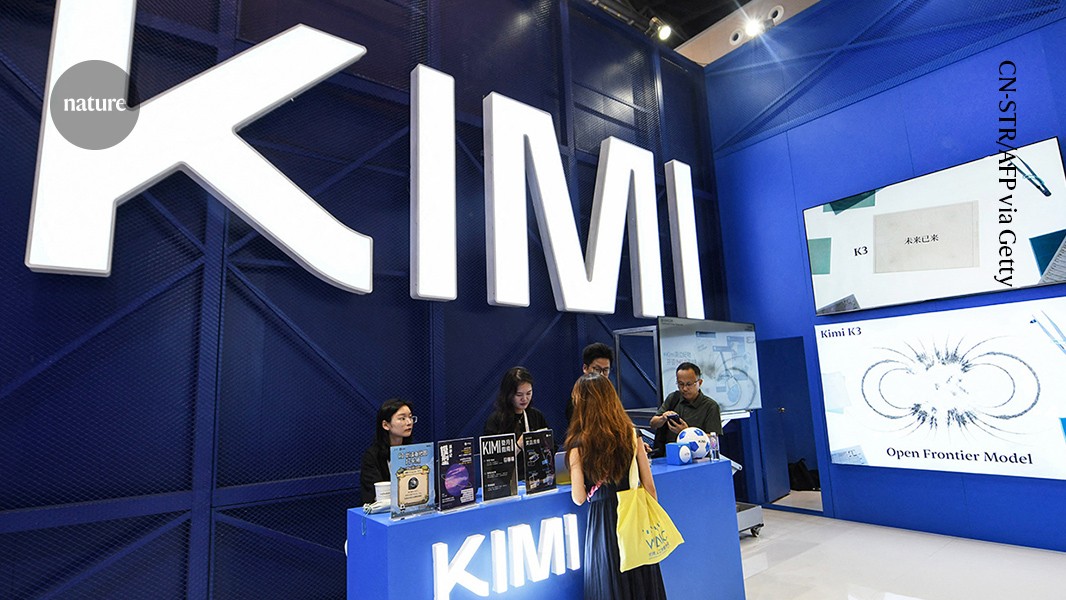

Credit: CN-STR/AFP via Getty
The latest Chinese-built large language model (LLM) is impressing scientists with its size and capabilities. Last week, Beijing-based Moonshot AI unveiled ‘Kimi K3’, a powerful reasoning LLM that can handle large swathes of text. The company’s own tests found that K3 can match or outperform rival US models on tasks such as coding and manipulating spreadsheets.
Not since DeepSeek has a Chinese artificial-intelligence model caused quite so much buzz. “It is a turning point,” says Joel Pearson, a cognitive neuroscientist at the University of New South Wales, Sydney, Australia, who studies how AI is impacting people’s lives. “People are calling it a ‘Sputnik moment’,” he adds.
Three days after the model’s release, Moonshot AI, said it had paused new sign-ups to K3 because demand had pushed its system close to the limits of its processing capacity.
The model’s launch on 16 July came just before the 2026 Artificial Intelligence World Conference in Shanghai. The conference began with Chinese President Xi Jinping announcing the formal start of a global alliance to create regulation that ensures AI is safe and benefits people. “In China’s view, all countries should take a people-centred approach and develop AI for the positive and for good,” Xi said at the conference, adding that AI should be a driver for “shared prosperity and common security”.
The timing of Kimi K3’s release is significant, says Mehwish Nasim, an AI researcher at the University of Western Australia in Perth. The model was launched just weeks after Claude Fable 5 by US company Anthropic, and days after OpenAI released its latest GPT-5.6 model. “China is signalling its ambition not only to build frontier AI systems but also to help shape the international AI ecosystem and its governance,” she says.
Largest open-weight model
K3 is open weight, like its predecessor Kimi K2 and DeepSeek models, which were developed by a Hangzhou-based firm of the same name, meaning its core components are publicly available and can be downloaded and modified by researchers for free, while information on the model’s training is private. It can also be accessed using an ‘application programming interface’, which allows software to communicate, at a lower cost than proprietary LLMs, such as those owned by OpenAI, Google and Anthropic. These LLMs are closed weight, meaning they cannot be downloaded and modified.
Moonshot says that the weights, or parameters, will be released on 27 July. Rahul Shome, a robotics and AI researcher at the Australian National University in Canberra, says that there has been a push from consumers, developers and researchers to make AI models open weight. K3 is particularly exciting because it would be the largest open-weight model, says Shome, with 2.8 trillion parameters and a working memory of one million tokens (the units of text used by AI models). The model is too large to run on personal devices, however, so it will probably require significant investment by institutions to run it, he adds.
K3’s large working memory means it could remember the contents of thousands of lines of code or a whole book and reduce the likelihood of producing fabricated information called hallucination, says Niusha Shafiabady, a computational intelligence researcher at Australian Catholic University in Sydney. Shafiabady says that she is going to test K3 for herself by asking it to summarize research findings.
Closing the gap
The performance and capabilities of open-weight models have historically lagged behind those of US proprietary ones. But the gap seems to be the tightest it has ever been, says Aaron Snoswell, an AI accountability researcher at the Queensland University of Technology Generative AI Lab, Brisbane.
Pearson says that Chinese open-weight models are changing how investors and users perceive the value of US frontier models. Google, Anthropic and OpenAI spend billions of dollars training their models compared with the much lower budgets of Chinese companies. Moreover, users could lose access to US models if the government decides to impose restrictions, says Pearson. Last month, Anthropic temporarily disabled its most advanced models, Fable 5 and Mythos 5, for all users after it was directed by the US government to suspend access for foreign nationals. Access to Fable 5 was restored this month, but Mythos 5 is only available to specific US organizations.
Toby Walsh, a computer scientist at the University of New South Wales, says that Chinese AI companies have been able to build frontier AI models despite the United States restricting China’s access to advanced AI chips, citing national-security concerns. “One suspects that necessity here was the mother of invention,” he adds.

