


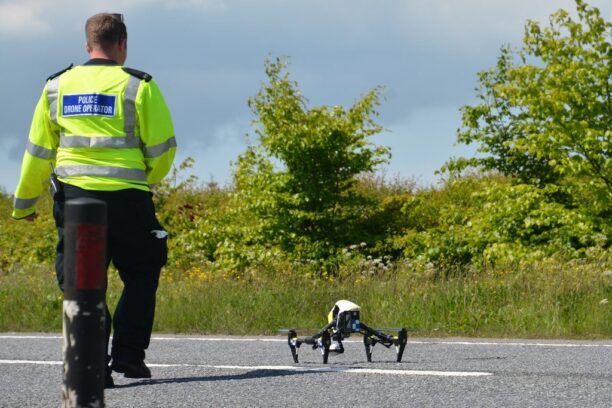
New DOJ/DHS rule and coordinated FCC actions establish the legal, technical, and spectrum framework for trained state and local agencies to deploy counter-drone systems
The federal government’s expansion of state and local counter-drone authority took a major step forward this week as the Department of Homeland Security (DHS), Department of Justice (DOJ), and Federal Communications Commission (FCC) released a coordinated package of actions designed to move the SAFER SKIES Act from legislation to implementation.
At the center of the effort is an Interim Final Rule published by DHS and DOJ that establishes the regulatory framework for state, local, Tribal, and territorial (SLTT) law enforcement and correctional agencies to conduct authorized counter-unmanned aircraft system (C-UAS) operations. The agencies are accepting public comments on the rule through September 6.
At nearly the same time, the FCC issued four companion actions addressing communications, spectrum, equipment authorization, and legal questions that could otherwise have slowed deployment of counter-drone capabilities. Together, the actions represent one of the most significant expansions of practical counter-UAS authority for state and local agencies since Congress passed the SAFER SKIES Act as part of the FY2026 National Defense Authorization Act.
Building the Framework
The SAFER SKIES Act expanded counter-UAS authority beyond a handful of federal agencies by allowing trained SLTT law enforcement and correctional agencies to detect, track, disable, or seize drones that pose a credible threat to public safety, critical infrastructure, correctional facilities, or major public events. That authority, however, depended on implementing regulations establishing how agencies would qualify, what systems they could use, and how operations would be conducted.
The new Interim Final Rule fills in those details. It establishes training and certification requirements, reporting procedures, oversight mechanisms, and operational safeguards. It also creates two key resources that will guide deployments: an Authorized Technologies List, identifying approved categories of counter-UAS technologies, and an Authorized Systems List, identifying specific approved systems at the make-and-model level. Both lists will be maintained through the FBI’s Law Enforcement Enterprise Portal (LEEP).
The rule also emphasizes that SLTT agencies operating radio frequency-based counter-UAS equipment must obtain FCC authorization in addition to meeting DOJ and DHS requirements, highlighting the importance of the FCC’s simultaneous actions.
FCC Removes Operational Barriers
Rather than waiting for agencies to navigate multiple regulatory processes independently, the FCC released four coordinated decisions intended to remove practical obstacles to implementation.
The most immediate action grants a 180-day blanket Special Temporary Authority (STA) allowing eligible SLTT agencies operating under the SAFER SKIES Act to use approved counter-UAS systems while longer-term authorization mechanisms are developed. The order also waives certain Commission rules as necessary to permit those authorized operations.
In a separate order, the FCC’s Office of Engineering and Technology waived several equipment authorization requirements that would otherwise prevent manufacturers from importing or marketing approved RF-based counter-UAS systems before receiving traditional FCC equipment authorization. The waiver applies only to systems included on the Authorized Systems List and only for sale to eligible SLTT agencies operating under the Act.
The practical effect is to reduce delays between federal approval of a counter-UAS system and its availability to qualified public safety agencies.
Clarifying Longstanding Legal Questions
Perhaps the most consequential FCC action addresses Section 333 of the Communications Act, which prohibits willful or malicious interference with authorized radio communications.
“No person shall willfully or maliciously interfere with or cause interference to any radio communications of any station licensed or authorized by or under this chapter or operated by the United States Government.”
Because many counter-UAS systems use radio frequency techniques to disrupt communication between a drone and its operator, questions have persisted about whether those technologies could legally be used by non-federal entities.
In one declaratory ruling, the FCC concluded that Section 333 does not apply to the federal government itself. The Commission also clarified that non-federal entities acting on behalf of or under the oversight of the federal government, including qualified SLTT personnel operating under the SAFER SKIES Act, may receive derivative immunity from Section 333 liability when conducting authorized counter-UAS operations.
A companion ruling addresses manufacturers and developers, clarifying that parties operating under FCC experimental authorization may test signal-jamming technologies under specified conditions without violating Section 333, provided they control both the jamming equipment and the drone communications involved in the testing.
For developers of counter-UAS technologies, the clarification provides additional legal certainty during product development and testing.
Significant Guardrails Remain
While the coordinated actions substantially expand operational capability, they do not authorize unrestricted counter-drone activities.
Agencies must still satisfy federal training and certification requirements, use systems included on the Authorized Systems List, comply with operational restrictions established under the SAFER SKIES Act, document mitigation actions, and report qualifying operations to federal authorities. The authority also remains limited to addressing credible threats to specified people, facilities, assets, events, critical infrastructure, and correctional institutions.
The FCC’s own fact sheet emphasizes that its actions are intended to support implementation of the SAFER SKIES Act by clarifying legal authority, providing temporary spectrum access, allowing approved equipment to reach qualified agencies more quickly, and enabling lawful testing and operation of counter-UAS technologies.
From Policy to Capability
The coordinated rollout marks another milestone in the federal government’s evolving approach to drone security.
Congress established new authorities through the SAFER SKIES Act. Executive Orders issued in June 2025 directed agencies to accelerate both drone innovation and counter-drone capabilities. The new Interim Final Rule and accompanying FCC actions begin translating those policies into an operational framework for state and local agencies.
For public safety organizations, the actions provide greater clarity on how authorized counter-UAS operations can be conducted. For manufacturers, they reduce regulatory uncertainty surrounding development, testing, and deployment of approved systems. And for the broader drone industry, they demonstrate that federal agencies are moving beyond establishing legal authority toward building the operational and regulatory infrastructure needed to support expanded counter-UAS operations across the United States.
With the Interim Final Rule now open for public comment through September 6, stakeholders throughout the drone, public safety, and counter-UAS communities have an opportunity to help shape how this new framework evolves before it is finalized.
Read more:

Miriam McNabb is the Editor-in-Chief of DRONELIFE and CEO of JobForDrones, a professional drone services marketplace, and a fascinated observer of the emerging drone industry and the regulatory environment for drones. Miriam has penned over 3,000 articles focused on the commercial drone space and is an international speaker and recognized figure in the industry. Miriam has a degree from the University of Chicago and over 20 years of experience in high tech sales and marketing for new technologies.
For drone industry consulting or writing, Email Miriam.
TWITTER:@spaldingbarker
Subscribe to DroneLife here.

