


You have full access to this article via your institution.

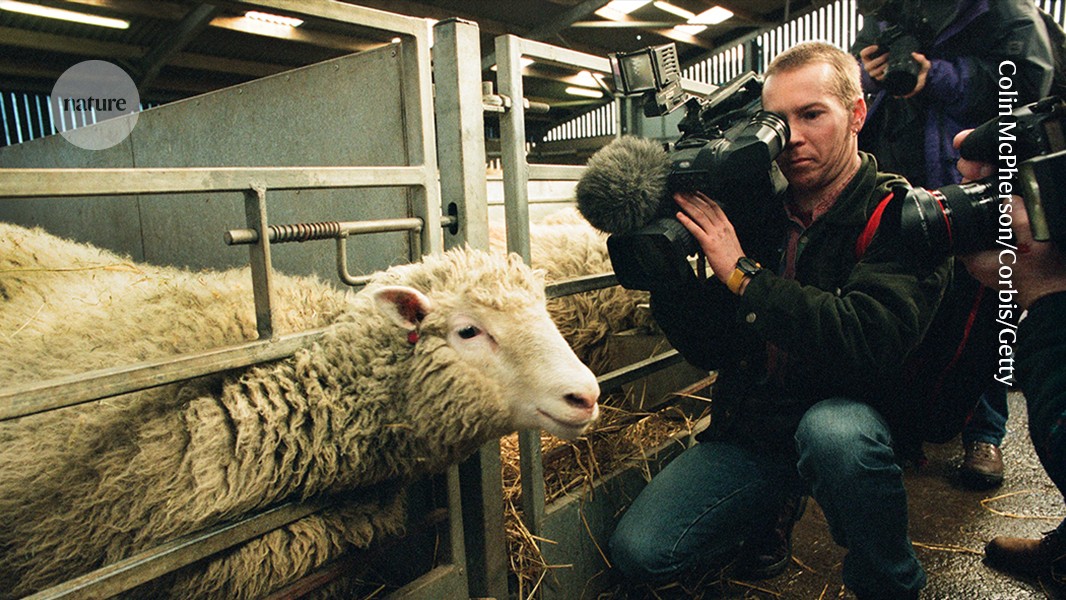
The team at the Roslin Institute was overwhelmed with media requests about Dolly.Credit: Colin McPherson/Corbis/Getty
Taxidermied, locked behind plexiglass and spinning slowly on a wooden dais in the National Museum of Scotland in Edinburgh, UK, the world’s most famous ewe remains a public spectacle three decades after her birth.

First CRISPR horses spark controversy: what’s next for gene-edited animals?
From that moment on 5 July 1996, Dolly the sheep — the first mammal cloned from an adult cell1 — was destined for celebrity, and her imprint on science is still evident in fields such as developmental biology and biotechnology. Dolly’s creation demonstrated that an adult cell can be reprogrammed to an embryonic state, which opened up the possibility of creating stem cells from adult cells. Ten years on, in 2006, details of the first such induced pluripotent stem cells were published2. The first therapies made from these cells were conditionally approved this year in Japan.
Reproductive cloning is now being used in agriculture to generate gene-edited cattle with no horns and pigs with organs that might be suitable for transplantation into humans. Moreover, an industry has sprung up to create copies of cherished pets, show animals and sport horses.
But in one important respect, Dolly’s legacy is not that anticipated in the frantic weeks after news of her birth became public in 1997. From the start, much of the world’s media portrayed Dolly as a step towards the imminent creation of cloned humans. No such development has materialized.

John Gurdon obituary: Biologist who made cloning possible
First and foremost, myriad ethical questions would surround cloning a human, not to mention formidable technical obstacles. The nuclear transfer technique that made Dolly was difficult to perform successfully in primates; monkeys would not be cloned using this method until 20183. The success rate is too low to consider the method in humans, and the risk of abnormalities resulting from the process is too high.
However, other advances in reproductive technology have been arriving at breakneck speed. Stem-cell technology, spurred by Dolly’s birth, has led to the creation of models mimicking the human embryo, and of mouse eggs and sperm from stem cells. Researchers have also developed techniques to replace faulty mitochondria in human embryos, and are engineering increasingly sophisticated artificial wombs. Last month brought a fresh wave of excitement, and worry, about the potential use of advanced gene-editing methods on embryos to create heritable genetic changes4,5.
Past imperfect
It is a lot for the public to process, particularly in the field of reproduction, in which new technologies can be portrayed as the gateway to a dystopian future and can challenge our concepts of what it means to be human. The experience of Dolly and her handlers could hold valuable lessons in how to navigate the present landscape.
Can a mouse be cloned indefinitely? Decades-long experiment has answers
The researchers who cloned Dolly, led by respected embryologist Ian Wilmut, were caught flat-footed by the frenzy of press surrounding her birth, says Bruce Whitelaw, former director of the Roslin Institute, the animal-sciences research centre near Edinburgh where she was born (and now part of the University of Edinburgh). A year earlier, the team had demonstrated that sheep could be cloned by transferring the nucleus from an embryonic cell grown in culture into an egg cell from which the nucleus had been removed6. That feat led to around 150 media requests over a week. When Dolly was announced, the institute was overwhelmed with many times this level of interest, over more than a month. “It was absolutely bonkers,” Whitelaw recalls. “We weren’t ready for that.”
The reaction to Dolly propelled genetics and reproductive biology into the public eye at a time when interactions between scientists and the media were less common than they are today, says Whitelaw. Now, ethicists, regulators and scientists are more joined up, and, increasingly, are thinking about what technologies might be next to emerge.
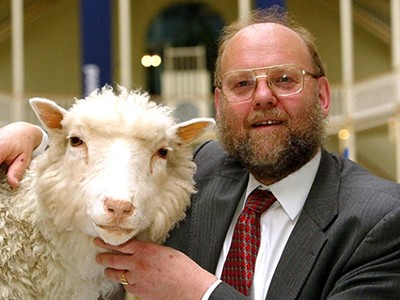
Ian Wilmut, embryologist who helped to produce Dolly the sheep (1944–2023)
But there is still no reliable system to prepare for the societal impact of those technologies, or to assess systematically how the public and other stakeholders might respond. Last month’s news that researchers are working out how to use a precise gene-editing technique to alter the DNA of human embryos highlights this. Some researchers say that not enough has been done to prepare the public or evaluate the ethics of heritable gene editing.
Even in the absence of such systems, governments must develop sensible regulation of new reproductive technologies. One example to emulate could be that of the UK Human Fertilisation and Embryology Authority, which proactively develops policies on fertility treatments and research involving human embryos.
At the same time, given the rapid pace of development, more countries need to adopt a structure to systematically help the public to evaluate and prepare for the possible outcomes of cutting-edge research in reproductive biology. Otherwise, confusion risks giving way to fear, and the hype that followed Dolly’s birth will inevitably be repeated.

