


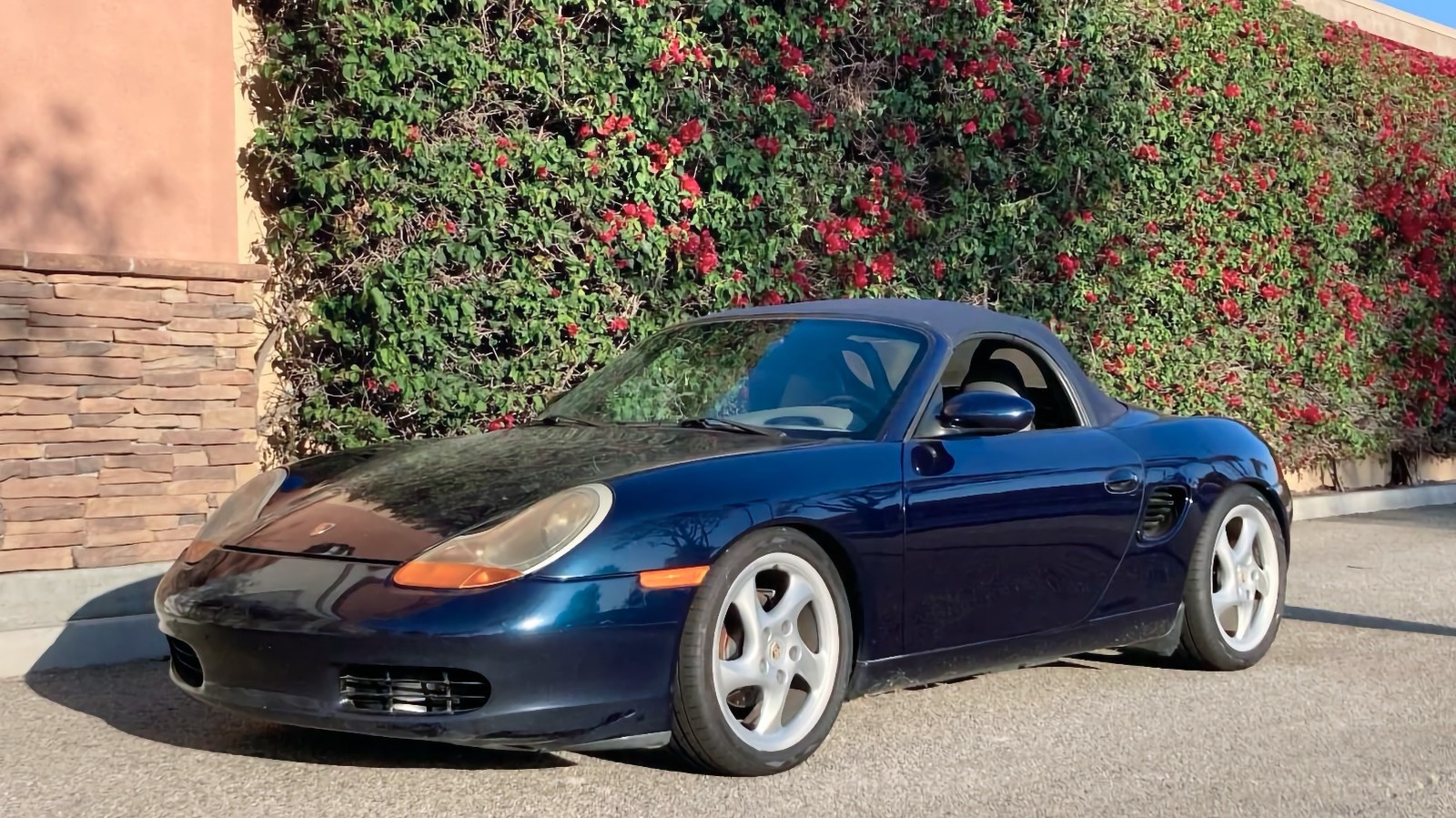
Today’s Nice Price or No Dice 986 has done a lot of miles and shows its age. It has also had an engine replacement, but it still requires some work to make it reliable. Let’s see if it’s worth getting our hands dirty.
In the party game “Hot Potato,” party-goers stand in a circle, tossing a beanbag or other small object from person to person while music is played. When the music stops at random, the person holding the object is eliminated. This continues until only one player remains. Extending outside of parlor games, the phrase ‘Hot Potato’ has long been used to describe any object, idea, or even company of questionable desirability that has gone through many hands. Saab Automobile is a prime example of a hot potato car company. Originally acquired by General Motors in 1989, the Swedish car builder suffered through that company’s bankruptcy and then its own, eventually shutting its doors. Since then, the brand has been owned by Spyker Automotive, NEVS (National Electric Vehicle Sweden), and, finally, the Chinese conglomerate Evergrande Group.
The 1976 Saab 99 GL we considered last Friday suggested happier times, when people wanted Saabs. Unfortunately for its collector-seller, the car’s $14,900 asking price severely limited demand. In the end, that was made clear in the comments and the 75% “No Dice” loss the Saab received.
Okay, now, who wants some leftover potato salad from the Fourth?
Sharing is caring
While Saab Automotive is long gone, Germany’s Porsche is still alive and kicking. That almost wasn’t the case, as in the 1980s, the company was on the ropes financially. Two decisions turned things around, staving off the wolves. The first of those was the decision to reach out to Toyota and humbly ask for advice on producing cars more efficiently. This led to the adoption of just-in-time production and parts sharing between certain models, reducing redundancy. The second decision that pulled Porsche’s feet from the fire was to pivot production to enter the wildly popular and profitable SUV and crossover market.
We’re not going to discuss that latter effort today. Instead, we’re going to note that this 1999 Porsche Boxster, while the marque’s entry-level car for the beginning of the Millennium, shares about 90% of its parts from the doors forward with the more expensive and storied 911 Carrera. Unlike the 911, however, which has vestigial rear seats, the Boxster’s mid-engine layout makes it exclusively a two-seater. That layout also potentially makes for a better-handling car, which is why the Boxster was initially only available with smaller-displacement engines than its big bro.
No funny business
Being a 1999 model, this Boxster has the smallest engine offered in the model line, a 2.5-liter, 201-horsepower M96 flat-six. This was Porsche’s first water-cooled boxer engine, and early models had issues with cracks in the alloy blocks and the cylinder liners walking. In fact, this car is on its second motor, the first apparently having gone belly up. According to the ad, that happened when the car had 170,000 miles on the clock, so it really gave its all. The replacement engine came out of a car with a far more reasonable 80K under its belt. This Boxster has now done an astounding 197,700 miles, with the engine now racking up 107,000 miles in total. A replacement clutch also entered the chat 27,000 miles ago. That sits between the M96 and a five-speed manual sourced from Audi (see? more sharing!)
Now, the seller claims that the engine “starts and runs well with no smoke or funny noises.” Currently riding on lowering springs and blown-out shocks, the seller says its ride and handling could stand improvement. They will include a set of four Bilstein B4 struts with the sale.
But wait, there’s more
There’s other work that needs to be done on this Boxster, though. According to the tale of woe that is the ad copy, the seller thinks that the alternator has failed. The car will start on a fully charged battery, but running for any length of time kills that. Because of this, the emissions codes have all been dropped from the OBDII, meaning that once the alternator is fixed, the car will need to be driven 330 miles to reset the codes, which could allow it to pass a smog test.
The rest of the car seems to be in good condition, albeit showing its age and that near trip to the moon the mileage implies. Notably, the nose is peppered with stone chips, and there’s a scratch in the paint on the rear-left fender. Things look better in the cabin, as the driver’s seat has been recovered and looks to be in solid shape. As an early car, this Boxster has the less-liked four-spoke steering wheel and a shift knob that looks like it came from an entry-level VW Polo. On the plus side, the top looks great and is said to work without issue. Finally, the title is clean, and the car carries current registration.
Cheap seats?
Okay, so we’ve established that this Boxster needs some love. The point of order is that this model is today about the cheapest way to get behind the wheel of a Porsche sports car. And, like the 914s, 924s, and 944s that preceded it, the Boxster, while cheap now, will eventually only increase in value.
But how cheap is this one now? The seller asks $5,000 for the car and suggests bringing a flatbed as the alternator issue makes it a poor candidate for a drive-off. That’s an additional cost to be considered. Then there’s the work on the charging system to think of. An alternator will cost several hundred dollars, and should the next owner be unable to diagnose and fix the problem, there’s the high cost of Porsche mechanics to consider.
With all that in mind, what’s your take on this broken Boxster and that $5,000 asking? Is that cheap enough to roll the dice despite the issues and high miles? Or would it be more prudent to give this Porsche a pass?
You decide!
Los Angeles, California, Craigslist, or go here if the ad disappears.
Hat tip to Tony A. for the hookup!
Help me out with Nice Price or No Dice. Hit me up at [email protected] and send a fixed-price tip. Remember to include your commenter handle.

