


Cell culture, antibodies, and reagents
HEK-293 cells (ATCC), including transient and stable lines, as well as CRISPR–Cas9 βARR1/2-knockout and parental lines61, were maintained in Eagle’s Minimum Essential Medium (MEM) supplemented with 10% fetal bovine serum (FBS) and 1% penicillin-streptomycin at 37 °C and 5% CO2. U2OS cells (DiscoveRx PathHunter) were cultured in MEM containing 2 mM l-glutamine, 10% FBS, and 1% penicillin-streptomycin under similar conditions. U2OS-based β-arrestin recruitment and internalization assays were performed per the manufacturer’s protocol (DiscoveRx). For chemokine-induced migration assays, leukocytes were isolated from wild-type mice as described previously18,37,61. Escherichia coli strains DH5α and BL21 (DE3) (New England Biolabs) were cultured in LB or Terrific Broth (Fisher Scientific) at 37 °C. DH5α was used for plasmid amplification, and BL21 was used for recombinant protein expression. Sf9 insect cells (Spodoptera frugiperda, Expression Systems, 94-001F) were cultured in ESF 921 medium (Expression Systems) at 27 °C. Baculoviruses were generated and amplified according to the manufacturer’s instructions. For serum starvation experiments, cells were cultured in serum-free medium supplemented with 0.1% BSA, 10 mM HEPES, and 1% penicillin-streptomycin. Transfections were performed using FuGene 6 (Promega) or Lipofectamine 3000 (Invitrogen), according to manufacturers’ protocols. All cell lines were confirmed mycoplasma-free by routine testing through the Duke University cell culture facility. Monoclonal anti-Flag M2–horseradish peroxidase (HRP) (A8592) and anti-ERK1/2 (ABS44) antibodies were obtained from Sigma-EMD Millipore. HRP-conjugated secondary antibodies (NA9340-1ML and NA9310-1ML) were purchased from Cytiva. Protease and phosphatase inhibitor tablets (cOmplete, PhosSTOP) were obtained from Roche. Anti–phospho-p44/42 MAPK (Thr202/Tyr204) antibody (9101L) was sourced from Cell Signaling Technology.
Recombinant protein expression and purification
The expression and purification of β-arrestins have been described previously44,62,63,64. In brief, E. coli BL21 (DE3) pLysS cells (New England Biolabs: C2527I) carrying pGEX4T1-Rattus norvegicus βARR1 or βARR2 construct, with their C terminus truncated (at amino acid 393 or 394, respectively), were cultured in Terrific Broth (Teknova) medium at 37 °C. After OD600 reached 0.6–0.8, the cells were induced with 0.1 mM isopropyl-β-d-thiogalactopyranoside (IPTG) at 18 °C overnight. Bacteria were collected by centrifugation (4,000 rpm), and cell pellets were resuspended in lysis buffer (20 mM HEPES, pH 8, 150 mM NaCl, 10% glycerol, 1 mM EDTA, 0.2 mM dithiothreitol (DTT), 1 mM phenylmethylsulfonyl fluoride, and 1 mM benzamidine) at 4 °C for 1 h. Cell suspensions were sonicated, centrifuged (14,000 rpm, 30 min, 4 °C), and the supernatant was loaded onto pre-equilibrated glutathione–agarose resin (GoldBio). After 3 h of binding at 4 °C, the beads were washed, and thrombin was added for overnight cleavage. The proteins were further purified by anion exchange chromatography followed by size-exclusion chromatography using a Superdex 200 Increase 10/300 GL column on an ÄKTA FPLC system (GE Healthcare). Eluted fractions were analysed by SDS–PAGE, pooled, concentrated using 30 kDa MWCO Amicon Ultra-15 Centrifugal Filter devices, flash-frozen in liquid nitrogen, and stored in aliquots at −80 °C. The same rat βARR1 constructs with mutations (L129A, L129S, L129G, P131A, P133A, E134A, D135A, K138A, C140A, Y249A, C251A, E283A, K284A and R285A) were generated and purified in a similar manner. Recombinant Gα subunits (Gαs, Gαq and Gαi) were purified as GST fusion proteins using glutathione–agarose affinity chromatography as previously described65. The heterotrimeric Gs protein complex, composed of Gαs, Gβ1 and Gγ2 subunits, was expressed in Sf9 cells using the baculovirus expression system and purified as previously described66. M2R expression, purification and reconstitution into high-density lipoprotein (HDL) particles were performed as previously described58. ERK2, SRC, p38α and JNK3 kinases were expressed and purified using previously established protocols6,16. Protein concentrations for each protein were determined by ultraviolet absorption at 280 nm and extinction coefficients estimated using the ExPASy ProtParam tool67.
Expression of β2AR constructs in Sf9 cells using the baculoviral system
The N-terminal Flag-tagged T4 lysozyme fusion-β2V2R construct (β2AR residues 1–341 fused to V2R residues 328–372), bearing a TEV cleavage site, was co-expressed with GRK2–CAAX (membrane-anchored GRK2) or wild-type β2AR in Sf9 insect cells using the Baculovirus Expression System, as described previously44,62,63,68,69. At 66 h after infection, cells expressing T4L–β2V2R were stimulated with 20 μM isoproterenol for 20 min at 37 °C to induce receptor phosphorylation (pβ2V2R), while β2AR-expressing cells remained untreated. All cells were washed extensively to remove residual agonist. For membrane preparation from these cells, briefly, cells were resuspended in cold homogenization buffer (75 mM Tris-HCl, pH 7.4, 2 mM EDTA, and cOmplete protease inhibitor) and collected by centrifugation at 500g for 5 min at 4 °C. After 2 additional rounds of centrifugation at 500g for 5 min at 4 °C, the supernatant was centrifuged at 21,000g for 30 min at 4 °C to collect crude membrane fractions. Pellets were then washed with resuspension buffer (75 mM Tris-HCl, pH 7.4, 2 mM EDTA, 12.5 mM MgCl2, cOmplete protease inhibitor, and PhosSTOP phosphatase inhibitor), passed through a 0.4 mm gauge needle 30 times using a syringe on ice, aliquoted, flash-frozen in liquid nitrogen, and stored at −80 °C.
Small-molecule library and reagents
A collection of structurally diverse, drug-like small-molecule libraries used in this work was obtained from the NCI/DTP Open Chemical Repository. The compound library comprised approximately 3,500 compounds, representing the structural diversity of over 250,000 unique small molecules. This DTP library included the NCI Diversity Set, natural products, and FDA-approved oncogenic drugs. Most compounds were certified as >95% pure by the supplier (NCI DTP Discovery Services). Powdered compounds were dissolved in 100% DMSO and stored at −20 °C. Isoproterenol (Sigma, I2760-1G), ICI-118,551, carvedilol, angiotensin II (ANGII; Sigma, A9525), and human epidermal growth factor (EGF) were purchased from Sigma-Aldrich, and AVP was obtained from GenScript. All small-molecule compounds, including BI-167107 (ref. 70), were dissolved in DMSO and stored at −20 °C as 100 mM stock solutions. The C-terminal peptide of the GPCR vasopressin-2 receptor (V2R), known as V2Rpp, was synthesized by the Tufts University Analytical Core Facility. Cellular agonist stimulations were performed at 37 °C, as described in the figure legends.
Differential scanning fluorimetry
DSF assay was performed to identify β-arrestin-binding small molecules from the drug-like compound library (DDLC) described above. The screen was conducted using the StepOnePlus Real-Time PCR System (Applied Biosystems) with the fluorescent reporter probe SYPRO Orange (Thermo Fisher Scientific) in a 96-well format. Proteins were buffered in 20 mM HEPES (pH 7.5) with 100 mM NaCl. Small molecules (100 μM) were screened with either βARR1 or βARR2 (5 μM). DMSO was used as a vehicle control, and V2Rpp (50 μM) served as a positive control.
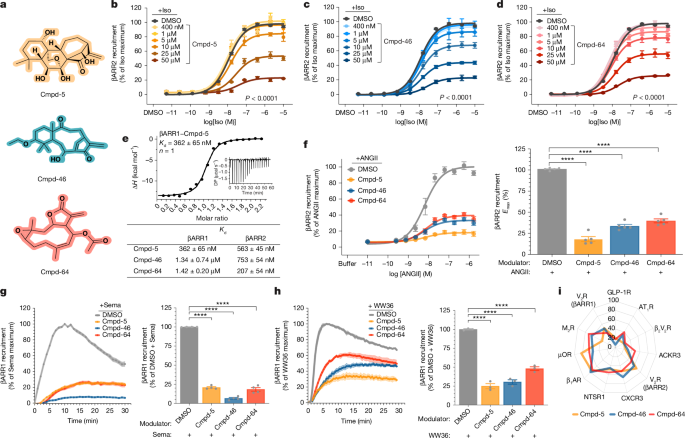
For DSF experiments involving the three positive control ligands (V2Rpp, IP6 and heparin, each at 50 μM) binding to β-arrestins, HEPES buffer was used as the vehicle control. Excitation and emission filters for SYPRO Orange were set to 475 nm and 580 nm, respectively. The temperature was increased by 0.5 °C every 30 s, from 25 °C to 99 °C, with fluorescence readings taken at each interval. Raw DSF data were analysed using Applied Biosystems Protein Thermal Shift Software. Fluorescence intensities were plotted as a function of temperature, and the midpoint of transition, or melting temperature (Tm), was calculated by plotting the first derivative of fluorescence emission as a function of temperature (dF/dT). The difference between the Tm of the protein–ligand complex and that of the protein alone represents the thermal shift (ΔTm), which indicates ligand binding to the protein of interest. For statistical analysis, experiments were conducted with at least three independent replicates per condition. The final selection of compounds for this study was guided by their efficacy in inhibiting βARR1/2 activity, along with favourable chemical properties, such as aqueous solubility and permeability, as described in the Results section. Three compounds were selected as candidate inhibitors: Cmpd-5 (NSC 250682), (1S,4aR,5S,6S,6aR,9S,11aS,11bS,14R)-1,5,6,14-tetrahydroxy−4,4-dimethyl-8-methylenedecahydro-1H-6,11b-(epoxymethano)-6a,9-methanocyclohepta[a]naphthalen-7(8H)-one; Cmpd-46 (NSC 302979), (Z)-3-ethoxy-6-hydroxy-4,4,13a-trimethyl-9-methylene-1,2,3,4,4a,5,6,9,10,11,12,13a-dodecahydro-7,10-(metheno)benzo[11]annulene-8,13-dione; and Cmpd-64 (NSC 22070), (Z)-4,10a-dimethyl-7-methylene-8-oxo-1a,2,3,6,6a,7,8,9a,10,10a decahydrooxireno[2’,3’:8,9]cyclodeca[1,2-b]furan-6-yl acetate.
Measurement of β-arrestin recruitment using the PathHunter assay
β-Arrestin recruitment to the agonist-activated receptor (β2V2R) was measured using the DiscoveRx PathHunter β-arrestin assay28, which uses enzyme fragment complementation. In this assay, the β2V2R is fused to an inactive portion of β-galactosidase (ProLink tag), and βARR2 is fused to the complementary enzyme acceptor (EA) portion, each stably expressed in U2OS cells. Upon agonist-induced recruitment of βARR2 to β2V2R, the β-gal fragments complement to form a functional enzyme, generating a measurable chemiluminescent signal. The signal intensity correlates directly with the extent of βARR2 recruitment. U2OS cells co-expressing β2V2R and βARR2 were plated at a density of 25,000 cells per well in white, clear-bottom 96-well plates 24 h before treatment. On the day of the experiment, cells were treated with either a single dose (50 μM) or varying concentrations of a specific β-arrestin modulator or vehicle control in Hanks’ balanced salt solution (HBSS) (Sigma-Aldrich) with 20 mM HEPES (pH 7.4) and 0.05% BSA. Cells were incubated at 37 °C, 5% CO2, and about 100% relative humidity for about 30 min, followed by stimulation with either 10 nM Iso or a serial dilution of Iso for 60 min at 37 °C. After agonist stimulation, PathHunter reagents were added, and cells were incubated for another 60 min at ambient temperature. Luminescence signals were measured using a CLARIOstar microplate reader (BMG Labtech).
NanoBiT luciferase complementation assays
For each NanoBiT assay, specific components are described below. For NanoBiT-based β-arrestin recruitment assays, CRISPR–Cas9 βARR1/2-knockout HEK293 cells were maintained in MEM supplemented with 10% FBS and 1% penicillin-streptomycin at 37 °C and 5% CO2. Cells were seeded in poly-d-lysine-coated white 96-well plates at 100,000 cells per well. β-Arrestin recruitment was monitored using the NanoBiT complementation system, which uses split NanoLuc luciferase fragments (LgBiT and SmBiT). Two assay formats were used. In the first, the LgBiT–CAAX (plasma membrane) and SmBiT–βARR1 format, cells were transfected with 125 ng Flag-tagged GPCR, 25 ng LgBiT–CAAX, 125 ng SmBiT–βARR1, and pcDNA filler using polyethylenimine (PEI) at a 3:1 PEI:DNA ratio. After 24 h, cells were lifted and replated in MEM with 1% FBS. The next day, cells were incubated with 2.5 μM fluorofurimazine and either modulator (50 μM) or DMSO for 20 min at 37 °C. Luminescence was recorded before and after agonist or vehicle addition using a Berthold Mithras LB 940 with a 480 nm filter (NanoLuc). For each condition, data were normalized to the mean baseline and vehicle-stimulated cells. Modulator responses were then normalized to the maximal signal observed in DMSO-pretreated cells stimulated with the highest agonist dose. In the second, the V2R–LgBiT and βARR1– or βARR2–SmBiT format, cells were transfected with 25 ng V2R–LgBiT and 125 ng βARR1– or βARR2–SmBiT using Lipofectamine 3000 and incubated for 48 h. Cells were washed and treated with coelenterazine-h and modulator (50 μM) or DMSO for 30 min at 37 °C. Baseline luminescence was recorded for 2 min followed by stimulation with 100 nM AVP or vehicle. NanoBiT luminescence was measured for 20 min using a PHERAstar FSX plate reader (BMG LabTech). AUC was used to quantify β-arrestin recruitment normalized to baseline and vehicle. NanoBiT assays between β2AR–LgBiT or CCR7–LgBiT and SmBiT–mini-Gi71 were performed similarly as above. HEK293 βARR1/2-knockout cells were seeded into white poly-D-lysine-coated 96-well flat-bottom plates (Corning; 353296). Coelenterazine-h (NanoLight; 301) was added at a final concentration of 10 μM before measurement. After establishing a 3-min baseline, cells were stimulated with 10 μM Iso or 250 nM CCL19 in HBSS to measure mini-Gi recruitment in the presence of 50 μM modulator in HEK293 βARR1/2-knockout cells. Luminescence was recorded for 27 min using a CLARIOstar plate reader (BMG LabTech).
FRET-based cAMP accumulation measurement
To measure cellular cAMP production in live cells mediated by stimulatory G protein, Gαs-coupled β2AR activation, FRET-based Epac sensors were used as described previously30. The Epac2 (ICUE2) sensor contains a CFP and YFP FRET pair. HEK293 cells stably expressing ICUE2 were plated in poly-d-lysine-coated, black, clear-bottom 96-well plates (Corning) at a density of 50,000 cells per well. At least 16 h after plating, cells were washed with PBS and incubated in HEPES-buffered saline solution (10 mM HEPES, 150 mM NaCl, 5 mM KCl, 1.5 mM MgCl2, 1.5 mM CaCl2, 10 mM glucose, 0.2% BSA, pH 7.4) for 1 h at 37 °C. Cells were then treated with either β-arrestin small-molecule modulators (40 μM) or DMSO for 5 min, and baseline fluorescence was monitored. Real-time cAMP measurement was initiated by stimulating cells with 10 μM Iso at 37 °C. FRET changes corresponding to cAMP accumulation were measured as changes in the background-subtracted 480 nm/535 nm fluorescence emission ratio (CFP/YFP), reflecting changes in cAMP levels. The entire cAMP accumulation profile was quantified by calculating the AUC for the time course. To assess the effect of modulators on the agonist-induced cAMP response, AUC values were expressed as a percentage of the response to Iso in the presence of DMSO (set as 100%), enabling comparison of the effect of each modulator relative to this agonist-alone control.
Intracellular calcium measurement
Intracellular (Ca2+) release was measured using the FLIPR Calcium 6 assay kit with a FlexStation 3 microplate reader, following the manufacturer’s instructions (Molecular Devices) and as described previously31. In brief, HEK293 cells stably expressing human angiotensin II type 1 receptor (AT1R), parental HEK293 cells transiently expressing AT1R, or HEK293 CRISPR–Cas9 βARR1/2-knockout cells transiently expressing AT1R were seeded in poly-d-lysine-coated, black 96-well assay plates at a density of 40,000 cells per well and incubated for 24 h. On the day of the experiment, cell plates were loaded with FLIPR Calcium 6 reagents and treated with β-arrestin small-molecule modulators (10 μM) or vehicle (DMSO) for 30 min. After establishing basal fluorescence (F0), the cells were treated with the agonist ANGII (30 pM for stably expressing AT1R or 120 pM for transiently expressing AT1R) while fluorescence intensity (F) was monitored in real time. These sub-maximal ANGII concentrations were empirically optimized to elicit moderate, temporally resolved Ca2+ transients, allowing sufficient time for β-arrestin-mediated desensitization to develop prior to the peak response. The complete Ca2+ transient profile was quantified by calculating the AUC over time. AUC values were normalized to the response to ANGII alone (set as 100%) to compare the effects of modulators relative to the agonist-alone control.
Measurement of receptor internalization by PathHunter assay
β-Arrestin-mediated receptor internalization was measured using the DiscoveRx PathHunter active receptor endocytosis assay according to the manufacturer’s protocol (DiscoveRx) and as previously described28. In brief, β2V2R was transiently transfected into U2OS cells stably expressing an EA-tagged βARR2 and an endosome-localized ProLink-tagged protein. The next day, cells were seeded at 25,000 cells per well in white, clear-bottom 96-well assay plates and incubated for 24 h before the experiment. On the day of the experiment, cells were treated with varying concentrations of a specific β-arrestin modulator or vehicle control in HBSS (Sigma-Aldrich) with 20 mM HEPES (pH 7.4) and 0.05% BSA. Cells were incubated at 37 °C, 5% CO2, and ~100% relative humidity for ~30 min, followed by stimulation with a series of concentrations of agonist (Iso) for 60 min at 37 °C. After agonist stimulation, PathHunter reagents were added, and cells were incubated for another 60 min at ambient temperature. Receptor–β-arrestin complex internalization was detected as luminescence resulting from the complementation of β-gal fragments (enzyme acceptor and ProLink) within endosomes. Luminescence signals were measured using a CLARIOstar microplate reader (BMG Labtech).
BRET-based receptor internalization assay
BRET-based assays were conducted to measure receptor internalization using a bystander BRET format as previously described33. In brief, HEK293 cells transiently expressing V2R–RLucII (BRET donor) and the early endosome marker 2×FYVE-mVenus (BRET acceptor) were pretreated with vehicle or β-arrestin modulator (40 μM) for 30 min. Receptor association with the endosome marker was measured as a BRET signal after stimulation with a range of AVP concentrations. BRET measurements were performed using the Synergy2 (BioTek) microplate reader with filter sets of 410/80 nm and 515/30 nm to detect RLucII (donor) and mVenus (acceptor) emissions, respectively. The BRET signal was calculated as the ratio of light intensity emitted by the acceptor over the donor, and the ‘net BRET’ ratio was determined by subtracting the vehicle control ratio from the corresponding AVP-treated ratio.
Gi activity assay
Gi-mediated inhibition of adenylyl cyclase was assessed using the GloSensor cAMP bioluminescence biosensor (Promega). HEK293 cells were transiently transfected with D2R or M2R together with the GloSensor cAMP reporter construct, using FuGENE 6 per the manufacturer’s protocol. Cells were seeded into poly-d-lysine-coated white clear-bottom 96-well plates at 60,000 cells per well and cultured for 24 h. GloSensor reagent was added per the manufacturer’s instructions and cells were equilibrated for 1 h at room temperature. Where indicated, pertussis toxin (PTX; 100 ng ml−1) was applied overnight as a positive control for Gi blockade. Compounds (Cmpd-5, Cmpd-46 or Cmpd-64; 50 μM) or vehicle (DMSO) in HBSS supplemented with 20 mM HEPES (pH 7.4) and 0.05% BSA were applied for 15 min at room temperature. Cells were stimulated with forskolin (2 μM, 5 min), followed by concentration-response stimulation with quinpirole (D2R) or acetylcholine (M2R). Luminescence was recorded every 5 min over 30 min using a CLARIOstar microplate reader (BMG Labtech). Forskolin-stimulated cAMP, quantified at 10 min after agonist addition, was normalized to the maximal forskolin response per condition. Gi activity was derived from the inhibitory plateau and expressed as a percentage of the DMSO plus agonist control.
Intramolecular FlAsH-BRET assay
Intramolecular FlAsH-BRET assays72 were performed in HEK293 βARR1/2-knockout cells transiently transfected using FuGENE4K with 2 μg total DNA per 15 cm dish. Cells were transfected with 1.5 μg of pcDNA3.1 encoding human AT1R and 0.4 μg of a plasmid encoding the indicated RLuc–β-arrestin2–FlAsH biosensors. Twenty-four hours after transfection, cells were replated into poly-d-lysine-coated 96-well white, clear-bottom plates at 100,000 cells per well in MEM supplemented with 10% FBS. Forty-eight hours after transfection, cells were labelled with FlAsH-EDT2 (FlAsH II In-Cell Tetracysteine Detection Kit, Thermo Fisher) at a final concentration of 2.5 μM for 30 min at room temperature. Following labelling, cells were washed twice with BAL wash buffer (250 μM 2,3-dimercapto-1-propanol in HBSS), then equilibrated in HBSS supplemented with 20 mM HEPES (pH 7.4). Modulators were applied at 50 μM for 15 min, followed by addition of Prolume Purple substrate (Nanolight Technologies). Cells were then stimulated with 10 μM angiotensin II. BRET signals were recorded using a CLARIOstar Plus plate reader in kinetic mode (480 nm donor, 530 nm acceptor) for 30 min, and peak values were used for quantification. ΔNet BRET was calculated by subtracting baseline values from from each condition, including agonist alone, modulator alone, or agonist plus modulator.
TRUPATH BRET assay
TRUPATH assays73 were performed in HEK293 βARR1/2-knockout cells transiently transfected using FuGENE4K with a total of 4 μg per 15 cm dish plasmid DNA, including pcDNA3.1 constructs encoding human GPCRs (β2AR, AT1R, M2R or NTSR1), Gα–RLuc8, Gβ3 and Gγ9–GFP2 at a 1:1:1:1 ratio. TRUPATH components were obtained from B. Roth via Addgene (1000000163). Twenty-four hours after transfection, cells were replated into poly-d-lysine-coated 96-well white, clear-bottom plates at 20,000–30,000 cells per well in phenol red-free DMEM supplemented with 2% FBS. BRET signals were acquired 48 h after transfection. On the day of the assay, cells were washed and incubated in HBSS containing 20 mM HEPES (pH 7.4). Modulators were applied at 50 μM for 15 min, followed by addition of Prolume Purple substrate (Nanolight Technologies). Cells were then stimulated with increasing concentrations of agonist (angiotensin II, neurotensin, isoproterenol or acetylcholine). BRET2 was recorded in kinetic mode for 30 min using a CLARIOstar Plus plate reader (480 nm/510 nm), and peak signals were used for quantification. ΔNet BRET ratios were calculated by subtracting the BRET ratio of the vehicle-treated control from each condition, agonist alone or agonist plus modulator. Data represent the mean of three technical replicates across 3–5 independent experiments and were fitted using a three-parameter logistic model in GraphPad Prism.
Chemotaxis assays
Chemotaxis assays were performed similarly to previously described protocols37. In brief, T cells were isolated from the spleens of wild-type mice, subjected to erythrocyte lysis, and filtered through a 70-μm filter. The cells were then suspended in RPMI 1640 medium containing 0.5% BSA and treated for 30 min with β-arrestin modulators or vehicle. A total of 1 × 10⁶ cells in 100 μl of medium were added to the upper chamber of 6.5-mm diameter, 5-μm pore polycarbonate Transwell filters (Corning Costar), and cells migrated towards 100 nM CCL19 in the lower chamber for 2 h at 37 °C. T cells that migrated to the lower chamber were collected, resuspended, washed, and stained for flow cytometry analysis using a Live/Dead marker (Aqua Dead, Thermo Fisher) and antibodies for cell surface markers (CD45+, CD3+, CD4+ and CD8+) prior to paraformaldehyde fixation. The total live T cell population (CD45+ and CD3+) and subset populations (CD45+, CD3+ and CD4+, or CD45+, CD3+ and CD8+) were measured using a BD LSR Fortessa machine from the Flow Cytometry Shared Resource (FCSR) at the Duke Cancer Institute (Durham, NC). CountBright beads (Thermo Fisher) were added immediately after resuspension of the lower chamber contents to correct for volume differences and any cell loss during wash steps. Per cent migration was calculated by determining the percentage of migrated cells treated with compounds relative to control wells, with migration in CCL19-treated wells alone set as 100%. The use of mouse splenocytes ex vivo for this T cell migration was conducted under institutional guidelines for the care and use of laboratory animals. No live animal procedures were performed. A representative gating tree is shown in Extended Data Fig. 5.
Adult ventricular cardiomyocyte isolation and contractility analysis
All animal experiments were approved by the Institutional Animal Care and Use Committee (IACUC) at Duke University Medical Center and performed in accordance with relevant guidelines and regulations. Ventricular cardiomyocytes were freshly isolated from 12- to 16-week-old C57BL/6J wild-type mice using a standard Langendorff perfusion system39,74. The heart was initially cannulated through the aorta and then perfused with an oxygenated buffer at 37 °C (120 mM NaCl, 14.8 mM KCl, 0.6 mM KH2PO4, 0.6 mM Na2HPO4, 1.2 mM MgSO4·7H20, 10 mM HEPES, 4.6 mM NaHCO3, 30 mM taurine, and 5.6 mM glucose, pH 7.3). After 2 min, the buffer was switched to a digestion solution containing 2.4 mg ml−1 collagenase (Worthington). Following 8 min of digestion, ventricles were transferred to a stopping buffer that included 10% calf serum. Myocytes were then manually dissociated and gradually brought to a physiological Ca2+ concentration (1.2 mM). Isolated cardiomyocyte was first pretreated with DMSO (0.1%), C5, C46 or C64 (25 µM) for 20 min followed by treatment with HBSS (basal), angiotensin II (positive control, 10 µM) or TRV027 (10 µM). Cells were plated in a chamber (Ionoptix) on a Nikon Eclipse TE300 inverted microscope (40× 0.9 NA objective, MRF00400, Nikon). Cardiomyocytes were paced at 1 Hz and 20 V (MyoPacer, Ionoptix), and sarcomere length was recorded by a MyoCam-S camera (Ionoptix). Ten consecutive contractions per cell (7–12 cells per condition) were averaged to quantify contractility and kinetic parameters (IonWizard 7.2). Only those cells exhibiting proper single cardiomyocyte morphology and responsiveness to electrical stimulation were included. Sample size represents the number of hearts at each condition derived from an average of 7–12 cells per heart for each condition. Statistical comparisons between conditions were performed using one-way ANOVA followed by Sidak post hoc test.
Isothermal titration calorimetry
ITC measurements were performed on a MicroCal iTC200 system at 25 °C. Prior to ITC experiments, all proteins (βARR1, βARR2 or βARR1 mutants) were extensively dialysed against 20 mM HEPES (pH 7.4), 100 mM NaCl, and 3 μM TCEP. Protein concentrations were determined by spectrophotometry at 280 nm, using extinction coefficients calculated from each protein sequence via the ProtParam program67. The dialysis buffer was used to dilute DMSO stock solutions of β-arrestin small-molecule modulators to their final concentrations for measurements. For each ITC experiment, β-arrestin modulators (Cmpd-5 at 350 μM, Cmpd-46 at 450 μM, and Cmpd-64 at 450 μM) were loaded into the syringe and titrated into the calorimetric cell containing βARR1, βARR1 mutants or βARR2 (at about 30–40 μM, depending on the protein and experiment). Additional ITC experiments were also performed using purified GST-fused Gα subunits (Gαs, Gαq and Gαi; about 30 μM) and Gαiβγ heterotrimer (about 30 μM). Gα subunits were prepared in the same buffer (20 mM HEPES, pH 7.4, 100 mM NaCl, 3 μM TCEP), whereas the Gαiβγ heterotrimer was maintained in buffer supplemented with 0.05% DDM and 10 μM GDP, with matched DMSO carrier conditions. Modulators (300 μM) or corresponding DMSO controls were loaded and titrated as described above. The reference cell was filled with distilled water. In all experiments, the titration sequence typically consisted of an initial 0.4 μl injection, followed by 19 injections of 2 μl each, with a 180-s interval between injections to allow thermal power to return to baseline. During the experiment, the reference power was set to 7 μcal s−1, and the sample cell was stirred continuously at 750 rpm. Raw data, excluding the first injection, were baseline-corrected, integrated, and normalized. Data were analysed and fit using a one-site independent binding model to obtain the equilibrium dissociation constant, Kd (from the association constant Ka = 1/Kd), stoichiometry (N), and thermodynamic parameters including enthalpy (ΔH) and entropy (−TΔS) of binding. Data were analysed using MicroCal PEAQ-ITC analysis software (v1.1.0.1262).
Radioligand-binding experiments
To assess the effects of β-arrestin modulators on β-arrestin- or Gαs–βγ-promoted high-affinity agonist binding, [3H]-Fen binding assays were performed using membranes from Sf9 cells expressing phosphorylated β2V2R (pβ2V2R) or β2AR28. Membranes were prepared from Sf9 cells co-expressing Flag-tagged T4L–β2V2R and GRK2–CAAX under agonist stimulation, or unstimulated β2AR alone as described above28. Reactions (150 μl) contained 6 nM [3H]-Fen (12.6 Ci mmol−1), pβ2V2R membranes, βARR1/2 or βARR1 mutants (2 μM), and β-arrestin modulators (100 μM) or vehicle in HN100 buffer (20 mM HEPES, pH 7.4, 100 mM NaCl, 12.5 mM MgCl2). For Gαs–βγ assays, β2AR membranes were incubated with 4.3 nM [3H]-Fen and Gαs–βγ heterotrimer (200 nM) in G protein assay buffer with or without modulators. Nonspecific binding was defined using propranolol (25 μM). Following 90 min incubation at room temperature, reactions were filtered onto PEI-soaked GF/B filters and washed with cold buffer. Bound [3H]-Fen was extracted overnight in scintillation fluid and quantified by scintillation counting. Specific binding was calculated by subtracting nonspecific from total binding.
Live-cell ERK1/2 activation assay
To evaluate the effect of small-molecule modulators on β-arrestin-dependent ERK1/2 signalling, HEK293 cells stably expressing β2AR were serum-starved for 6 h (refs. 34,75), then pretreated with β-arrestin modulators (30 μM) or vehicle for 20 min at 37 °C. Cells were subsequently stimulated with carvedilol (10 μM, 5 min), a β-arrestin-biased agonist known to promote ERK1/2 phosphorylation via β-arrestin scaffolding of RAF–MEK–ERK signalling components. Cells were lysed, sonicated (15 s), and centrifuged at 14,000g for 15 min at 4 °C. Equal amounts of total protein were resolved by SDS–PAGE on 4–20% Tris-Glycine gels (Thermo Fisher Scientific), transferred to nitrocellulose or PVDF membranes, and immunoblotted with anti–phospho-ERK1/2 (1:2,000; Cell Signaling) and total ERK1/2 (1:10,000; Millipore Sigma). HRP-conjugated secondary antibodies were used for detection. Protein bands were visualized using Pierce SuperSignal West Pico ECL substrate (Thermo Fisher Scientific), imaged on a ChemiDoc XRS system (Bio-Rad) and quantified by densitometry using ImageLab (Bio-Rad). Data were analysed using GraphPad Prism.
Pulldown analysis of β-arrestin–effector interactions
To assess the effects of the compounds on βARR1 interactions with its effector proteins SRC and JNK3, βARR1–Flag (5 μM) was incubated with a 20-fold molar excess of Cmpd-5, Cmpd-46 or Cmpd-64 for 30 min at room temperature. Subsequently, 15 μM of SRC or JNK3 was added. To evaluate compound effects on βARR1–ERK2 binding, βARR1 (15 μM) was pre-incubated with a 20-fold molar excess of Cmpd-5, Cmpd-46 or Cmpd-64 for 30 min at room temperature, followed by the addition of 5 μM ERK2–Flag. Afterward, 50 μl of anti-Flag M2 affinity gel (Millipore Sigma) was added, and the mixtures were incubated for 1 h at room temperature with rotation. The resin was then collected by centrifugation and washed 3 times with 1 ml of 20 mM HEPES (pH 7.5), 100 mM NaCl. Bound proteins were eluted using 0.2 mg ml−1 Flag peptide in 20 mM HEPES (pH 7.5), 100 mM NaCl, mixed with Laemmli sample buffer (Bio-Rad), and analysed by SDS–PAGE followed by western blotting. Detection was performed using monoclonal anti-Flag M2-peroxidase (HRP) antibody (1:2,000, Sigma-Aldrich A8592, RRID:AB_439702) for βARR1–Flag and ERK2–Flag; polyclonal A1CT antibody76 (1:5,000) for βARR1; anti-SRC monoclonal antibody (1:10,000, EMD Millipore 05-184, RRID:AB_2302631) for SRC; and anti-JNK3 monoclonal antibody (1:5,000, Cell Signaling 2305, RRID:AB_2281744) for JNK3. Western blot images were taken using Bio-Rad ChemiDoc system and the densitometry analysis was performed by ImageLab v6.1 and statistical differences were determined by one-way ANOVA with Dunnett’s post hoc test in GraphPad Prism software.
G protein GTPase assay
GTPase activity of purified heterotrimeric Gi protein was measured in vitro using the GTPase-Glo assay (Promega). HDL-reconstituted M2R (100 nM) was pre-incubated with iperoxo (10 μM) or DMSO for 15 min at room temperature in assay buffer (20 mM HEPES, pH 7.4, 100 mM NaCl, 10 mM MgCl2). β-arrestin modulators (Cmpd-5, Cmpd-46 or Cmpd-64; 10 μM each) or DMSO control were subsequently added together with Gi heterotrimer (500 nM) and GTP (2.5 μM), and reactions were incubated for 1 h at room temperature in the continued presence of iperoxo or DMSO. Reactions were terminated by addition of GTPase-Glo reagent, followed by detection reagent, according to the manufacturer’s instructions. Luminescence was measured using a CLARIOstar plate reader (BMG Labtech).
Cytotoxicity assay
MTT assay was performed according to the manufacturer’s instructions (Roche Diagnostics). HEK293 and U2OS cells were seeded in 96-well plates. The following day, cells were treated with the indicated concentration of modulator or vehicle for 8 h. To evaluate the cytotoxic effects of the compounds, cells were incubated with 3-(4,5-dimethylthiazol-2-yl)-2,5-diphenyltetrazolium bromide (MTT) reagent at 37 °C for 4 h. The optical density was measured at 595 nm (the absorbance of each sample was measured at 560 and 670 nm). The optical density values of blue formazan formed in live cells based on the reduction of MTT were determined at 595 nm. Cell viability was expressed as the percentage of MTT reduction in compound-treated cells compared to vehicle-treated cells.
Cryo-EM sample preparation and data acquisition
The expression construct for βARR1–BRIL was designed by inserting the thermostabilized apocytochrome b562 (M7W, H102I, K106L) from E. coli (BRIL) between residues 176–182 at the hinge region of rat βARR1 (ref. 64) truncated at residue 393 and purified as wild-type βARR1. βARR1–BRIL was incubated with 1.5-fold molar excess of anti-BRIL Fab (BAG2)42 and twofold molar excess of aFabNb43 for 1 h at room temperature. The complex was subjected to size-exclusion chromatography on a Superdex 200 Increase column (Cytiva Life Sciences) in 20 mM HEPES 7.5, 150 mM NaCl buffer. Peak fractions were concentrated to 2 mg ml−1 using Vivaspin 6 column with molecular weight cut-off of 30,000 kDa (Sartorius). The complex was incubated for 2 h on ice with 50-fold molar excess of Cmpd-5 solubilized in DMSO (βARR1–BRIL–BAG2–aFabNB–Cmpd-5) or equivalent amount of DMSO (βARR1–BRIL–BAG2–aFabNB–Apo), and then concentrated to 7–8 mg ml−1. The sample was applied to glow-discharged 300-mesh holey-carbon grids (Quantifoil R1.2/1.3, Electron Microscopy Sciences) using a Vitrobot Mark IV (Thermo Fisher Scientific) at 4 °C and 100% humidity. The data were collected on a Titan Krios transmission electron microscope (Thermo Fisher) operating at 300 kV equipped with a K3 direct electron detector (Gatan) in counting mode with a BioQuantum GIF energy filter (slit width of 20 eV) at a magnification of 81,000× corresponding to a pixel size of 1.08 Å at the specimen level. Sixty-frame movies with a dose rate of about 15 e− pixel−1 s−1 and a total accumulated dose of about 54–60 e− Å−2 were collected using the Latitude-S (Gatan) single-particle data acquisition program. The nominal defocus values were set from −0.8 to −2.5 µm.
Cryo-EM data processing
Movies were subjected to beam-induced motion correction using Patch Motion Correction in CryoSPARC v4.0.1 (ref. 77) followed by determination of contrast transfer function parameters in Patch CTF. Micrographs with contrast transfer function fit better than 3.5 Å were used for further analysis. Particles manually selected from 15 micrographs were used to train a model in the particle picking tool Topaz v0.2.5a78. The trained model was used to pick particles in all micrographs generating 1,572,529 particle projections for βARR1–BRIL–BAG2–aFabNB–Cmpd-5 and 1,307,318 particle projections for βARR1–BRIL–BAG2–aFabNB–Apo. The particles were rescaled to the pixel size of 1.3824 Å for further processing. A subset of particles (500,000) was subjected to ab initio model generation with 5 classes. All particles were then subjected to five rounds of heterogeneous refinement. The resulting particle stacks (396,911 particles for βARR1–BRIL–BAG2–aFabNB–Cmpd-5 and 832,520 particles for βARR1–BRIL–BAG2–aFabNB–Apo) were used in non-uniform refinement and local refinement with a mask excluding aFabNb and the constant region of BAG2. Then particles were subjected to 3D classification without alignment in CryoSPARC with a mask excluding aFabNb and the constant region of BAG2. Finally, the best classes with 177,430 particles (βARR1–BRIL–BAG2–aFabNB–Cmpd-5) and 479,224 particles (βARR1–BRIL–BAG2–aFabNB–Apo) were subjected to another round of local refinement in CryoSPARC, generating a map with a global resolution of 3.47 Å and 3.52 Å, respectively. The cryo-EM maps were post-processed using DeepEMhancer with highRes deep learning model79.
Model building and refinement
The initial models were built manually by fitting the crystal structure of βARR1 (PDB: 1G4M)80 into the experimental electron densities using UCSF Chimera v1.15 (ref. 81). The BRIL–BAG2–aFabNb part of the model was derived from the cryo-EM structure of Frizzled5–BRIL–BAG2–aFabNb (PDB: 6WW2)82. The structures were refined by combining manual adjustments in Coot v0.9.8.3 (ref. 83) and ISOLDE84 in UCSF ChimeraX 1.6.1 (ref. 81), followed by real-space refinement in PHENIX v1.20.1-4487 (ref. 85) with Ramachandran, rotamer, torsion and secondary structure restraints enforced. The models were validated with MolProbity v4.5.1 (ref. 86). Difference density maps between the Cmpd-5-bound and apo states were calculated using a local scaling-based density difference approach45. Structural superpositions and pairwise r.m.s.d. and Q-score calculations were performed using the PDBeFold server87. Cryo-EM refinement statistics are summarized in Extended Data Table 1.
Modelling and molecular dynamics simulations
The apo βARR1 model in the basal state and the β2V2R–βARR1 complex (PDB code: 6TKO)60 model were built and simulated as described previously88. Due to a considerable number of missing residues in the Cmpd-5-bound βARR1 cryo-EM structure, we constructed a Cmpd-5-bound βARR1 model by placing Cmpd-5 in the MCL cleft of an equilibrated basal βARR1 model according to the experimentally derived location of the bound Cmpd-5. A βARR1 model in the active state was constructed by homology modelling with Modeller (v10.0)89 using the crystal structure of the V2Rpp-bound βARR1 in the active state (PDB code: 4JQI)44 as the template. Parts without any template—that is, residues 1 to 5 and 307 to 311—were ab initio modelled with Modeller. The resulting model with the lowest DOPE score was selected for the following steps. The selected βARR1 models were processed by the Protein Preparation Wizard of Schrodinger Suite (v2023-1). The first and last residues of this model are in positively and negatively charged states, respectively, without capping, as assumed in their natural condition. The prepared model was then immersed in a simulation water box using the System Builder of Schrodinger Suite (v2023-1). A simple point charge water model was used to solvate the system, and Na+ and Cl− ions were added to neutralize the system and the salt concentration of the system was increased to 0.15 M. The total system size was about 148,000 atoms.
Molecular dynamics simulations were carried out using Desmond MD System (v6.1; D.E. Shaw Research)90 with the OPLS4 force field91. The simulation systems were minimized and equilibrated with restraints on the ligand heavy atoms and the protein backbone. For both the equilibrations and the following production runs, the constant temperature 310 K was maintained by Langevin dynamics, 1 atm constant pressure was achieved with the Langevin piston method92. A cut-off distance of 9 Å was used for the nonbonded interactions, and the particle-mesh Ewald summation method was used for the electrostatics interactions. The integration timestep was set to 2.5 fs. The isothermal-isobaric (NPT) ensemble was used in a periodic boundary condition. The production runs of β-arrestin simulations are without any restraints. The analysis and visualization were performed with VMD93 and PyMol (Schrodinger).
Absolute protein–ligand binding free energy perturbation calculations
We used absolute protein–ligand binding free energy perturbation (AB-FEP) approach as implemented within Schrodinger suite (release 2025-2)94 which is based on the originally proposed double decoupling scheme95. In this method, starting from the ligand in the water, the van der Waals and electrostatic interactions within the ligand, and between the ligand and water, were first gradually turned off, yielding a dummy ligand. The dummy ligand was then restrained to the protein binding site through a set of cross-link restraints. Finally, the van der Waals and electrostatic interactions within the ligand, and between the ligand and protein, were gradually turned on, while the cross-linked restraints were relaxed. The starting point for the AB-FEP run was a representative frame from the trajectory shown in Supplementary Videos 1 and 2.
Molecular docking of β-arrestin modulators
Molecular docking was performed to evaluate the binding of Cmpd-5, Cmpd-46 and Cmpd-64 at the βARR1 allosteric site identified in the cryo-EM structure of the βARR1–Cmpd-5 complex. The βARR1 structure was prepared from the cryo-EM model, with the Cmpd-5 binding site defined by residues forming the middle loop, lariat loop and C-loop. Docking was carried out using Schrödinger Maestro (suite 2025-2). Ligands were prepared using LigPrep with ionization states assigned for physiological pH. A receptor grid was generated centred on the Cmpd-5-binding pocket. Cmpd-5 docked with a pose that closely aligned to the experimentally resolved conformation, validating the identified binding pocket. By contrast, Cmpd-46 and Cmpd-64 produced lower-scoring poses with less favourable shape and contact complementarity, consistent with their reduced binding and functional activity.
Graphing and statistical analyses
All graphs were generated and analysed using GraphPad Prism 10.0 (GraphPad Software). Dose–response curves were fitted to a log(agonist) versus response model with parameters for span, baseline, and half-maximal effective concentration (EC50), and minimum baseline was corrected to zero. For statistical comparisons, one-way ANOVA with Dunnett’s post hoc test was generally used for comparisons across more than two groups, and two-way ANOVA with Sidak’s post hoc test or similar was used for comparisons involving multiple conditions, as specified in the figure legends. Most experiments were conducted with three biological replicates, and additional replicates served as controls. Replicates in the figure legends refer to biological replicates, with technical replicates included in some experiments for intra-replicate variation. Differences with P values < 0.05 were considered significant. Further statistical details and replicate information are provided in the figure legends.
Inclusion and ethics statement
All authors meet the authorship criteria required by Nature Portfolio journals and contributed meaningfully to the study. Authorship was determined collaboratively and was not influenced by gender, seniority, or institutional affiliation. Roles were agreed upon in advance, and the work was conducted responsibly and ethically, following institutional standards and inclusive research practices.
Reporting summary
Further information on research design is available in the Nature Portfolio Reporting Summary linked to this article.

