


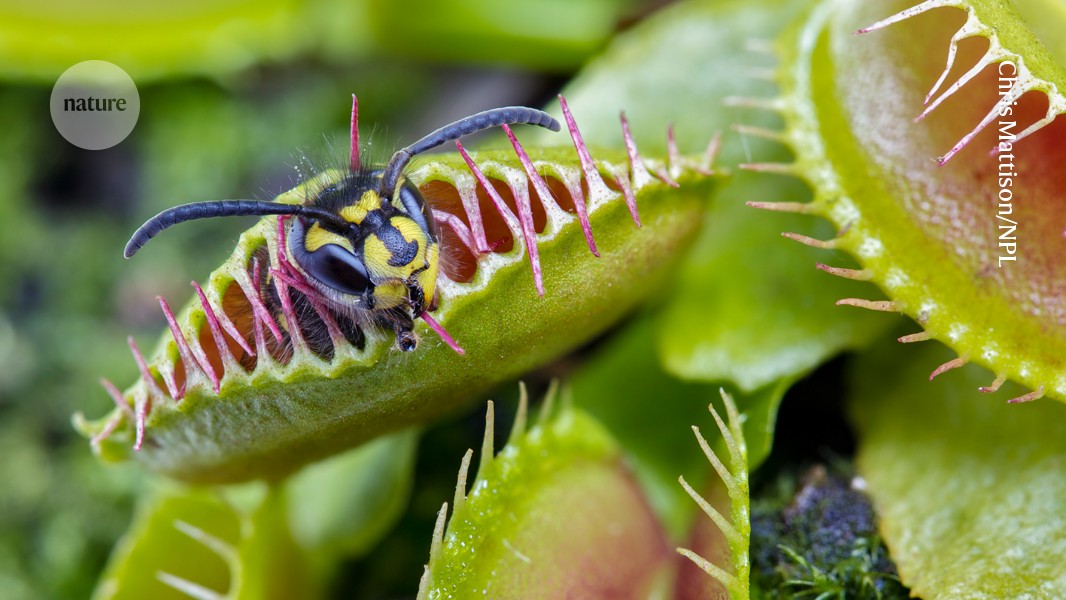

The lobes that form the Venus flytrap’s mouth curve inward to trap prey.Credit: Chris Mattison/Nature Picture Library
Ever since renowned biologist Charles Darwin proclaimed in 1875 that the carnivorous Venus flytrap was one of the “most wonderful” plants in the world, scientists have been trying to work out how it snaps shut so quickly on its prey. Plants are not known for their speed, but the flytrap (Dionaea muscipula) closes in less than a second.
A research team has now snapped a key piece of the puzzle in place. Experiments showed that, after an insect crawls into the flytrap’s maw, cells on the outer surface of the hinged leaf that forms the plant’s ‘mouth’ soften. This allows the leaf to change shape and hinge shut, the researchers report today in Science1.
Little lab of horrors
“This is a breathtaking, very elegant paper,” says biomechanics researcher Simon Poppinga, director of the botanical garden at the Technical University of Darmstadt in Germany. Plants can relax the rigid outer walls of their cells to enable growth, but that process happens over a much slower timescale than the flytrap’s snap, says Poppinga, who was not involved in the study. Cell softening at the pace seen in the flytrap is a phenomenon scientists haven’t seen before, he says.
The discovery could help scientists to better understand basic plant processes, he adds, and it could inspire them to design sophisticated soft robots that spring into action when one of their materials changes its stiffness.
What a softie
Ever since Darwin admired the “rapidity” of the Venus flytrap, researchers have been solving its mysteries one by one. Some studies have shown that when insects stimulate ‘hairs’ in the plant’s mouth, an electrical impulse runs across the leaf, triggering it to imprison and digest its prey2. In 2005, physicist Yoël Forterre, at what has since become Aix-Marseille University in France, and his colleagues reported that, when the hinged leaf forming the plant’s mouth is in the ‘open’ position, its two lobes are curved outwards in a strained configuration. The team found that, when an insect arrives, the strain is released suddenly — flipping the lobes to curve inward and closing the trap in as little as one-tenth of a second3.
How plants evolved into carnivores
Twenty-one years later, Forterre has solved another mystery. Researchers have long debated how the strain in the flytrap’s leaves is released. One theory suggests that water moves rapidly from the inner surface of the trap to epidermal cells on its outer surface, leading to swelling that drives the transition. Another theory holds that the rigid walls of the outer epidermal cells soften suddenly, releasing the strain.

